
Upstox Originals
Is the American market finding new winners beyond the Magnificent Seven?

6 min read | Updated on July 31, 2026, 18:42 IST


SUMMARY
Every bull market eventually changes its favourites. Is the AI rally reaching that point? The Magnificent Seven may still dominate the market, but they're no longer moving together. As investors become more selective, money is spreading to a wider set of companies powering the AI boom. Is this the beginning of a shift in market leadership?
The S&P 500 is up ~9% this year. | Image: Shutterstock
For the last two years, investing in AI seemed almost effortless. Buy Nvidia. Add Microsoft, Apple, Amazon, Alphabet, Meta and Tesla. Sit back and let the market do the heavy lifting. Together, the Magnificent Seven became so dominant that their combined weight in the S&P 500 jumped from 12.3% in 2015 to 34.3% by December 2025.
But 2026 has started to change that script. Why?
After all, the S&P 500 is up ~9% this year. If the market is still rallying, shouldn't the Magnificent Seven be leading the charge? Not quite.
Yet, the Magnificent Seven returned just 5.5% on a cap-weighted basis through 13 July 2026, even though they still accounted for 32.24% of the index as of July. In June alone, the group wiped out nearly $2.3 trillion in market value.
So, where is the money going?
Increasingly, to the companies powering the AI boom behind the scenes: semiconductor equipment makers, networking firms, power infrastructure providers and data centre specialists.
That doesn't mean the Magnificent Seven have fallen out of favour. Apple, Alphabet and Nvidia continue to support market returns. But with 2026 shaping up to be the group's weakest year since 2022, investors appear to be asking a different question: Who stands to benefit most from AI's next phase?
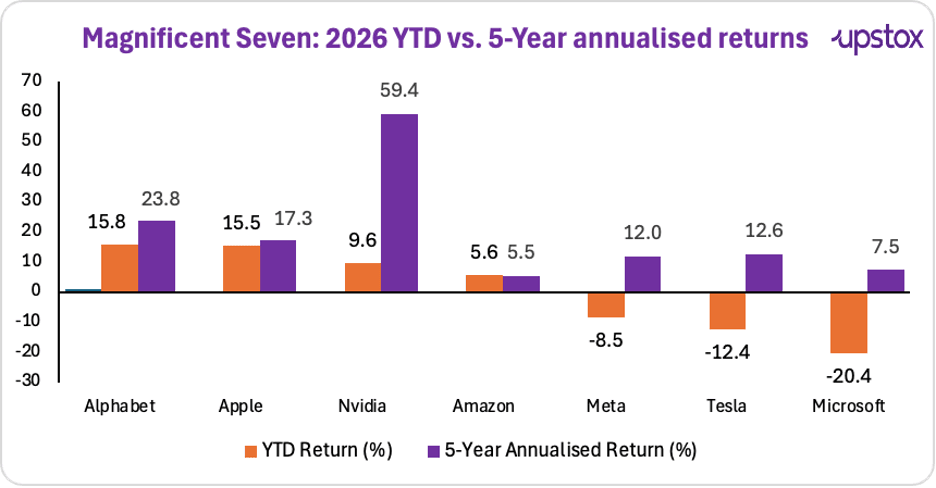
Source: Nasdaq Historical Data Note: 5Y annualised returns represent the compound annual growth rate (CAGR) from July 2021 to July 2026, calculated using Nasdaq historical closing prices as of July 8, 2026.
Could the biggest AI winners be hiding outside Big Tech?
As of 8 July 2026, the S&P 500 Equal Weight Index had gained ~10.7%, outperforming the market-cap-weighted S&P 500's ~9.3% return. That's a sign that the rally is being driven by a much broader set of companies.
Semiconductors have been the biggest beneficiaries. As of 8 July 2026, Micron had surged 232.4%, while Intel and AMD were up 198.8% and 141.6%, respectively, as demand for memory chips and server CPUs continued to rise.
The story doesn't stop with semiconductors. Companies helping build AI data centres are also seeing demand soar. GE Vernova's Q1 2026 orders jumped 71% to $18.3 billion, with its backlog reaching $76 billion, compared with $38 billion in total 2025 sales.
Vertiv reported 30% sales growth and a 64% jump in operating profit in the first quarter, while Eaton posted record electrical sales and a 48% increase in backlog. Even Arista Networks has emerged as a key beneficiary as demand for high-speed networking equipment continues to grow.
| Company | Industry | YTD Return (%) |
|---|---|---|
| Micron | Semiconductors | 232.4 |
| AMD | Semiconductors | 141.6 |
| Intel | Semiconductors | 198.8 |
| Lam Research | Semiconductor Equipment | 94.6 |
| Vertiv Holdings | Data Center Infrastructure | 96.2 |
| GE Vernova (GEV) | Power Infrastructure | 63.9 |
Source: Screener, as of July 8, 2026
The AI opportunity, however, extends beyond these infrastructure leaders. Many smaller companies across industrials, software and specialised technology are also benefiting from the AI investment cycle. We explored this trend in greater detail in our article, Beyond Big Tech: The Rise of the US Small Caps in 2026 Magnificent 7 is no longer moving as one trade
Yes. One clue lies in how the Magnificent Seven are trading. The chart below tracks the rolling three-month average correlation among the seven stocks. Simply put, correlation measures how closely the stocks move together; a reading closer to 1 means they tend to rise and fall in tandem, while a lower reading suggests they're moving more independently.
As of July 2026, the group's average correlation had fallen to 0.27, from a peak of 0.78 in mid-2025. The sharp decline suggests investors are no longer reacting to the group as a single AI theme.
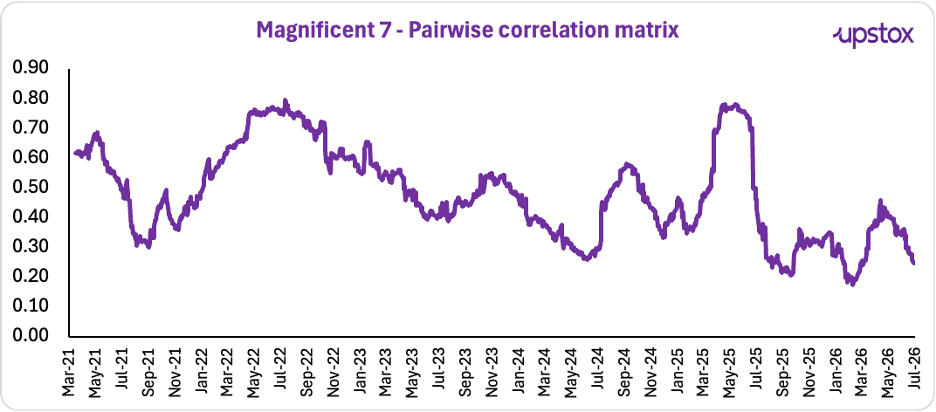
Source: Factset, as of Jul 8, 2026
What's driving the divergence?
While some companies have continued to reward investors, others have come under pressure as the market has become more selective about AI spending and returns. Apple gained 15.64% through 8 July 2026, helped by its revamped AI strategy, the iPhone 17 upgrade cycle and the rollout of Apple Intelligence in China through partnerships with Alibaba and Baidu.
Unlike Microsoft, Amazon and Meta, Apple has focused on integrating AI into its ecosystem of more than 2.5 billion active devices, rather than spending heavily on AI infrastructure.
Nvidia was up 8.09% through 8 July 2026, following a 1,177% return between 2023 and 2025, as strong AI demand continued to support earnings.
Alphabet rose 14.84%, backed by 63% year-on-year growth in Google Cloud revenue to around $20 billion in Q1 2026 and a cloud backlog of about $460 billion, nearly double the previous quarter.
Others have found the market less forgiving.
-
Take Tesla fell about 10.5% despite delivering 480,126 vehicles in Q2 2026, well above Wall Street's estimate of 406,024. (Read more: Performance up, stock down: What Tesla teaches investors)
-
Microsoft, meanwhile, was the worst-performing Magnificent Seven stock through 8 July 2026, down 18.5%. (Read more: Why was June 2026 Microsoft's worst month since the dot-com crash?)
-
Meta raised its 2026 capex guidance to $64–72 billion from $60–65 billion, while free cash flow fell to $10.3 billion from $12.5 billion.
-
Amazon plans to spend around $200 billion on capex in 2026, even as its trailing 12-month free cash flow dropped to $1.2 billion from $25.9 billion.
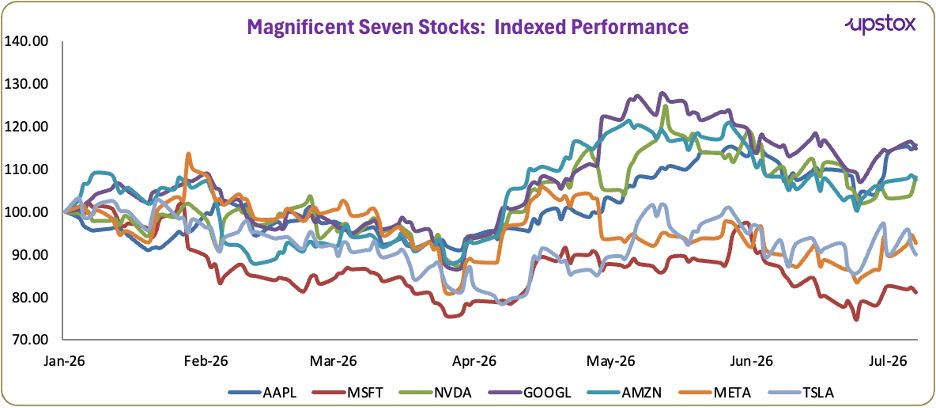
Source: Investing.com, as of Jul 8, 2026
So, will passive funds be forced to sell?
Not immediately. In a cap-weighted index, falling share prices automatically reduce a stock's weight without requiring funds to sell. But if concentration continues to trigger diversification rules or investors pull money from passive funds, the largest holdings could face additional selling pressure. With the top 10 stocks still accounting for around 40% of the S&P 500, even a few mega-caps can have an outsized impact on the broader index.
Is this a systemic slowdown, or just an easing after years of sharp gains?
It's still too early to say. The rally is undoubtedly becoming broader, but that doesn't automatically make it healthier. Some investors are rotating into the next set of AI beneficiaries, while others are simply reducing exposure to an increasingly crowded trade.
The next few quarters should make the distinction clearer. If record AI investment begins translating into stronger earnings and cash flows, 2026 may be remembered as a healthy reset after years of exceptional gains. But if monetisation continues to lag, today's broadening could prove to be the first sign that the market is becoming more selective about where it assigns premium valuations.
About The Author
Next Story

