
Upstox Originals
India’s hospital bed shortage: Is private expansion enough?

7 min read | Updated on September 23, 2026, 14:15 IST


SUMMARY
Eighteen of India’s largest private hospital chains are spending about ₹40,000 crore to add more than 34,000 beds by FY30. For a country short on hospital beds, that sounds like exactly the right medicine. So why might it do little for the families who need care the most? And if most of the new capacity is priced for the insured few, who builds for everyone else?
Stock list

India’s private hospital chains plan to spend about ₹40,000 crore to add 34,000 beds by FY30. | Image: Shutterstock
India has just 1.3 hospital beds for every 1,000 people. The government’s target is 2. That gap sounds small, but in a country of about 146 crore people, it adds up to roughly 10 lakh missing beds. So, there’s little doubt that India needs more hospital beds.
Now here’s the good news. India’s listed private hospital chains are in the middle of their biggest building spree yet. They plan to spend about ₹40,000 crore to add 34,000 beds by FY30. In the June quarter alone, they had about 15% more working beds than a year earlier.
Sounds like a great solution, right? But, you see, Indian families still pay 43.4% of the country’s health bill from their own pocket. For most people, the real question isn’t just “is there a bed?” It’s “can I afford it?”
And this is where the real challenge begins: Can private hospital expansion bridge India’s bed shortage if a large section of the population still struggles to pay for private healthcare?
The great hospital building spree
Here’s what five of the biggest listed chains have lined up, straight from their own investor presentations.
Announced expansion pipelines of five listed hospital chains
| Chain | Beds planned | Timeline |
|---|---|---|
| Apollo Hospitals | 5,798 total beds (4,710 census beds) | Through FY31 |
| Aster DM Quality Care | 4,179 (FY27: 634; FY28: 1,190; FY29: 1,555; FY30 onwards: 800) | FY27 to FY30 and beyond |
| Max Healthcare | 4,053 (FY27: 645; FY28: 500; FY29: 1,458; FY30: 1,450) | FY27 to FY30 |
| Medanta (Global Health) | 2,950 (South Delhi 400; Pitampura 750; Mumbai 750; Guwahati 650; Varanasi 400) | Over the next five years |
| Narayana Health | 1,535 (HSR Bengaluru 215; Rajarhat Kolkata 350; Central Bengaluru 220; South Bengaluru 350; Raipur 300; South-West Bengaluru 100) | FY27 to FY29 |
Source: Company filings
But can this actually solve the shortage?
Specialised care takes centre stage
Private hospitals are increasingly focusing on specialised treatments, which tend to generate higher revenue. Cardiac care, oncology, neurology, gastroenterology and orthopaedics now account for 65% of hospital revenues, compared with 59% before the pandemic. Oncology alone has grown from 12% to 18%.
The price of a hospital admission
The cost of treatment highlights the affordability challenge. In the June quarter, Apollo Hospitals earned an average of ₹1,86,630 per inpatient, while Medanta earned ₹2,01,891.
Compare this with average monthly per capita consumption expenditure of ₹4,122 in rural India and ₹6,996 in urban India. An average Apollo admission is equivalent to around 27 months of urban spending and 45 months of rural spending. While this isn't a direct comparison with household income, it shows how expensive private healthcare can be relative to everyday spending.
Follow the money
The payer mix at Max Healthcare offers another perspective. Nearly four of every five rupees Max earned from healthcare services in FY26 came from patients billed at hospital tariffs: self-paying, privately insured or corporate-covered, and international patients. Government and institutional schemes made up the rest.
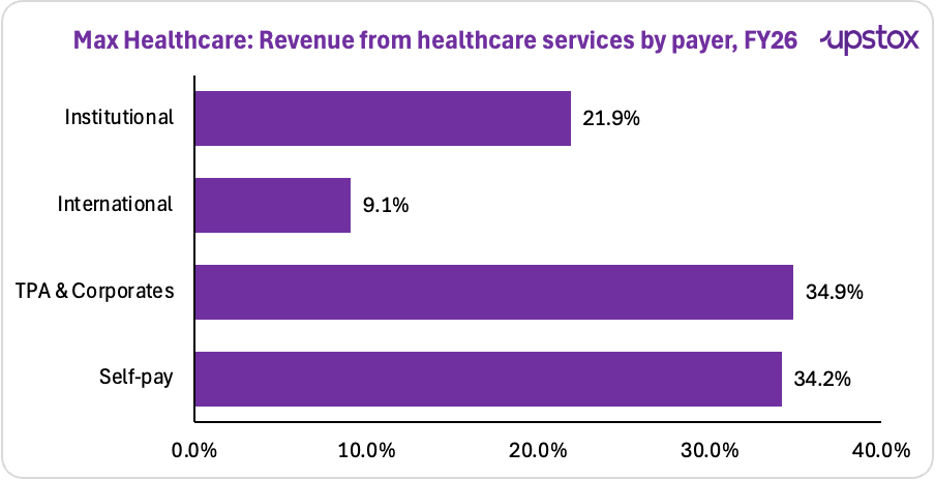
Source: Max Healthcare, FY26
Every bed comes with a hefty price tag
Private hospital expansion also requires substantial capital. The cost of adding a bed varies based on location, land prices, hospital format and the level of medical infrastructure.
| Project | Beds | Project cost (₹ crore) | Cost per bed (₹ lakh) |
|---|---|---|---|
| Narayana, Rajarhat (Kolkata) | 350 | 900 | 257 |
| Narayana, South Bengaluru | 350 | 800 | 229 |
| Narayana, HSR (Bengaluru) | 215 | 490 | 228 |
| Max, Vaishali tower | 202 | 425 | 210 |
| Narayana, Raipur | 300 | 540 | 180 |
| Narayana, South-West Bengaluru | 100 | 84 | 84 |
Source: Company disclosures.
So, what can actually solve this problem?
There’s no single fix. But a few pieces fit together.
Can government insurance bridge the affordability gap?
PM-JAY covers the bottom 40% of households with up to ₹5 lakh per family a year, and every Indian above 70 since October 2024. By June 2026, it had approved 12.69 crore hospital admissions worth ₹1.92 lakh crore across 37,413 hospitals. Private hospitals handled 6.74 crore of the 11.69 crore admissions recorded by February 2026. That makes it the biggest bridge between private beds and poorer patients.
Two upgrades could make it stronger: covering what happens outside the hospital bed, like medicines, tests and outpatient visits, where families still pay the most; and keeping package rates in step with costs so more private hospitals want to take part. The government has taken steps to improve scheme participation, including revisions to health benefit packages, increases in selected package rates and measures to improve claim settlement.
The economics, however, depend on the details of each package. A hospital may be able to deliver one treatment within the prescribed reimbursement amount but face a different cost structure for another.
Smarter, tiered pricing?
The October 2025 overhaul of CGHS rates offers a template. It revised rates for nearly 2,000 procedures, the first major revamp since 2014, and linked them to hospital accreditation and city tier, with lower rates in tier-II and tier-III cities. Prices that reflect real costs, but vary by location, give hospitals a reason to build beyond metros without pricing out local patients.
Build where the need is.
The toolkit already exists. Guidelines issued in 2019 offered private hospitals in non-metro cities viability gap funding of up to 40% of project cost, along with help on land and clearances, if they treat PM-JAY patients. Some chains are already heading that way, with Medanta in Guwahati and Varanasi, Narayana in Raipur, and Aster pushing cancer care beyond the big cities. A 2025 PGIMER study also found that a 100-bed district private hospital running on PM-JAY rates can break even by its fourth year.
Build lighter.
Leased and managed hospitals need far less capital. Narayana’s leased Central Bengaluru project works out to about ₹73 lakh per bed, against ₹2.57 crore for its greenfield Rajarhat hospital. Max has signed built-to-suit leases in Mohali, Thane and Dehradun, and an operations deal in Pitampura. Less capital per bed means hospitals can charge less and still earn a fair return.
In summary
Private hospital expansion is real, and it’s big. But on its own, it’s filling the top of India’s healthcare pyramid, where patients are insured, cities are richer and specialties pay well. The shortage that hurts most sits lower down, in affordable beds in smaller towns.
Closing that gap will take insurance that pays more of the bill, prices that work for both hospitals and patients, cheaper ways to build, and a strong public base underneath it all.
For investors, the premium focus keeps margins healthy for now. The things worth watching are PM-JAY package rates, how quickly tier-II and tier-III hospitals ramp up, and how much of the next wave of beds is built on lighter, lower-cost models.
About The Author
Next Story

