
Upstox Originals
How Quant Small Cap Fund traded its way back to new highs

5 min read | Updated on August 17, 2026, 15:35 IST


SUMMARY
Quant Small Cap Fund has staged one of the strongest recoveries in the small-cap mutual fund category this year. But was this simply the result of a broader small-cap rally? We examine the factors behind the turnaround and the risks investors should keep in mind.
Baroda BNP Paribas Mutual Fund is managed by Baroda BNP Paribas Asset Management India Pvt. Ltd. | Image: Shutterstock.
With ₹33,739 crore in assets, Quant Small Cap Fund is the largest equity scheme in the Quant Mutual Fund stable and, by assets under management, the fourth-largest small-cap fund in India. Why are we talking about it? Because its recent round trip is one of the more instructive stories in the category right now.
Rewind to late 2025. Between November 2025 and March 2026, the fund looked like it had lost its mojo. As small-cap stocks corrected, its Net Asset Value (NAV), slipped nearly 16%. However, over the next three months, it staged a remarkable comeback; NAV surged over 30% to ₹313.1 as of 4 August, 2026. And that's exactly why this fund deserves a closer look.
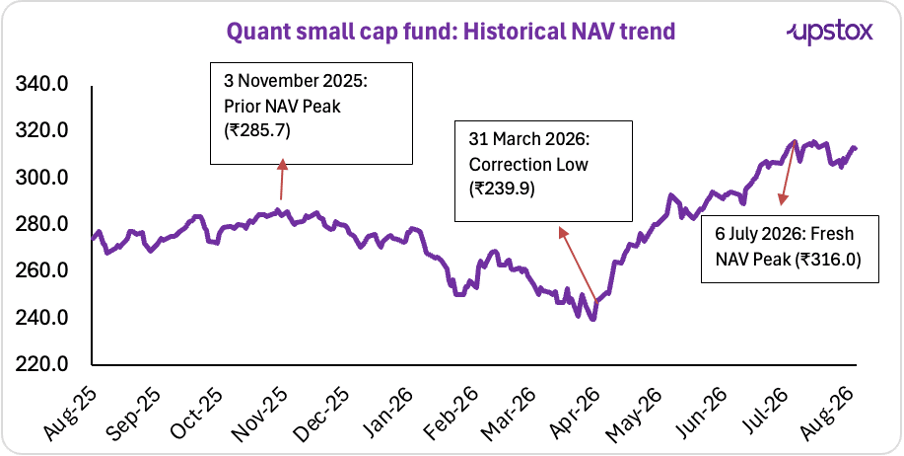
Source: Quant Mutual Fund, Historical NAV data, as of 4 August 2026
Has it just rebounded with the market?
No. The fund has regained lost ground and is once again outperforming its benchmark, delivering a 13.1% one-year return versus 5.2% for the Nifty Smallcap 250 TRI. Its longer-term track record also remains intact, with 18.4% CAGR over three years and 17.2% CAGR over five years, both ahead of the benchmark.
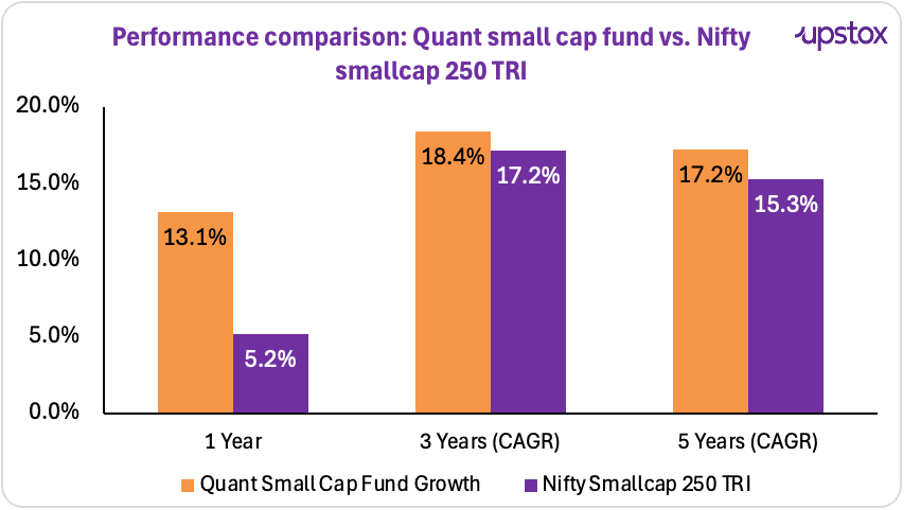
Source: Value Research, as on 4 Aug 2026
So, what's working for Quant Small Cap?
Active portfolio churn made a difference
One of the defining traits is that it rarely sits still. Instead of following a traditional buy-and-hold approach, the fund relies on its proprietary VLRT framework, which evaluates Valuation, Liquidity, Risk Appetite and Time, to continuously reassess portfolio positions. The idea is simple: markets evolve quickly, and portfolios should evolve with them.
Backing the right stocks at the right time
The fund's recovery wasn't driven by hundreds of stocks inching higher. It was driven by a handful of high-conviction bets delivering outsized gains.
Between 1 Jan and 6 Aug 2026, several of Quant Small Cap Fund's largest holdings, including HFCL, RBL Bank, Adani Power, Adani Green Energy, gained sharply. The biggest winner was HFCL, Quant's largest equity holding, whose share price surged 209.0% between 1 January and 6 August 2026. Other key holdings also posted strong gains over the same period, including Adani Power (+39.5%), Adani Enterprises (+34.5%), Adani Green Energy (+34.3%) and RBL Bank (+23.5%).
The fund manager also became more aggressive just before the rally gathered pace. In June 2026, Quant increased its exposure to Adani Enterprises, Adani Green Energy, RBL Bank and HFCL, while adding 10.15 lakh shares of Adani Enterprises, 3.26 lakh shares of Adani Green Energy and 70.8 lakh shares of RBL Bank.
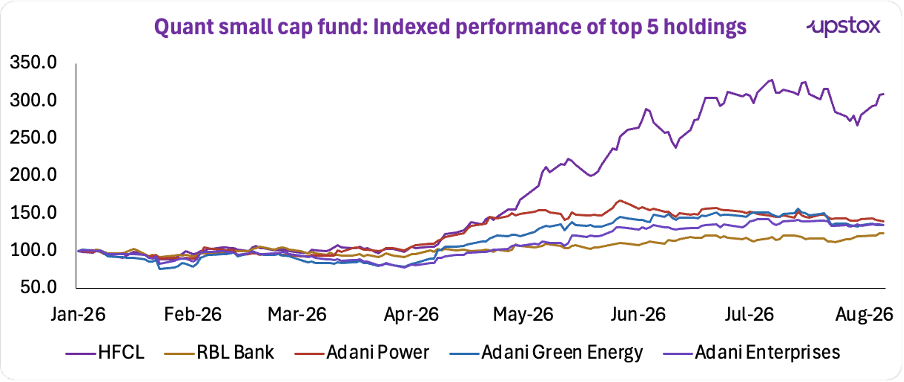
Source: Investing.com, as on 6 Aug, 2026
Portfolio rotation strategy
Besides the stocks, an equally important part of the story is the stocks it chose to exit. In June 2026, Quant Small Cap Fund completely exited Reliance Industries, selling nearly 2.01 crore shares of what had previously been its largest holding, accounting for more than 8% of the portfolio. It also exited Jio Financial Services, Praj Industries, Exide Industries and Aarti Industries, among others.
It's worth noting that this wasn't about avoiding an imminent correction. Reliance had already declined nearly 21%, from ₹1,592.3 on 2 January 2026 to ₹1,258.8 on 10 June 2026, before recovering. The significance of the move lay elsewhere: it released capital that was subsequently redeployed into higher-conviction positions such as HFCL, RBL Bank, Adani Enterprises and Adani Green Energy, several of which went on to outperform during the market rebound.
Cash became a strategic advantage
Unlike passive funds that remain almost fully invested, Quant actively adjusts its cash allocation based on market conditions. The idea is straightforward: hold more cash when opportunities look scarce and deploy it when valuations become more attractive. That approach was evident in June 2026. The fund reduced its allocation to TREPS, a short-term money market instrument commonly used to park cash, from 5.34% to 4.01%, deploying more capital into equities just as the market recovery gathered momentum.
Can the appealing returns be sustained?
Recent returns have been strong, but investors should also weigh the risks that could shape the fund’s performance going forward.
As of June 2026, nearly 87% of its portfolio was invested in equities, while the remaining 13% was held in debt instruments and cash equivalents. Although the cash allocation gives the fund flexibility to deploy capital during market volatility, its high equity exposure also means performance remains closely linked to movements in the broader small-cap market.
The fund also follows a concentrated and actively managed investment strategy. While this approach has contributed to the recent recovery, it can also result in sharper swings in performance if market leadership changes or the fund’s sector and stock selection doesn’t play out as expected.
What does this mean for investors?
The broader market backdrop has also changed. As of 24 July 2026, the BSE 250 Small Cap Index was trading at a P/E of 35.7x, above its five-year median of 29.2x. While valuations are not at extreme levels, they are no longer as inexpensive as they were during the March correction.
This suggests the next phase of returns is likely to be driven more by earnings growth than by further valuation expansion. For active funds such as Quant Small Cap Fund, the ability to continue identifying companies with improving fundamentals will become increasingly important.
For investors, the focus should shift from recent performance to whether the fund can continue executing its strategy in a market where valuations have become more demanding and opportunities more selective.
About The Author
Next Story

