
Upstox Originals
Flipkart Minutes is finding its next customers in smaller cities. Can the economics work?
8 min read | Updated on October 06, 2026, 15:20 IST


SUMMARY
Flipkart Minutes now runs nearly 1,200 stores across more than 150 cities, and says its customer base in Tier 2+ cities grew nearly 25x in the year to September 2026. That is a sharp turn: as recently as May 2025, the business was reportedly planning to focus on just eight metros. What changed, and, more importantly, can the small-town strategy pay off?
Flipkart Minutes now has nearly 1,200 dark stores across more than 150 cities. | Image: Shutterstock
What a difference a year makes.
In May 2025, Flipkart Minutes, Flipkart's quick-commerce arm, was reportedly planning to shrink to about eight cities.
The logic was simple: more than 90% of the industry's orders came from eight metros. Fast-forward to 11 September 2026, its second anniversary.
Minutes now has nearly 1,200 dark stores across more than 150 cities. It hasn't abandoned the big cities: close to half of those stores are in India's top 10 cities, metros still bring in 60-65% of its demand, and North India accounts for about a third of the business, with the South scaling up fast.
But the map now stretches much further. Ambala, Barabanki, Bhagalpur, Roorkee, Siliguri and Tiruppur have all joined the network. And Minutes' customer base in Tier-2 and smaller cities has grown nearly 25x in a year, against roughly 4x growth for Minutes as a whole.
Minutes isn't alone out there. Blinkit, Zepto and Swiggy Instamart are expanding too, building denser metro networks while pushing beyond them.
Still, Minutes' small-town push stands out, because it started so late. It launched in August 2024 as a pilot in parts of Bengaluru, years after Blinkit, Zepto and Instamart had built their networks.
From there, its expansion has been rapid:
| Period | Dark stores / MFCs | Cities |
|---|---|---|
| Aug 2024 (launch) | Pilot in select parts of Bengaluru | 1 |
| Apr 2025 | 200+ | 14 |
| Dec 2025 | 500+ | 30+ |
| Jun 2026 | 1,000 | 130+ |
| Sep 2026 | ~1,200 | 150+ |
Source: News reports
Why is Flipkart Minutes expanding to smaller towns?
The big cities are getting crowded
The biggest cities are already packed with dark stores. The leading players keep adding capacity, but they're fighting for the same customers and the same pincodes. Minutes has been building its metro footprint alongside its smaller-city expansion.
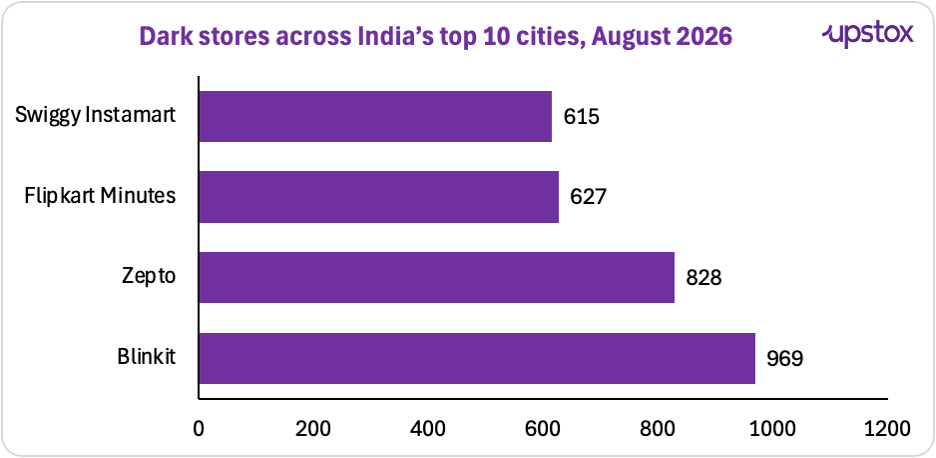
Source: CLSA, August 2026
Minutes has closed the gap quickly. But the incumbents still lead on order volumes and store productivity.
The bigger issue is density.
A July 2026 analysis by Bernstein found that around nine in 10 dark stores added by the five big players in the April-June quarter went into pincodes the category already served. By its estimate, the top five metros had around 4,300 dark stores against a profitable capacity of roughly 3,600.
The overlap is worst in the biggest cities: nearly 80% of metro pincodes were served by three or more players, Bernstein found.
Blinkit, for instance, already reaches 80-90% of pincodes in its top eight cities, compared with under 30% outside them, according to Eternal's April 2026 shareholder letter.
An opportunity for Minutes?
In Delhi NCR, 34% of urban households order from a quick-commerce app at least once a month. In the average Tier-2 city, that figure is just 6% — roughly one in seventeen households.
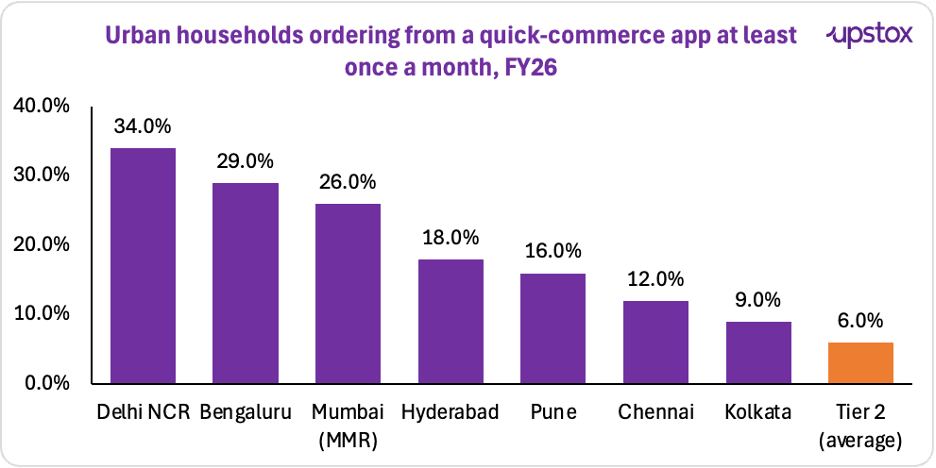
Source: Quick Commerce Market Share in India 2026
That's a wide gap. And it isn't because smaller cities don't spend.
Redseer estimated in July 2025 that 90-plus non-metro cities accounted for 60-70% of retail spending across India's top 100 cities, yet only a little over 15% of quick-commerce sales.
Plenty of shopping already happens there.
Very little of it happens through a quick-commerce app.
So platforms have two ways to grow: squeeze more orders out of metro customers, or reach the many who have barely started using the category.
On the second route, Minutes has an edge most rivals lack. Flipkart's marketplace already holds years of data on what customers in different towns buy. Its grocery warehouses were already in place. And Minutes can be a doorway into the wider Flipkart ecosystem.
Labour can help too
There is another cost advantage in smaller cities: people.
Pickers and packers in metros typically earn ₹16,000-20,000 a month, including night-shift premiums for 24×7 operations. In Tier-2 cities, wages are 20-25% lower, at roughly ₹12,000-16,000, with fewer surge opportunities.
Retention can also be better.
Metro dark stores face monthly attrition of around 30%, with workers sometimes switching jobs for as little as ₹500 more.
In Tier-2 cities, job-hopping culture is less prevalent. A tech-enabled dark-store job can be seen as a premium retail role compared with working at a local kirana, resulting in 35-40% lower attrition.
Sure, there is a trade-off.
Hiring can take longer in smaller towns because there are fewer workers already familiar with QR scanners and SKU management; new hires may need 4-7 days of upfront training.
Still, cheaper and stickier labour makes the maths more attractive once a store has enough demand.
What does a small-town Minutes store need to pay for itself?
Quite a bit, obviously. But less than its metro counterpart.
Lower rentals, cheaper labour and smaller store formats mean the break-even point is much lower in Tier-2 cities. Emkay estimates that a Tier-2 dark store needs roughly 800 orders a day to break even, compared with around 1,300 in a metro. That implies the daily fixed-cost burden of a Tier-2 store is close to 40% lower than that of a metro store.
Lower costs don't make a store profitable on their own. Rent, salaries and power bills fall due whether the store is busy or not, so it still needs enough orders, with big enough baskets, to cover them.
And here's the interesting bit: as the chart below shows, an average Minutes store is only just clearing that lower break-even line.
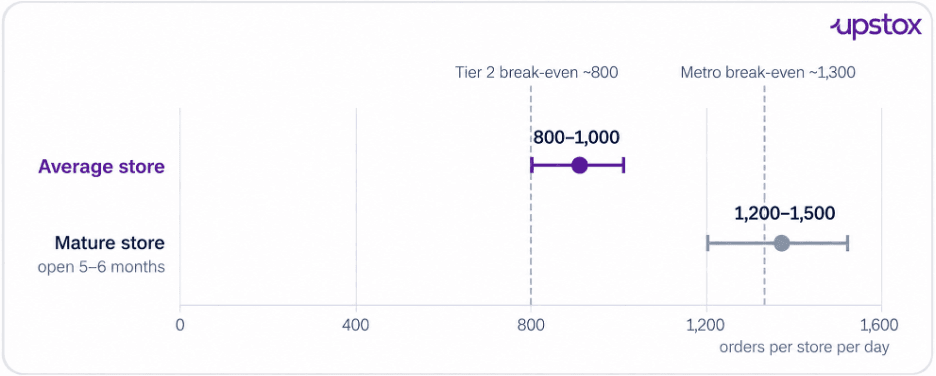
Source: Emkay. Orders per dark store per day: estimated range (dot marks the midpoint) against estimated break-even
Then there's the upfront bill: a new store can cost up to ₹2.5 crore to set up, against around ₹17 crore in annual revenue for a typical Minutes store.
So the small-town model buys Minutes breathing room on costs. But each store still has to clear a simple hurdle: earn enough to keep the lights on, and eventually enough to justify the cost of opening it.
Now, how long could Minutes have to wait for its stores to pay off?
Minutes is barely two years old, so it's too early to say whether its new stores will make money.
But there is one useful reference point: Blinkit.
It's not a perfect comparison; Blinkit doesn't report small-city profitability separately. But its journey shows how long quick-commerce stores take to mature. Blinkit, too, started with the big cities.
At the end of 2023, around 90% of its order value came from its top eight cities. Then came larger non-metros such as Jaipur and Lucknow, followed by smaller markets. Only from mid-2025 did smaller cities take a growing share of new store openings. In other words, Blinkit spent roughly two years building density in the metros before going deeper.
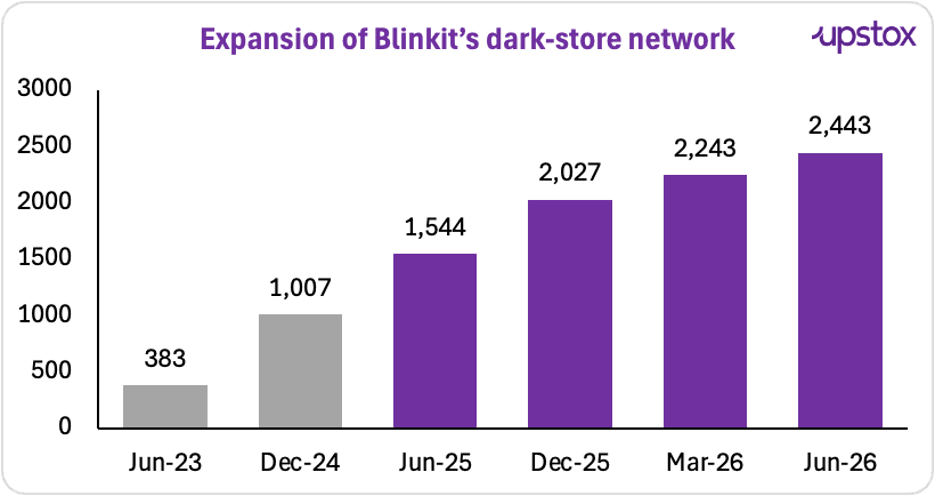
Source: Blinkit; Note: purple marks the period when smaller cities took a growing share of new stores
Then came the waiting game. Blinkit lost 17.8% of net order value in FY23. It turned its first quarterly profit only in Q4 FY26. Even today, its adjusted EBITDA margin is just 0.6%, though mature markets such as Gurugram and Noida were already closer to 5% by late 2025.
That's quite a journey; roughly three years from deep losses to a thin network-level profit.
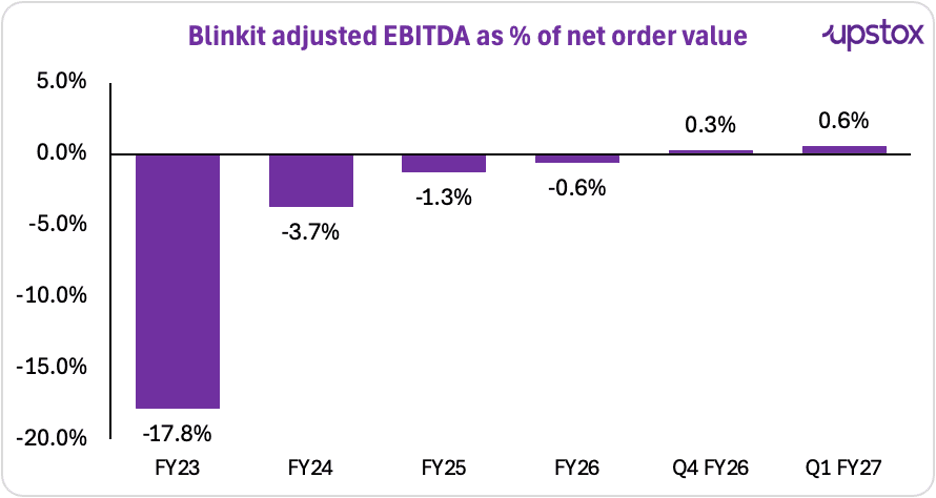
Source: Eternal (formerly Zomato) shareholder letters
But here's the catch: smaller cities don't automatically mean better economics. In the June quarter, Blinkit's net average order value slipped 1.3%, from ₹525 to ₹518. The company blamed, in part, its push into smaller towns, alongside more frequent, smaller orders and a growing share of lower-priced products. Cheaper rent and labour help, but if customers spend less per order, the store has to make it up through more orders and lower running costs.
Then there's assortment.
Blinkit has been widening its range: around 80,000 SKUs in Delhi NCR, 50,000 in the next seven cities and 20,000 beyond the top eight. The idea is simple: give customers more reasons to open the app, instead of relying on discounts to bring them back.
So, what's the lesson for Minutes?
Smaller cities bring down the cost of running a store. But cheaper stores won't make the model work if baskets shrink.
For Minutes, the bigger prize is making each store dense, productive and useful enough to earn repeat orders, rather than simply opening more of them and waiting for customers to spend more.
About The Author
Next Story

