
Upstox Originals
Can America's AI boom keep its cool?

6 min read | Updated on July 30, 2026, 16:06 IST


SUMMARY
AI data centres in the US are attracting billions of dollars in fresh investment. But as extreme weather puts pressure on power grids and water supplies, investors are beginning to ask a different question: can infrastructure keep pace with AI's explosive growth?
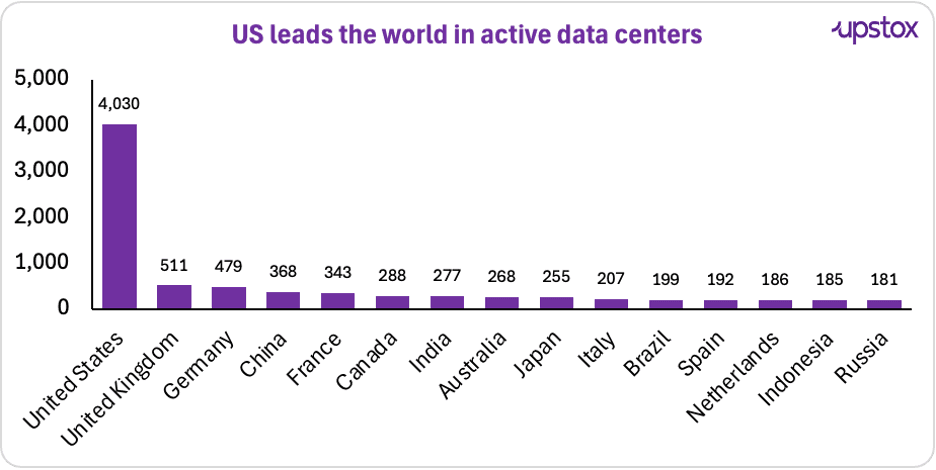
The US already hosts around 4,000-4,400 of the world's 10,800-11,000 data centres. | Image: Shutterstock
It's been a brutal few weeks across the United States. A powerful heat dome has pushed feels-like temperatures above 110°F (43.3°C) in Washington, DC, while New York City experienced temperatures around 104°F (40°C) during the peak of the heatwave, sending electricity demand soaring and putting fresh pressure on the country's power grid and water supplies.
So, what does a heatwave have to do with AI? Well, It is exposing one of the industry's biggest challenges: keeping rapidly expanding AI infrastructure running when the electricity and water systems it depends on are already under strain.
As temperatures rise, households, businesses and data centres all compete for the same finite resources, making infrastructure resilience an increasingly important investment theme.
The timing couldn't be more significant. The US already hosts around 4,000-4,400 of the world's 10,800-11,000 data centres, nearly 40% of global capacity, with hundreds more planned. According to Wood Mackenzie, US data centre capacity is expected to grow from around 24 GW today to 110 GW by 2030. Under an accelerated AI growth scenario, data centres' share of the electrical equipment market could jump from less than 2% in 2020 to around 40%.
Source: News articles, as of Feb 2026
The real challenge: Heatwaves are putting electricity and water under pressure
Can the power grid keep up?
Heatwaves don't just make the weather uncomfortable, they also push electricity demand to its annual peak. As millions of Americans turn on their air conditioners, power consumption surges, leaving utilities with less spare capacity on the grid.
The effects are already becoming visible. Earlier this year, around 50,000 customers near Lake Tahoe, California, were asked to find a new electricity provider amid rising demand linked to data centre development. In Henrico County, Virginia, home to 37 data centres, local schools were asked to reduce electricity consumption as pressure on the grid increased.
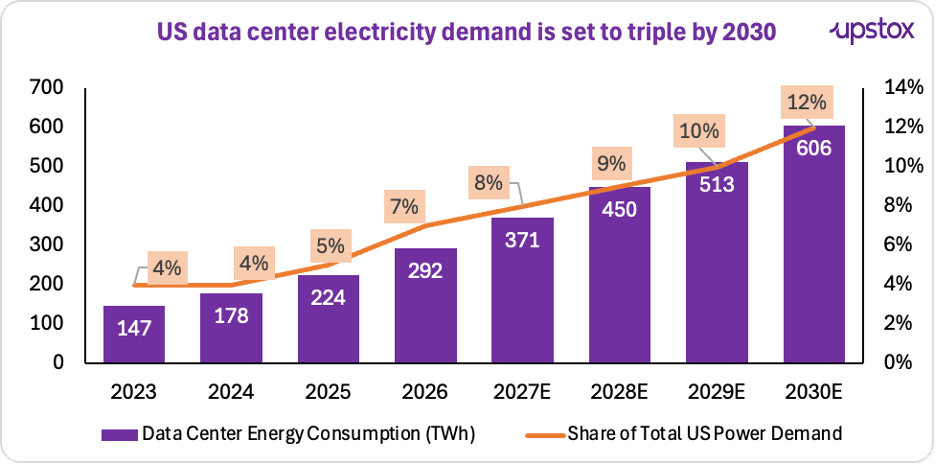
The challenge is that this pressure is likely to intensify as AI infrastructure expands. Data centres already account for around 7% of US electricity demand, and that share is expected to rise to 12% by 2030. Together, they consume about 176 terawatt-hours (TWh) of electricity every year, enough to power roughly 16 million homes, or provide electricity to nearly 40 million people, roughly the population of Canada, California, or megacities such as Jakarta and Dhaka.
Source: News articles
A typical hyperscale data centre requires between 100 and 300 megawatts (MW) of electricity, enough to power as many as 300,000 US homes, or a city of roughly 750,000 people. Grid Strategies estimates that as much as 90 gigawatts (GW) of new data centre capacity could come online by 2030, equivalent to adding nine times New York City's peak summer electricity demand to the grid in less than five years.
Water: The quieter crisis
The hotter it gets outside, the harder servers work to stay cool, and the more water they need to do it. Which is a problem, because right now, that demand is spiking at the exact moment reservoirs are running dry.
So, how much water are we talking about?
A mid-sized data centre can use up to 300,000 gallons a day. A large one? Up to 5 million gallons daily, roughly what an entire town of 50,000 people gets through. One study even found that a model like GPT-3 "drinks" the equivalent of a 500 ml water bottle for every 10-50 responses it gives you.
But here's the catch: it's not about how much water they use. It's about where they're using it.
Turns out, two-thirds of all data centres built since 2022 sit in water-stressed regions, places like southern Arizona, the Colorado River Basin, and Texas. And nearly 80% of the water used for cooling doesn't even make it back into the system. It just evaporates.
Now add a drought to that mix.
In May 2025, more than 60% of the contiguous US was in drought. Sure, data centres didn't cause that. But when a facility down the road is drawing millions of gallons a day, and your reservoir is already running on fumes, that distinction starts to feel a little academic.
How big is the investment cycle?
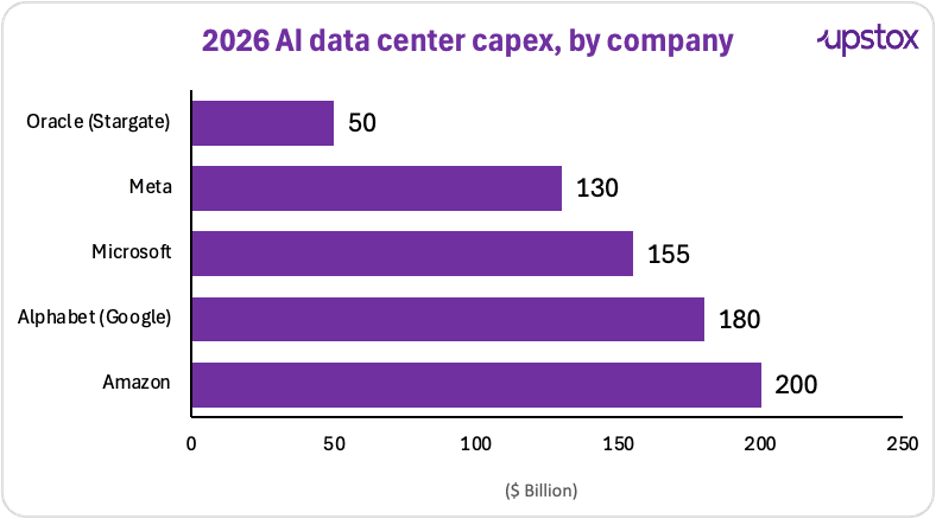
So far in 2026, the world's largest companies have committed at least $750 billion to building out data centers globally, up from $450 billion just last year. The US alone is expected to soak up around 40% of the roughly $7 trillion in data center investment flowing worldwide through 2030, according to ConstructConnect.
Companies such as Google, Meta, Microsoft and Amazon are pouring billions of dollars into new datacenters, with developers often drawn to dry, sparsely populated areas, due to the lower cost of land and generous tax breaks. Arid climates are also thought to cause the least amount of corrosion to equipment over time.
Source: ET
Now, how can AI growth be balanced with infrastructure capacity?
The answer isn't to slow AI investment. Fair enough, AI demand isn't going away anytime soon. The bigger challenge is ensuring that power and water infrastructure expand alongside it.
On the electricity side, companies are redesigning how data centres are cooled. Technologies such as direct-to-chip liquid cooling can reduce peak power demand by 6-14%, lower annual energy consumption by 4-13%, improve Power Usage Effectiveness (PUE) from around 1.22-1.25 to roughly 1.18, and reduce central plant energy use by 18-28%. Those improvements don't just lower electricity bills, they also reduce pressure on local grids as AI workloads grow.
Water management is evolving too. One example comes from Quincy, Washington, where Microsoft partnered with the city to build a dedicated water reuse utility. Instead of relying on fresh groundwater, the system treats and recirculates cooling water back into Microsoft's data centre in a closed loop, significantly reducing dependence on local potable water supplies.
In summary
In short, the AI boom doesn't need to slow down, but it does need to become smarter. As power and water constraints become more visible, the next generation of winning data centres may be defined not by their size, but by how efficiently they use the resources around them.
About The Author
Next Story

