
Upstox Originals
Beyond the tax haven: The untold story of the Swiss miracle

7 min read | Updated on July 09, 2026, 16:10 IST


SUMMARY
For most people, Switzerland is synonymous with private banks and low taxes. But, long before it became the world's favourite place to park wealth, Switzerland was investing in railways, innovation, world-class industries and institutions people could trust. If a country with so few natural advantages could achieve this, what can India, with 100x the opportunities and resources, learn from its journey?

How did this become a $937 billion economy with 580,000 millionaires. | Image: Shutterstock
Ask most people why Switzerland is rich, and you'll probably get one answer: "Oh, it's a tax haven." But does that explain everything?
Nope. We often skip the more interesting part of the story. Because 200 years ago, Switzerland wasn't a banking secret. It was one of the poorest countries in Europe. In 1820, Switzerland's GDP per capita stood at just $1,090 (1990 international dollars), poorer than most of the continent. Every year, poor Swiss children crossed into southern Germany just to find work as seasonal farm labourers.
No oil. No coastline. Around 60% of the land buried under the Alps (Europe's highest mountain range), leaving barely any room to farm or build for a population of 8.5 million.
So how did this become a $937 billion economy with 580,000 millionaires, roughly one in every seven residents?
Before we get to that, the chart below tracks GDP per capita across selected economies from 1980 to 2030. Switzerland has consistently remained well above both the global average and advanced economies, with its GDP per capita reaching around $126,000 by 2026.
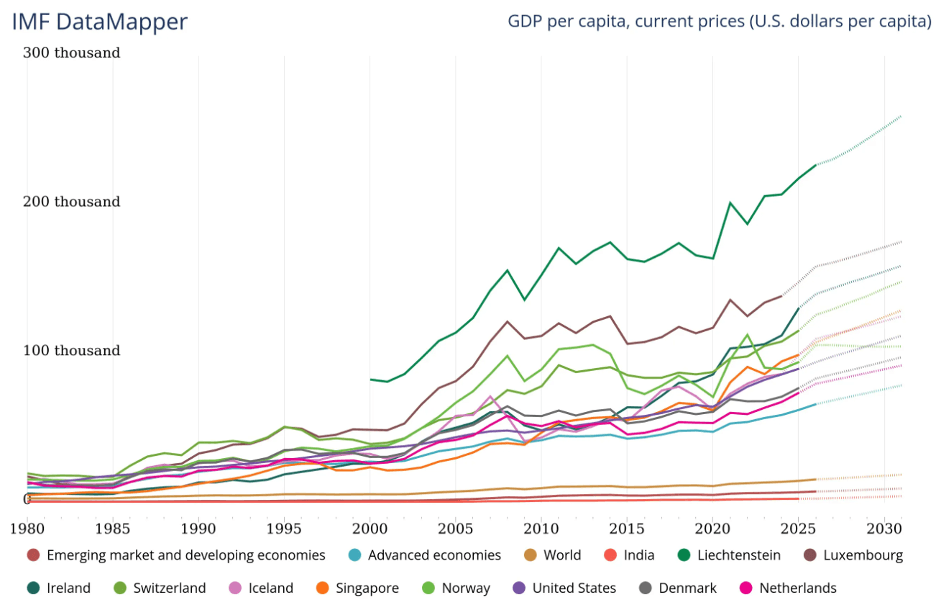
Source: IMF; Note: The dotted sections indicate IMF projections.
A bold bet on railways?
By the 1850s, railways were transforming Britain, France and the US. Switzerland, meanwhile, was still dependent on horse carts.
So in 1852, Alfred Escher, often regarded as the architect of modern Switzerland, pushed through the Railway Act. Sounds simple enough, right? Except it wasn't. Building railways here was no easy feat, with rugged Alpine terrain and limited steel and capital.
So how do you finance something a country can't afford?
Escher founded what would later become Credit Suisse and raised money from the Swiss people themselves rather than relying on foreign lenders. Around 3 million shares were issued, and the public response was extraordinary. The offering was reportedly 73x oversubscribed.
Next challenge - talent. Switzerland had almost no engineering colleges and very few trained engineers.
So where would the talent come from? Well, the political chaos in Europe became Switzerland's opportunity. As revolutions swept across the continent in 1848, scientists, engineers and entrepreneurs flocked to politically stable Switzerland, helping institutions like ETH Zurich become world-class.
Turned geography into an advantage?
For centuries, the mountains were a nightmare for trade. Goods had to be hauled across the Gotthard Pass on mules, a journey that took 2–3 days and was possible only during a few summer months.
So, what did Escher do?
He convinced neighbouring countries to help finance the Gotthard Railway Tunnel. After nearly 10 years of construction, the tunnel opened in 1882.
The results were dramatic.
- Travel time between Zurich and Milan dropped from 2–3 days to about 8 hours.
- Transport costs fell by more than 80%.
- Switzerland became Europe's key transit corridor, linking Germany, Italy, France, the Netherlands, Belgium and Luxembourg.
Today, it has over 5,000 km of railway tracks, operates more than 20,000 trains every day, and boasts the densest railway network in the world.
It built industries the world couldn't ignore?
Switzerland's domestic market was tiny. That meant local companies had to think globally from day one.
By 1920, Swiss firms exported 98% of their watches, 95% of their silk and stitchery, 90% of their chemicals, and 80% of their chocolate.
Switzerland doesn't even grow cocoa.
Yet it became synonymous with premium chocolate. In 1875, Daniel Peter invented milk chocolate by combining cocoa with Henri Nestlé's condensed milk. A few years later, Rodolphe Lindt revolutionised chocolate-making with conching, a process that gave chocolate its smooth, melt-in-your-mouth texture.
The same story played out across industries.
Now, what keeps Switzerland rich even today?
The world’s pharma hub
Switzerland is home to pharmaceutical giants Roche and Novartis.
Your go-to Swiss watches
Switzerland doesn't produce the most watches, it produces the ones people aspire to own. Whether it's a Rolex, Patek Philippe, Omega or Audemars Piguet, "Swiss Made" has become a global symbol of quality. No surprise then that Swiss watch exports touched CHF 25.2 billion (~$31 billion) in 2025.
Trading the world's resources - without owning them?
Most of the commodities traded through Switzerland never enter the country. Instead, firms such as Glencore, Vitol, Trafigura, Gunvor, Mercuria, and Cargill International buy and sell them globally, using Switzerland as a hub because of its low taxes, legal stability, and strong trade-finance ecosystem.
Today, 900+ commodity trading companies operate in Switzerland, employing around 10,000 people directly and 35,000 indirectly. In 2024, the sector contributed 2.3% of the country's GDP.
Banking
Home to banking giants like UBS, Julius Baer, Pictet Group, Lombard Odier, Zurich Insurance and Swiss Re, Switzerland has turned trust into one of its biggest exports. These institutions serve clients across the globe, making finance a key pillar of the Swiss economy. A look at the economic impact:
| Metric | Share of the overall economy |
|---|---|
| Jobs (FTE) | 5.50% |
| Gross Value Added | 8.80% |
| Taxes Generated | 9.20% |
####### Source: BAK economics, 2024
The world's top gold refining hub
Switzerland has virtually no commercial gold mines, yet it refines around 65–70% of the world's newly mined gold every year.
Sounds unbelievable, right? Well, gold mined in countries like Canada, Australia, Ghana and Peru is shipped to Switzerland as semi-pure doré bars, where refiners like Valcambi, PAMP, Argor-Heraeus and Metalor purify it to 99.99% investment-grade quality before exporting it across the globe.
So, is it just the tax haven thing?
Not really. Low taxes explain why money sits in Switzerland. They don't explain why Swiss chocolate, watches, pharma and railways became world-beating in the first place. That part came from a small country with nothing to lose, betting everything on its own people.
A lesson for India?
Of course, Switzerland and India are worlds apart. One has 8.5 million people; the other has 1.45 billion. So copying Switzerland isn't the point. Learning from its principles is.
For starters, can innovation become a private-sector mission? Switzerland puts 3.4% of GDP into R&D, versus 0.65% in India, and two-thirds of that Swiss R&D is funded privately, versus just 36% in India. The US (78%) and China (77%) lean private too. And can trust be built, on purpose, over decades? Switzerland didn't become a financial hub overnight, it took stable institutions and predictable rules, repeated for generations. India's GIFT City, now home to 600+ registered entities, is an early step in that direction. The real question is whether it can build that same reputation over the next 30–40 years.
Switzerland's real lesson isn't about tax rates. It's that wealth doesn't come from what a country has, it comes from what it's willing to build with what little it's got.
About The Author
Next Story

