
Market News
Polycab, KEI, RR Kabel: UltraTech’s ₹1,800 crore C&W bet triggers rout; why cables may be safer

5 min read | Updated on September 09, 2026, 13:58 IST


SUMMARY
The Aditya Birla Group company announced the launch of its wires and cables business, Ultravolt, last Wednesday, marking its fourth new business foray in three years.
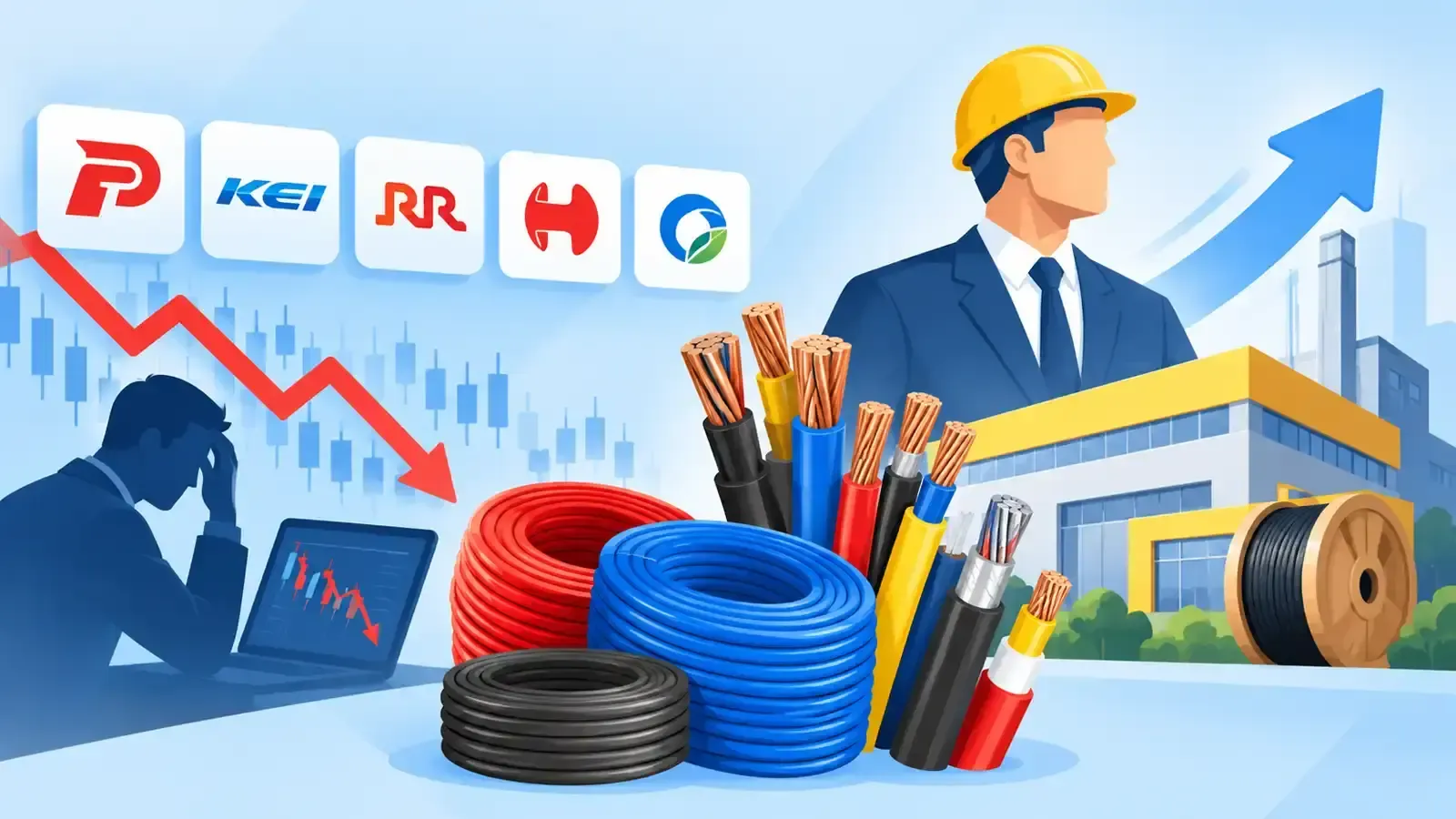
UltraTech Cement’s ambition to become at least the No. 2 player in India’s wires and cables (C&W) market over the next three to five years is ahead of its earlier guidance.
Cables and wires (C&W) stocks, including RR Kabel, KEI Industries, Polycab India, Havells India and Finolex Cables, took a heavy beating last week amid concerns over intensifying competition after UltraTech Cement entered the segment earlier than expected.
"Backed by an investment of ₹1,800 crore, Ultravolt will be the second-largest player in the wires segment by capacity. Housed under UltraTech Cement Limited, the business aims to build a scaled national brand and become one of the top two players within five years," the company said in its press release.
How existing C&W players have fared in the past one month
Data show that most stocks have fallen over the past 1 month. Polycab India shares have slipped over 9.6% during the period, while Havells India has slipped 12.5%, KEI Industries shares have cracked over 17%, and R R Kabel has declined 12%.
Finolex Cables, on the other hand, has jumped nearly 29% during the window.
What CITI said on C&W companies
UltraTech Cement’s ambition to become at least the No. 2 player in India’s wires and cables (C&W) market over the next three to five years is ahead of its earlier guidance and is likely to weigh on the near-term stock performance and valuations of Indian cables and wires companies, according to CITI.
The investment firm said UltraTech had earlier guided for an investment of ₹1,800 crore in the business. Based on an estimated 7x asset turnover at 100% capacity utilisation, it believes this investment could generate around ₹12,500 crore in revenue, implying a 7–8% market share over the next four to five years.
CITI expects the disruption to be greater in the wires segment compared with cables.
It noted that RR Kabel and Havells India have higher exposure to wires than Polycab, and are therefore likely to face greater competitive intensity.
According to CITI, the cables segment has relatively higher entry barriers due to the longer lead time required for approvals and certifications, along with greater SKU requirements, manufacturing complexity, and technical know-how.
Jefferies on Finolex Cables
Despite a 60% year-to-date rally, the investment firm said Finolex Cables trades at around 21 times forward earnings, at a discount to its cables and wires peers. Jefferies sees further rerating potential, supported by healthy cables and wires demand and growth in the optical fibre cable (OFC) business.
Jefferies said OFC growth is driving margin expansion and could become a meaningful contributor to Finolex Cables’ earnings. The company’s fibre draw capacity is expected to double to 8 million km by December 2026, which Jefferies believes will support further growth.
Meanwhile, electricals remain the company’s key business, while solar and extra-high-voltage (EHV) cables are expected to provide additional growth drivers. Jefferies expects Finolex Cables to deliver a 17% sales CAGR and 22% EBITDA CAGR between FY26 and FY29E.
The investment firm sees scope for the stock to re-rate towards a 23x target multiple, with Finolex Cables offering exposure to housing and capital expenditure. However, key risks include a slowdown in demand and volatility in copper and optical fibre prices.
Jefferies on Polycab
Jefferies said the recent correction following UltraTech Cement’s entry into the wires and cables (C&W) segment could be a buying opportunity. Polycab shares have fallen around 10% over the past five trading sessions after the launch of UltraTech’s Ultravolt brand and are currently trading at around 35 times one-year forward earnings.
According to Jefferies, UltraTech’s planned ₹1,800 crore capex, assuming an asset turnover of 4–5 times, could result in sales equivalent to around 5–6% of the C&W industry by FY30. The investment firm also noted that around 25% of the market remains informal, providing room for a new organised player to enter the segment.
Jefferies believes Polycab is relatively better placed given that 70–75% of its product mix comprises cables, while UltraTech’s focus appears to be more on wires. The investment firm also pointed out that the C&W industry’s net profit margins of around 5–7% leave limited room for companies to offer price discounts.
Difference between cables and wires
Wires and cables are both used to carry electricity, but they differ mainly in their construction and applications.
A wire is typically a single conductor covered with an insulating layer and is commonly used for household electrical connections and appliances.
A cable, on the other hand, generally consists of two or more insulated conductors bundled together with an additional protective layer, making it suitable for more complex and higher-capacity applications.
In simple terms, wires are generally used for individual electrical connections, while cables are used to carry multiple electrical signals or higher loads in applications ranging from buildings to industrial and power infrastructure.
Related News
About The Author
Next Story

