Market News
Asset quality improves for SBI, HDFC, ICICI, others in Q4 results; here’s what’s next for the banking sector

5 min read | Updated on May 15, 2026, 08:34 IST


SUMMARY
Asset quality among the top banks has been improving over the quarters on the backdrop of stricter regulations and tightening provision norms. With concerns remaining over credit growth, experts chart a way forward for banks in the upcoming quarters.
Stock list

Q4 FY2026 financial performance of the banks was supported by improved asset quality, healthy credit expansion and higher income.
Experts predict that this move comes on the backdrop of stricter norms from the banking regulator, the Reserve Bank of India (RBI), and tightening of the provision norms in the country.
How did banks perform in Q4 results?
In the March quarter results for the fiscal year ended 2025-26, the financial performance of the banks was supported by improved asset quality, healthy credit expansion and higher income.
The country’s largest private sector lender, HDFC Bank, witnessed a 9% increase in Q4 net profits, while the core net interest income (NII) rose on a year-on-year basis. Meanwhile, SBI posted a 5.5% rise in Q4 net profits and a 3.13% rise in net interest income for the March quarter.
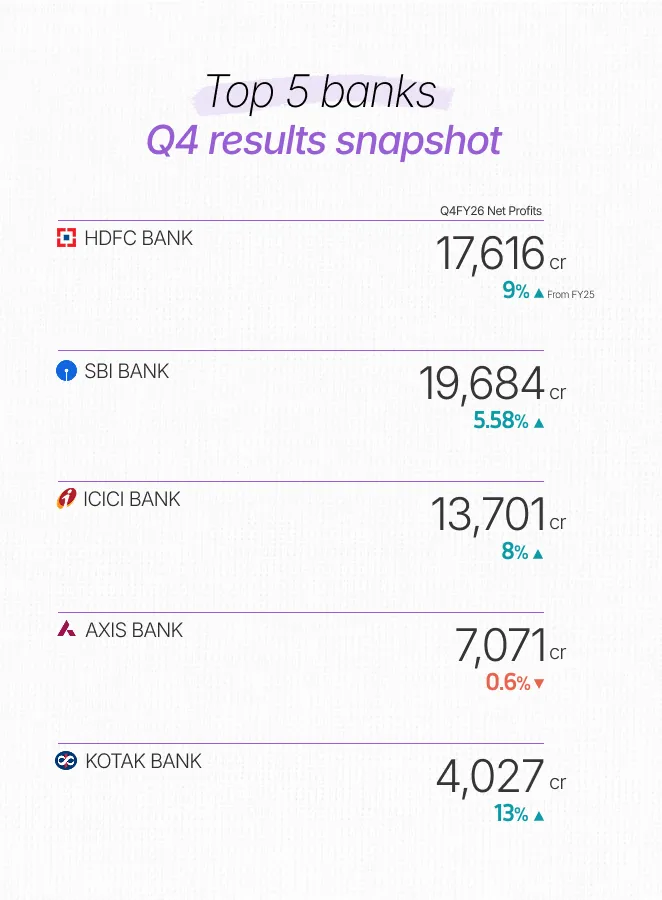
Experts said that SBI's profits failed to meet market expectations, as the last couple of quarters have been extremely good for the bank which in turn kept the expectations higher, the stock dived to a three-month low post earnings.
ICICI Bank also showed a healthy performance in Q4 results, with PAT rising by 8% to ₹13,701 crore, while the NII rose 1.99% year-on-year. While Axis Bank posted a flat growth in net profits to ₹7,071 crore, in contrast, the NII rose by 4.7% to ₹14,457 crore.
Fifth largest bank by market capitalisation (M-Cap), Kotak Mahindra Bank witnessed a 13% rise in net profits to ₹4,027 crore, while the net interest income rose 8% to ₹7,875 crore year-on-year.
Is asset quality improving?
Data collected from NSE filings showed that the top 10 banks (both public and private sector) listed on the Indian stock markets have witnessed a strengthening asset quality in the March quarter.
HDFC Bank, State Bank of India (SBI), ICICI Bank, Axis Bank, Kotak Mahindra Bank, Bank of Baroda, Punjab National Bank, Union Bank of India, Canara Bank, and Indian Bank were among others to witness improving asset quality in Q4 results.
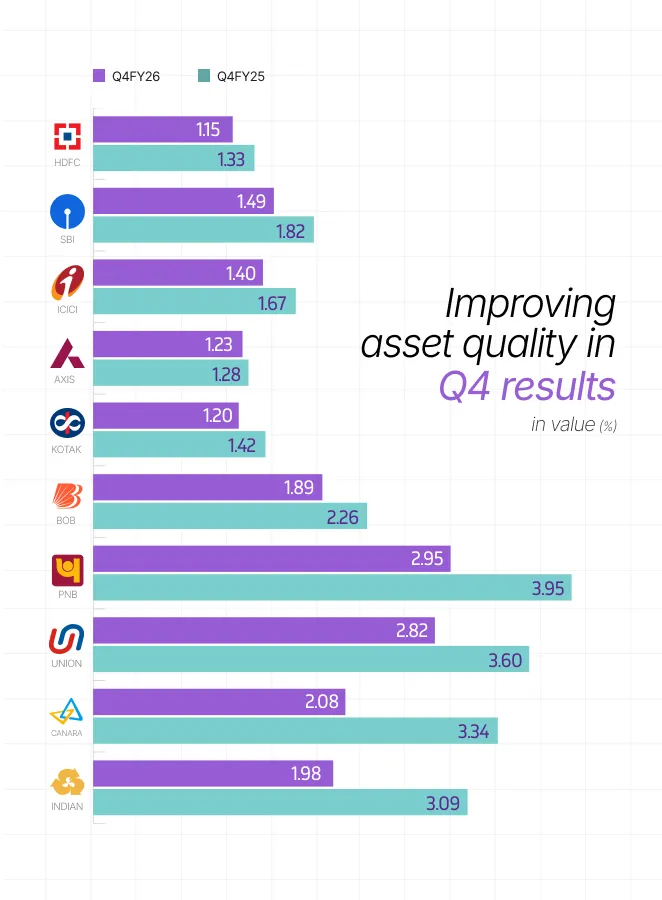
Mumbai-based independent capital market analyst Ambareesh Baliga said that with the help of tough regulatory oversight and the tightening of the provision norms in the Indian banking sector, the banks have sorted out their NPA baggage situation, which they had in the past, while maintaining provision reserves.
“In the last three to four years, a lot of NPA clean-up has happened, and the credit norms have also been getting quite stiff. So all this improved the asset quality,” said the expert.
Independent equity market analyst Ajay Bodke also explained how, historically, the NPA crisis was a result of the time and cost overruns of industrial projects in India, many of which ended up being NPAs for corporate-focused banks.
“The banks were holding on to these NPAs without adequate provisions for the bad debts. So after Raghuram Rajan (former RBI governor) took over, he conducted the asset quality review, in turn forcing banks to start providing for dodgy assets,” he said.
After Q4 FY2026, market experts, including those from the Australian investment giant, Macquarie Group, now indicate that the asset quality remains stable and strong for major banks like SBI, even though credit costs remain a concern.
What’s next in store for banks?
Looking forward, Baliga expects the next couple of quarters to remain dull for the banking stocks due to the estimates around credit growth among the lenders taking longer than the expected timeline.
“At least the next couple of quarters, possibly it looks a bit dull, because the credit growth which we are thinking will happen may take a while longer,” he said.
The Finance Ministry, in a recent statement, also said that so far, the government-aided capex cycle has supported the structural reforms and private investments, in turn boosting the demand for credit growth in the domestic economy.
The expert also said that due to the rise in the cost of funds, the margins of the banks have also been falling, which is a cause of concern as of now. “But I don't think it will get squeezed any further. The only issue is the credit growth, which might take longer.”
On the economic front, market experts have widely predicted that Prime Minister Narendra Modi’s speech earlier this week could be an indication that things are likely to slow down in the Indian economy, which may or may not materialise due to the uncertainty looming over markets amid mixed global cues.
While uncertainties grip market investors, the focus continues to be on any potential relief sign from the global markets, as so far the global sentiment has been able to steer the equities rather than domestic cues.
Related News



About The Author
Next Story