
Upstox Originals
Is Nvidia quietly becoming its own customer's banker?

6 min read | Updated on August 12, 2026, 18:52 IST


SUMMARY
Nvidia just lined up over $500 billion from Wall Street to fund the AI boom. If you own Nvidia shares, or any fund with AI exposure, it is important to know that a growing share of Nvidia’s revenue might be coming from customers Nvidia itself is helping to pay. That is not a red flag by itself. But it's the kind of detail that only starts to matter once demand slows down.
Nvidia has raised ~$500 billion to fund its AI expansion. | Image: Shutterstock
The investors? Big finance companies like Apollo Global Management, Blackstone, BlackRock, Brookfield Asset Management, Goldman Sachs and KKR.
On the face of it, this appears to be good news, but the stock reacted differently and fell as much as 3.2% on the day.
Where does Nvidia use these funds?
As seen in the table below, Nvidia has been investing heavily to build, support and bolster the entire AI infrastructure. The additional funds raised are expected to continue this endeavour.
| Month | Deal | Approx. value |
|---|---|---|
| Jan 2026 | Additional equity stake in CoreWeave | $2 billion |
| Feb 2026 | Equity stake in OpenAI, part of its $110 billion funding round | $30 billion |
| Mar 2026 | Stake in Nebius Group (9.3% disclosed later) and backing for Thinking Machines | $2 billion+ |
| Jul 2026 | Reported talks to guarantee financing for OpenAI's Ohio data centre, plus tied chip-purchase financing | Up to $250bn + $350bn |
Source: Bloomberg, CNBC (reported by TechNextWeb, May 2026), Benzinga/Sahm Capital (Jul 2026), Axios, Nvidia Newsroom (Aug 2026)
Here are the questions that arise
- Why did the share price react negatively?
- What are analysts worried about?
- Is Nvidia’s chip business really starting to mirror a bank?
So, let’s answer these.
The main worry certain analysts have is that Nvidia has been “funding” its own clients. Let’s break these down.
- Step 1: Nvidia lends money in clients either in the form of a loan or an investment.
- Step 2: These clients, in-turn, use these funds to purchase chips from Nvidia
- Step 3: This increases Nvidia’s sales.
Given the heavy capital demand in the AI business, many of these clients continue to need funding consistently. As such, the circular transactions keep continuing.
This has raised some eyebrows on the street. Basically, similar (not exactly) to a bank, Nvidia has been lending money to its own customers, which has helped them boost business.
The main concern? What happens to these clients if Nvidia stops funding them? Does demand collapse?
Let’s take the example of CoreWeave.
How the circular part actually works: the CoreWeave example
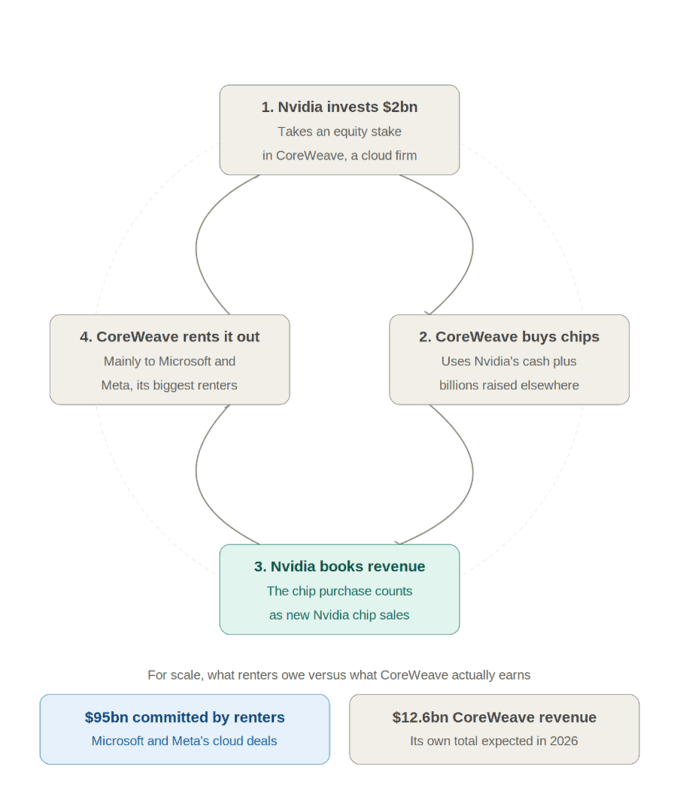
Take CoreWeave, one of the two companies in the table above. It doesn't make chips; it rents out cloud computing power built entirely from stacks of Nvidia GPUs.
Here is the sequence: Nvidia invested ~$2 billion in CoreWeave, and Microsoft and Meta have separately committed roughly $60 billion and $35 billion.
CoreWeave then spends most of these funds to purchase Nvidia chips to build data centres. Nvidia records that purchase as chip revenue. CoreWeave then rents out the computing power those chips create, mainly to Microsoft and Meta.
Follow the money and it loops back on itself. Nvidia's cash becomes CoreWeave's chip order. CoreWeave's chip order becomes Nvidia's revenue. And the value of Nvidia's original investment now depends on CoreWeave finding enough renters to pay for all that capacity.
If Microsoft or Meta ever scale back what they've committed, three things wobble at the same time: CoreWeave's ability to repay Nvidia, the value of Nvidia's stake in CoreWeave, and Nvidia's own sales growth, because a chunk of it came from CoreWeave in the first place. That is the whole circular financing worry in one sentence.
Why some analysts are reaching for a 1990s comparison
This pattern is not new on Wall Street, and analysts have reached for an uncomfortable historical comparison to describe it. Telecom equipment makers Lucent and Nortel lent billions to their own customers in the late 1990s so those customers could buy telecom gear. The orders looked spectacular, until the telecom bubble burst and the loans went bad. Neither company's stock ever fully recovered.
Not everyone agrees with the comparison. One widely shared analysis pointed out that Nvidia's $2 billion stake in CoreWeave covers less than 6% of the roughly $35 billion CoreWeave plans to spend in building AI infrastructure this year, with the rest raised elsewhere, which is hardly circular in the way critics suggest.
CEO Jensen Huang himself has pushed back hard, calling the idea ridiculous in one interview, and argued that Nvidia's equity stakes are a small fraction of what these companies ultimately raise on their own.
What the revenue numbers suggest
Both things are true at once. Nvidia's revenue is real. It's audited and growing, with gross margins still near 75%. That part isn't in doubt.
What's harder to know is where that growth is coming from. Some of it is demand that would have shown up anyway. Some of it may only exist because Nvidia's own money got there first. It's hard to tell the two apart from the outside.
This doesn't make circular financing wrong. Companies have financed their own customers for decades, from oil majors to carmakers, and it usually works fine. The real test comes later: does the demand hold up on its own, or was it only there because of the financing?
For now, there's one number worth watching. How much of Nvidia's revenue growth is coming from companies it has invested in or is financing directly? And is that share going up or down over time? Nvidia doesn't publish this number itself. But analysts are starting to piece it together, deal by deal.
What matters more than this week's headlines
Nvidia's next earnings report lands on August 26, 2026, with guidance already pointing to $91 billion in quarterly revenue. That number will matter less on its own than what it says about the health of the companies Nvidia has been funding (CoreWeave, Nebius, OpenAI, and the rest).
These companies will also report their earnings soon, and a key metric to check will be if they can pay their bills without Nvidia's help. The $500 billion question was never really about whether Nvidia can find buyers for its chips. It's whether those buyers can stand on their own.
About The Author
Next Story

