
Upstox Originals
Beyond big tech: The rise of the US small caps in 2026

5 min read | Updated on July 22, 2026, 14:43 IST


SUMMARY
US small-cap stocks have staged a remarkable comeback after years of lagging larger peers. Falling borrowing costs, better earnings expectations, and attractive valuations have helped power a 17.3% rally in the Russell 2000. What's driving this resurgence, which sectors are leading the gains, and can small caps sustain their momentum through the second half of 2026?

The Russell 2000 Index has surged ~17.3% in 2026 outperforming every major US benchmark. | Image: Shutterstock
The US equity market has found an unlikely leader in 2026, and no, it isn't Big Tech. After years of playing second fiddle to large-cap technology stocks, US small caps have staged a remarkable comeback.
Through July 20, 2026, the Russell 2000 Index, which tracks around 2,000 of the smallest publicly listed US companies, surged ~17.3%, outperforming every major US benchmark.
In comparison, the Nasdaq Composite gained 9.8%, the S&P 500 advanced 8.5%, while the Dow Jones Industrial Average rose 7.1% through July 20, 2026.
The outperformance marks the Russell 2000's strongest showing relative to the S&P 500 in years and signals a notable shift in market leadership beyond the mega-cap technology stocks that dominated returns for much of the past decade.
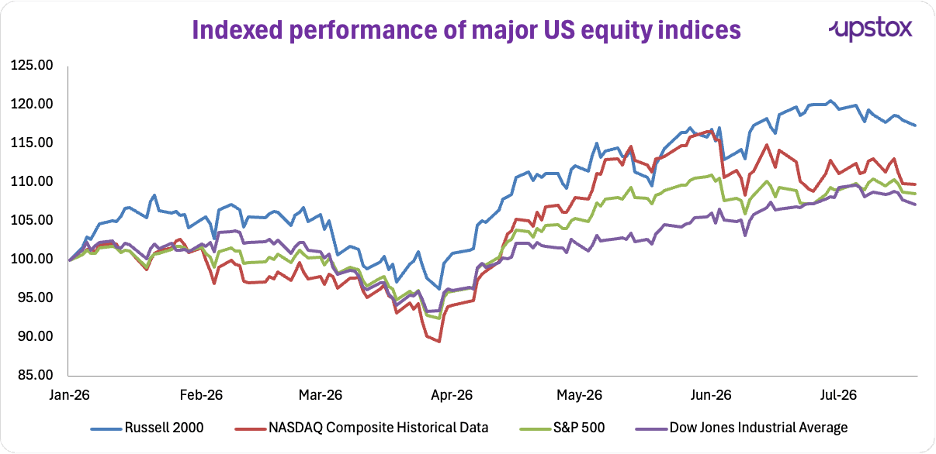
Source: Investing.com, data as of 20 July, 2026 (Indexed to 100)
What does this mean for the US markets?
For the US markets, this signals that the rally is becoming healthier and more broad-based rather than relying on a handful of mega-cap stocks. The Russell 2000's strong performance suggests that investor confidence is extending beyond the market's largest companies, with capital rotating into smaller and more cyclical businesses.
As financials, industrials, technology, and other sectors participate, the rally becomes less concentrated and more resilient to weakness in any single group. For investors, this broadening market leadership could create opportunities beyond the traditional mega-cap winners while reducing the market's dependence on a few heavyweight stocks.
Why is this happening now?
The Fed made borrowing cheaper
Small companies don't usually have the luxury of locking in fixed-rate loans the way big corporations do. Around 40% of Russell 2000 debt floats with interest rates; so when the Fed cut rates three times in late 2025 (from.25–5.50% to 3.50–3.75%), small-cap balance sheets felt it almost instantly. Bank of America reckons every quarter-point cut adds back roughly 2% to Russell 2000 earnings.
The AI boom finally trickled down
For years, AI spending mostly benefited a handful of giant companies; Nvidia, Microsoft, the usual suspects. But by 2026, that spending had spread further down the supply chain, into the smaller companies that make the equipment, run the tests, and supply the components those giants need. Three small-cap chip stocks; MaxLinear, Aehr Test Systems, and Ichor Holdings; each shot up more than 400% in six months (Jan-June 2026).
The small caps were just really, really cheap
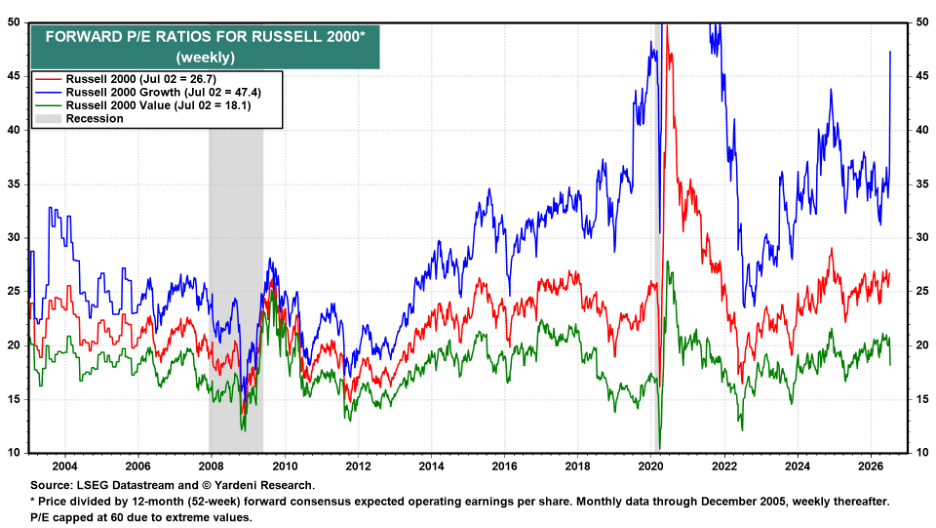
After four years of being ignored, small caps had shrunk to just 4.6% of the broader US market; well below their historical average of 7.6%. Back in January, the Russell 2000 traded at 18x earnings while the S&P 500 traded at 22x. As one fund manager put it, the valuation gap had gotten so wide "a truck could drive through it." Eventually, gaps that wide tend to close; and in 2026, they did.
The earnings actually showed up
Small-cap companies had been stuck in an earnings slump since 2023. That slump is ending. Analysts expected 23% earnings growth for the Russell 2000 in 2026 back in January, by July, that number had jumped to 38%, with some estimates going as high as 43% for the next twelve months.
Policy and geography helped too
A new tax law let capital-intensive small businesses write off equipment and R&D spending immediately, which is a bigger deal for smaller companies than for cash-rich giants. And because small caps mostly sell to Americans rather than the whole world, they were less exposed to the geopolitical noise; tariffs, conflicts abroad; that occasionally rattled larger, more global companies this year.
Which sectors are leading the small-cap resurgence?
The first-half rally in US small-cap stocks wasn't driven by a single theme. Leadership broadened beyond the AI-heavy technology names that dominated large-cap indices in 2025, with economically sensitive sectors taking center stage.
Financials, Industrials and Information Technology together accounted for nearly 46% of the Russell 2000's sector weight by mid-2026, making them the biggest contributors to the index's advance. Health Care remained the largest sector at 21.1%, followed by Financials (18.8%), Industrials (14.3%) and Information Technology (13.2%).
Have we seen this before?
History suggests that such a strong first half is quite rare. Since 1980, the Russell 2000 has delivered a first-half gain of more than 20% only five times. However, what happened next wasn't always the same; some rallies continued, while others lost steam. The chart below shows the first-half gains in each of these years and how the index performed in the third quarter and the second half.

Source: Schaeffer's Investment Research
Can Indians get exposure to these stocks?
Yes. Under the RBI's Liberalised Remittance Scheme (LRS), Indian residents can remit up to $250,000 abroad each financial year to invest in US-listed stocks. Certain brokerage platforms provide access to these shares, while fractional investing allows you to start with a relatively small amount instead of buying an entire share. In summary
Markets are constantly evolving, and leadership rarely stays in one place forever. The resurgence of US small caps is a reminder that today's overlooked companies can become tomorrow's outperformers when the economic backdrop changes. For investors, staying diversified may prove more valuable than simply chasing yesterday's winners.
About The Author
Next Story

