
Upstox Originals
Decoding silver’s 40% price correction

6 min read | Updated on July 02, 2026, 15:01 IST


SUMMARY
A metal long overshadowed by gold suddenly became one of India's hottest trades. Silver's rally drew in investors, pushed imports to record levels and even triggered policy action from the government. Now that prices have corrected sharply, the real question is whether the silver story is over — or only entering its next chapter.
Silver prices have corrected almost 40% in 2026. | Image: Shutterstock
In India’s precious metals movie, gold has always been the main character :- emotional, aspirational, and impossible to ignore at weddings. Silver was the dependable supporting star; it was familiar, useful, always present in anklets, utensils, pooja plates and gifts, but rarely the headline act.
Then, over the past year, silver moved closer to the spotlight. Prices surged, investors rushed in, and imports hit record highs. Now, the correction is showing that this is not just about a metal losing shine in the short term, but about an old household favourite being taken more seriously as an investment, industrial input and policy concern.
What’s happening with silver and why?
Silver’s fall looks dramatic because the rally before it was dramatic too. After rising from mid-2025, silver climbed rapidly through the end of the year. On a weekly closing basis, it moved from around $37/oz in June 2025 to about $101/oz in early 2026 — a rise of nearly 170%.
During that frenzy, it also briefly touched an all-time high of $121.64/oz in January before sliding in the months that followed. By June, the weekly price had cooled to around $60/oz, marking a correction of roughly 40% from its weekly closing peak and about 50% from the January high.
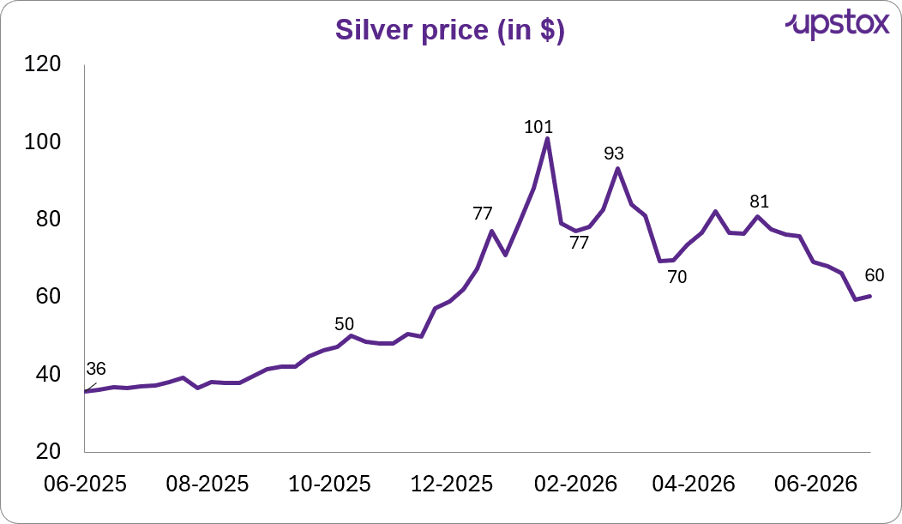
Source: Investing.com, Data as on 30-07-26
The fall came when the trade had little room for disappointment. Silver had already run up fast, so profit-booking was always a risk. Then the macro mood turned less friendly: the US dollar strengthened, hawkish Fed signals kept rate expectations firm, and non-yielding assets like silver became less attractive.
That timing matters. Silver did not fall because its long-term demand story disappeared. It fell because the short-term trade had become stretched just as the dollar and interest-rate backdrop turned against it.
Silver also has another complication. It is not only a precious metal. It is used in solar panels, electronics, EVs and other manufacturing-linked sectors. So unlike gold, it reacts not just to safe-haven demand, but also to industrial demand and global growth expectations.
That is why silver can rise quickly when the story is hot, and fall sharply when sentiment cools.
India did not just buy silver. It financialised it.
While silver was rallying globally, India was not watching from the sidelines. It was buying into the story.
But this rush was different from the usual festive or wedding-season buying. Silver was not only moving through jewellery counters, coins, utensils and gifting baskets. It was also entering demat accounts through silver ETFs, where investors were treating it as a cheaper, faster-moving alternative to gold.
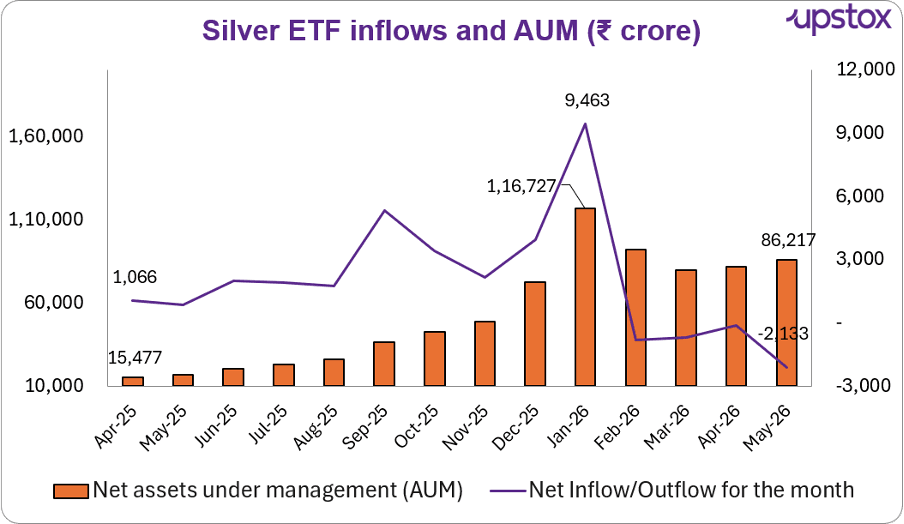
Source: AMFI
The ETF data shows how quickly the silver story scaled up in financial markets. Silver ETF assets under management rose more than 7.5 times between April 2025 and January 2026, before easing by about 26% by May 2026.
Indians have always bought precious metals for comfort, safety and tradition. But silver ETFs turned that familiar instinct into a market trade. People were no longer only buying silver to gift, wear or store. They were buying it because they expected it to perform. That is why the correction feels louder. When a quiet household metal becomes a portfolio bet, the fall is rarely quiet.
The problem with India’s silver rush
India buying silver is not new. Indians have always bought precious metals. What changed this time was the scale, and the number of places demand was coming from.
Households were buying silver for weddings, festivals and gifts. Investors were entering through ETFs. Industrial users needed it for solar panels, electronics, automobiles and EV-linked infrastructure. Importers were bringing in more metal to meet that demand.
Then prices turned.
And this is where silver becomes tricky. Strong long-term demand does not protect the metal from short-term corrections. Once the rally became stretched, profit-booking, a stronger dollar and hawkish Fed signals started weighing on prices. The investment trade cooled first, and the rest of the market felt the impact.
India felt it too. Domestic silver prices fell by about 34% between January and June 2026, broadly in line with the global weekly price correction of roughly 35%. Currency, duties and local supply conditions can affect Indian prices, but they did not stop silver from correcting sharply this time.
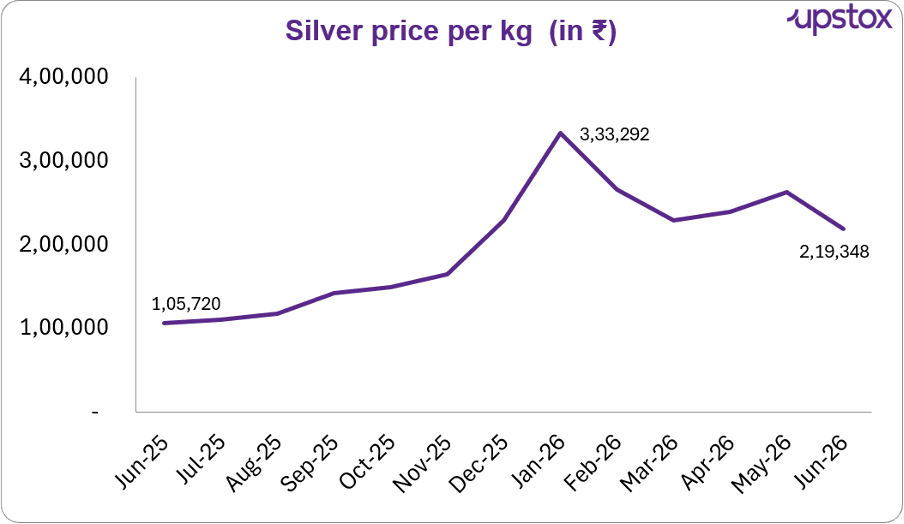
Source: MCX
The bigger issue for India was the import bill left behind by the rush. India depends on imports for more than 80% of its silver demand, so when buying jumps, more dollars leave the country. In FY26, India’s silver import bill touched a record $12 billion, up from $4.8 billion a year earlier.
That is when silver stops being only a consumer story. It becomes a trade-bill story too. The government moved quickly. In May 2026, India tightened silver import rules and raised duties to slow the rush. The impact was immediate: silver imports fell 87% year-on-year in May 2026, while volumes dropped 94% to 33 tonnes.
That is what makes this correction more meaningful than a routine commodity fall. Silver now connects Indian households, investor portfolios, factories and the country’s external account. When it moves sharply, the impact does not stay with traders. It travels across the economy.
What this means now
For investors, silver’s crash is a reminder that it is not simply “cheap gold”. It can rise fast, but it can fall just as quickly because it reacts to the dollar, interest rates, ETF flows, industrial demand and import rules.
For consumers, lower prices may help jewellery, coins and gifting demand. For industrial users, cheaper silver can reduce input costs in solar, electronics and EV-linked sectors. But in India, the benefit will depend on duties, supply and import restrictions. So, silver’s fall is not one story. It is a buying opportunity for some, a warning for others, and a policy concern for India.
The price has lost shine, but silver’s importance has not.
About The Author
Next Story

