
Upstox Originals
Why malls are India's hottest retail real estate

7 min read | Updated on November 26, 2026, 16:50 IST

SUMMARY
India's malls are becoming some of retail real estate's hottest assets, with footfalls, spending and retailer demand all rising. Scarce Grade A space is lifting occupancy and rents for established developers, but holding that edge will depend on getting the right store mix and experiences that keep shoppers coming back.
Stock list
In the first half of 2026, overall retail leasing in the top seven cities hit a four-year high of 6.27 million sq. ft., up 10.5% YoY according to JLL.
Does this sound familiar? You spend over 20 minutes finding a parking spot. The food court is packed, the billing queue at the popular store seems endless, and getting a table at a restaurant or café involves a long wait. Yet, come the weekend, the mall is still where everyone seems to be headed.
And not without reason. A mall offers something that few other urban spaces can: a little bit of everything under one roof. It is a place to shop, eat, watch a film, entertain children, meet family, hangout with friends or simply escape the heat. Increasingly, it is as much a social destination as a retail one.
Not surprisingly, footfalls in malls are rising, shoppers are spending more, and the best malls are running close to full occupancy. Take for instance Nexus Select Trust, which owns 19 malls across 15 cities. In the September quarter, footfalls at its malls grew 4% year-on-year (YoY), while tenant sales grew 13% (this is basically net sales generated by stores in the mall). Further, trading density (i.e. sales per unit of retail space) rose 14%, and 97% of its retail space was leased.
This growth is driven by a confluence of factors. Firstly, shoppers are in search of value-added experiences. Secondly, both legacy and new-age brands are looking to amplify their offline presence and create an omnichannel experience for shoppers. Thirdly, while demand is growing, the availability of quality retail space is limited.
Together, these forces are making well-run malls some of the most sought-after assets in Indian retail real estate.
Building a catch-all hub
To be sure, just opening a mall isn’t enough. Malls are today competing with instant deliveries, online shopping and on-tap entertainment. In order to convince people to travel to the mall, malls need to offer not just a well-curated selection of stores and services, but also live-events, pop-ups, and experiences that no app can match.
Mall developers have been doing just that. Large-scale installations with immersive, interactive experiences have found favour across major malls. In addition, developers have been regularly hosting live music concerts, food festivals, art expos and regional cultural celebrations to drive footfalls.
The strategy seems to be paying off, with malls seeing growth in footfalls as well as consumption.
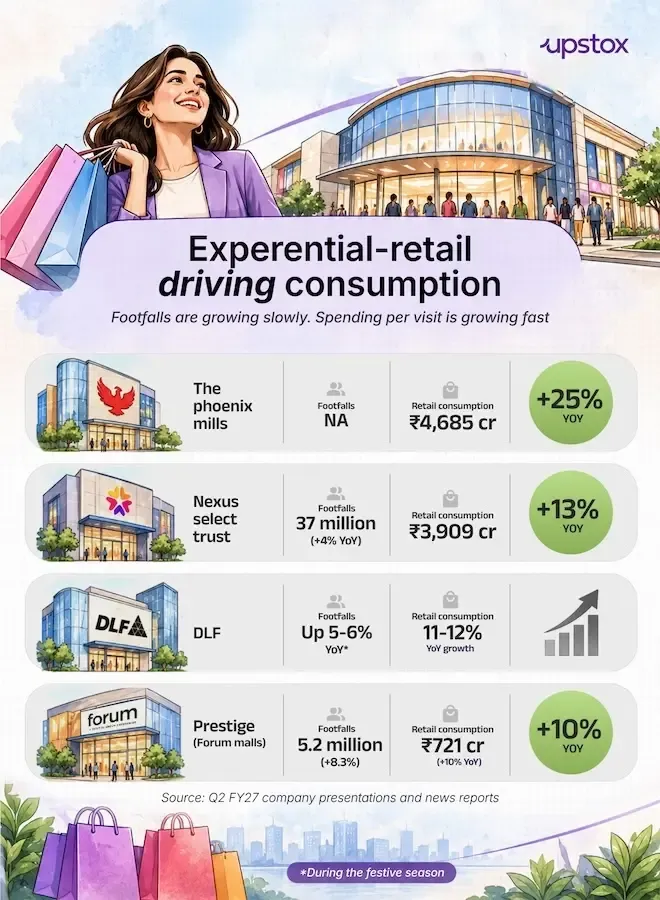
Getting the right mix of stores has also contributed to the growth. Phoenix Mills’ malls in Bengaluru and Pune, which were repositioned with a fresh mix of brands, have witnessed 19% and 21% YoY growth in consumption, respectively, in the September quarter.
DLF, meanwhile, says consumption across its retail portfolio is growing 11-12% YoY. The company attributes this to premiumisation, with shoppers looking for better brands and experiences. Footfalls at its malls have surpassed pre-pandemic levels and average sales per footfall is also rising.
Jostling for space
Naturally, where there's a crowd with money to spend, brands will follow. Retailers are competing for space in the malls that can give them visibility, footfalls and access to shoppers with spending power.
In the first half of 2026, overall retail leasing in the top seven cities hit a four-year high of 6.27 million sq. ft., up 10.5% YoY according to JLL. Within this, malls did even better: their share of that leasing rose to 43.1% from 38.9% a year earlier, which means leasing volume in shopping malls grew 22.4% YoY.
In fact, the demand is growing faster than the supply. Cushman & Wakefield’s October report notes that almost no new Grade A mall space (i.e. the best-located and best-managed retail centres) has come up recently. September was the third consecutive quarter without a single addition. With quality mall supply constrained, the vacancy in existing Grade A malls slipped to 4.8% from 7.25% in the same period last year. As a result, though the retail real estate sector continued to see active occupier demand in Q3 2026, leasing volumes moderated by 4.4% YoY.
That means demand isn't the bottleneck. Good space is. And "good" is the operative word, because the rest of the market tells a very different story.
According to a Knight Frank analysis, Grade A accounts for 50% of the total shopping centre stock in India, the rest constituted by Grade B and C. Its retail report puts vacancy across all shopping centres at 23%, against about 6% in Grade A. An earlier report notes that India had about 74 ‘ghost malls’, where vacancy was higher than 40%. Knight Frank attributes the problem to weak tenant curation, ageing infrastructure and declining relevance. Put simply, these malls have lost their ability to give brands and shoppers a compelling reason to visit.
Redeveloping them could be a big opportunity. Anarock estimates that about 40-50 million sq ft of underperforming Grade B and C malls in Tier I cities are candidates for repositioning through re-zoning, experiential retail and a rejig of anchor tenants.
Until that happens, landlords with the right assets are in a sweet spot. Because constrained supply + strong demand = pricing power.
Having the cake and eating it too
Anarock’s report notes that Grade A/A+ retail assets across key metropolitan markets are witnessing historically low vacancy levels of ~0–2%, alongside sustained rental growth of ~6–10% YoY in Grade A/A+ assets.
That is beginning to show up in mall operators' income. Phoenix's retail rental income rose 15% in the September quarter, while DLF's increased 9%. There's more to come as existing leases expire. About half of Nexus’ gross rentals are due for renewal by FY30, offering roughly 20% upside if leases are repriced to current market levels. In the September quarter alone, it re-leased 0.5 million sq ft at rents around 25% higher than before.
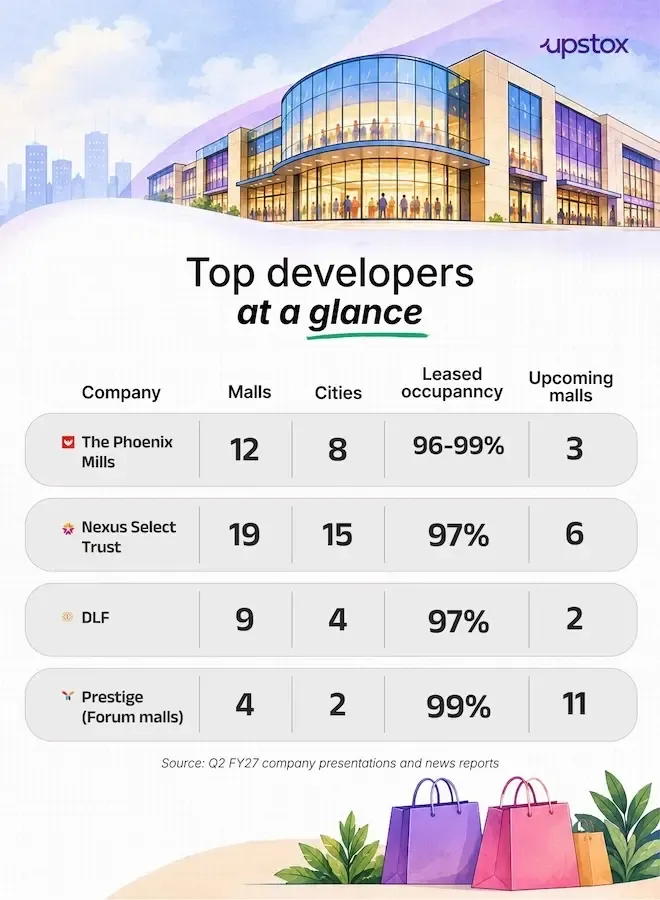
Phoenix also expects to renew leases at rates roughly 20% higher. Meanwhile, Prestige Estates Projects expects its exit rentals to rise from ₹369.8 crore in FY27 to ₹1,179.4 crore in FY30. (Note: Instead of standalone quarterly rental income, Prestige discloses annualised exit rentals, meaning the 12-month forward rent run-rate from leases active on the last day of the quarter).
Besides maximising income from existing properties, developers are also expanding their mall portfolio through new developments and/or acquisitions. JLL estimates an addition of ~51.1 million sq. ft. of new shopping mall space over the next five years, taking the total shopping mall stock to 143.2 million sq. ft. by the end of 2031.
A near-term projection by Crisil states that the industry is expected to add 4.5-5 million sq ft over FY27 and FY28, more than double the supply added in the previous two.
How will this sudden influx change the market dynamics? Not much, according to Crisil. Around 70% of the space scheduled to open this fiscal has already been pre-leased. Occupancy is hence expected to remain around 93-94%. Alongside, it expects new space and higher rentals to positively impact mall operators’ income, with 14-16% revenue growth in FY28, compared to 10-11% this year.
For now, the numbers seem to favour established mall operators. High occupancy, rising rentals and strong retailer demand make a compelling case for the sector.
But the opportunity comes with a caveat: getting the location or tenant mix wrong can quickly turn a promising asset into a ghost mall with high vacancy and dwindling footfalls. So, as developers expand, the focus must be on creating high-quality experiential retail, not just adding square footage. Or to borrow, and slightly tweak, the classic line, ‘Only if you build it right, they will come.’
Related News

About The Author
Next Story

