
Upstox Originals
Why the best argument for silver’s price rally also helped end it

5 min read | Updated on October 30, 2026, 23:12 IST

SUMMARY
In just the past nine months, silver has crashed more than 50%! Ironically, the argument that powered the rally has also been one of the main reasons for this correction. To keep costs under control, industrial users switched to substitutes and used less silver. For investors, this offers a critical investing lesson – when prices are driven by investors and not the actual users of any commodity, a deeper look may be necessary.
Silver prices have corrected over 50% from their 2026 high | Image: Shutterstock
Just a year ago, fund houses could not cater to investors who wanted silver exposure. In October 2025, Kotak Mutual Fund stopped accepting fresh lump-sum money into its silver fund of funds.
Physical silver in India had become so scarce that it was trading at a steep premium to international prices. Axis MF and Tata MF did the same within days, and some silver ETFs traded 10–12% above the value of the metal they held. Investors were willing to pay extra just to make sure they did not miss the rally!
A year later, the queue has gone. So has half the price. Silver has lost more than half its value since January 2026.
| Metal | Peak (2026) | Latest | Fall from peak |
|---|---|---|---|
| Silver, international ($ per ounce) | Nearly $117 (Jan 28) | $54.05 (Oct 28) | About 54% |
| Silver, MCX spot (₹ per kg) | ₹3,79,983 (Jan 29) | ₹1,94,170 (Oct 23) | About 49% |
Source: Outlook Business, Trading Economics, Kitco
One number is worth keeping in mind before going further. Silver is still about 14% higher than it was a year ago. The people nursing the deepest losses are not the early buyers. They are the ones who arrived late.
Was the industrial case for silver just hype?
No. The bull argument was built on something real. Silver’s ability to efficiently conduct electricity makes it very useful for solar panels, cars, electronics and the power grid. The Silver Institute expects 2026 to be the sixth straight year in which the world uses more silver than it produces, with a shortfall of 46.3 million ounces.
Then what has changed?
Expensive silver made its biggest users buy less of it.
Think about what happens at home when tomatoes suddenly cost three times as much. Nobody stops cooking. The dal gets one tomato instead of two, and someone in the house quietly reaches for the lemons.
Solar manufacturers did exactly this. By January 2026, silver had overtaken polysilicon as the single most expensive material in a solar module, at around 16–17% of the total, according to price agency OPIS.
Certain Chinese manufacturers announced that they would start mass-producing solar cells using base metals such as copper. Panel makers kept building panels. They just used less silver in each one. The Silver Institute’s data shows how far this went.
| Particulars (forecast for 2026) | Change |
|---|---|
| Solar demand for silver | - 19% |
| Total industrial demand | - 3% |
Source: Silver Institute
Industrial demand fell for the first time since the pandemic, and the market still stayed in deficit only because coin, bar and ETF buyers, who had heard for months that factories would need ever more of this metal, kept absorbing the very silver those factories were now choosing not to buy. Users were walking away. Investors were walking in.
Did Indian investors buy at the peak of the cycle?
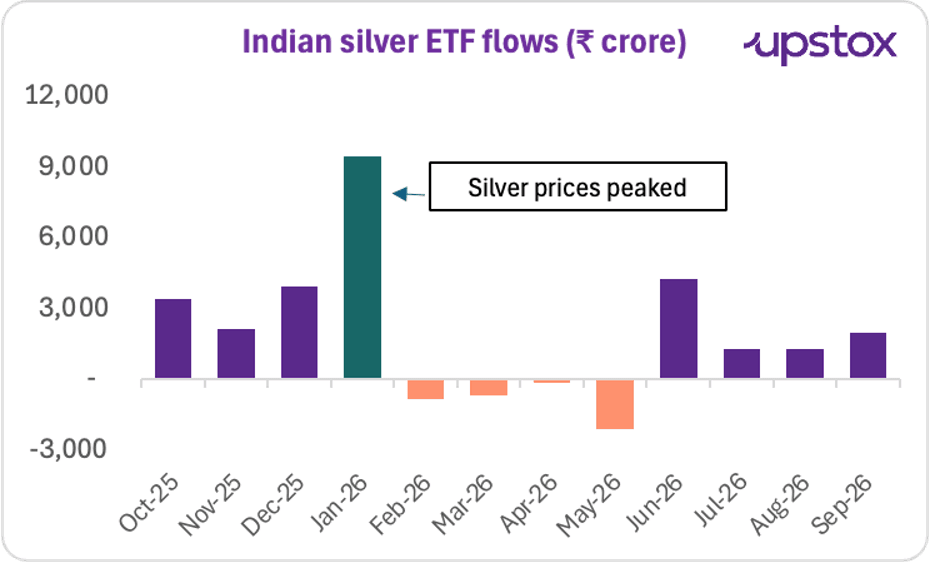
Source: AMFI monthly data, News articles
In January 2026, the month silver hit its record, Indian silver ETFs took in ₹9,463 crore. That was more than double December’s figure and the biggest month the category has ever had. AMFI’s January note pinned the silver ETF rush on demand from electric vehicles, semiconductors, telecom and AI.
Unfortunately, the tide turned. Over the next four months, investors pulled out about ₹3,770 crore, with May alone accounting for ₹2,133 crore.
Silver falls about twice as hard as gold
Gold rode the same wave and is down about 28% from its January record. Silver is down about 54%.
Silver’s market is much smaller than that of gold and leans more on factory demand, so a change in growth expectations or a wave of leveraged selling moves it further. It rises faster than gold. It also falls faster.
How to tell when a true story has become a crowded trade
By no means is the silver story over. The deficit is real, and nobody knows where the price will go from here. The point is this. A true story about an asset and a sensible price for it are two separate things, and in a bull run the first one gets used to sell the second. Silver left clues along the way. Most of them were visible without any special data.
| What you notice | What it can tell you |
|---|---|
| Fund houses limit fresh investment | Demand is running ahead of the product’s supply |
| An ETF trades well above the value of what it holds | Buyers are paying extra just to get in |
| The biggest real-world users are cutting back | Investors, not users, are now setting the price |
| Inflows hit a record in the same month as the price | Late money is arriving all at once |
The second column is the useful one. When the people who actually use a commodity start buying less of it, it's worthwhile to ask who is still buying, and why.
About The Author
Next Story

