Upstox Originals
Why Hyundai can’t rely on the Indian market alone for its $15.5 billion investment

6 min read | Updated on November 25, 2026, 09:24 IST

SUMMARY
Hyundai will invest $15.5 billion (about ₹1,47,000 crore) in India between 2026 and 2032. The plan has raised a few eyebrows. It just posted its highest-ever quarterly sales, yet its net profit has fallen YoY for three straight quarters. Can the Indian market absorb all the cars Hyundai plans to build, and protect its profit too?
Stock list
Hyundai will invest $15.5 billion (about ₹1,47,000 crore) in India between 2026 and 2032. | Image: Shutterstock
Hyundai is building enough capacity in India to make more than 11 lakh cars a year. But there’s a catch: Indian buyers may not be enough to fill those factories.
That is the puzzle behind Hyundai Motor Group’s $15.5 billion (about ₹1,47,000 crore) investment in India between 2026 and 2032. The company has just posted its highest-ever quarterly sales, yet its net profit has now fallen YoY for three straight quarters. Domestic sales are growing, but margins are under pressure.
So, the questions being asked are
- Will it be able to sell all these cars in India? Or will exports need to step up?
- How will it impact profitability?
- Is the profit fall a one-off?
No. It is a trend. Net profit has fallen YoY in each of the last three quarters, and the PAT margin has slipped from 9.0% in Q2 FY26 to 5.8% in Q2 FY27. Rising raw material costs have hurt profitability. Revenue has held up, so the problem is not sales. It is how little of each sale turns into profit (as seen in the table below).
| ₹ crore | Q2 FY26 | Q3 FY26 | Q4 FY26 | Q1 FY27 | Q2 FY27 |
|---|---|---|---|---|---|
| Revenue | 17,460.8 | 17,973.5 | 18,916.2 | 16,334.6 | 20,696.1 |
| Net profit | 1,572.3 | 1,234.4 | 1,255.6 | 888.6 | 1,196.2 |
| Net profit YoY | 14.3% | 6.3% | - 22.2% | - 35.1% | - 23.9% |
| PAT margin | 9.0% | 6.9% | 6.6% | 5.4% | 5.8% |
Source: HMIL quarterly results
What can cushion the blow?
Exports, which earn Hyundai “much, much higher” margins than domestic sales, according to MD & CEO Tarun Garg. But in Q2 FY27, exports grew only 3.7% YoY, while domestic sales grew about five times faster.
Who will buy the cars produced in the new plants?
By 2030, Hyundai plans to take its combined capacity (Chennai and Pune) to around 11.4 lakh cars a year. Now compare that with sales. Hyundai sold about 3 lakh cars in India between April and September 2026. At that pace, it would sell about 6.1 lakh cars in a full year. That is only a little over half of what its plants will be able to make.
Add exports, and the total is still about 7.9 lakh cars a year, around 3.5 lakh short. For India alone to fill the plants, Hyundai’s sales here would have to almost double. That is why exports need to step up.
The chart below puts Hyundai’s yearly sales next to the capacity it is building.
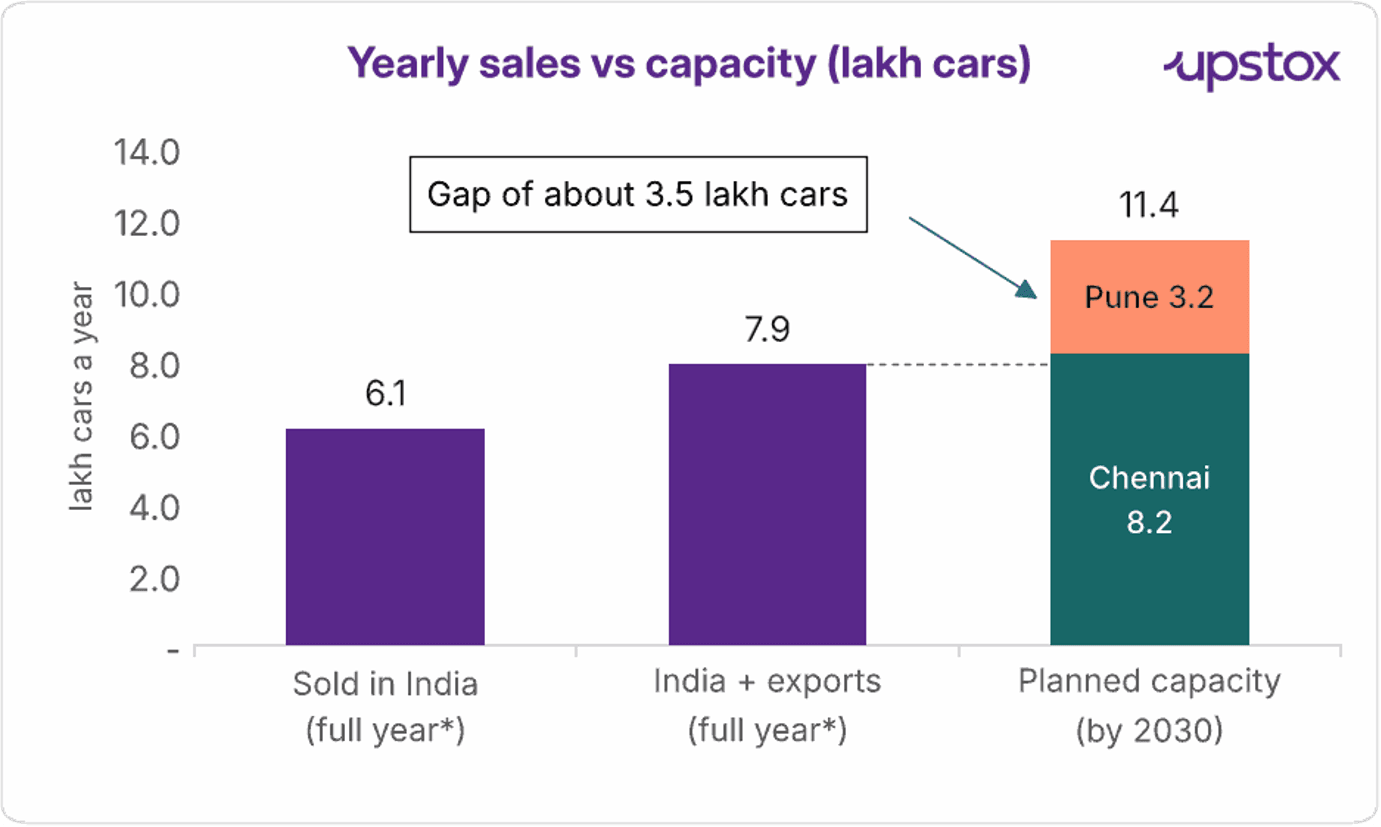
Source: HMIL. *April to September 2026 sales, doubled for a full year
But, Maruti sells nearly 19 lakh cars a year. Why can’t Hyundai sell 11 lakh?
It is a fair question. About 47 lakh cars were sold in India in FY26, and Maruti Suzuki alone sold nearly 19 lakh of them. So why can’t Indians buy 11.4 lakh Hyundais?
The answer is market share. Maruti sells that many cars because it holds about 40% of the market. Hyundai holds about 12%, and its share is slipping. In FY26, its domestic sales fell 2.3% YoY even as the market grew, and it dropped from second to fourth place, behind Mahindra and Tata Motors.
To sell 11.4 lakh cars a year in India, Hyundai would need about 24% of today’s market, roughly double its current share. The chart below shows how big that gap is.
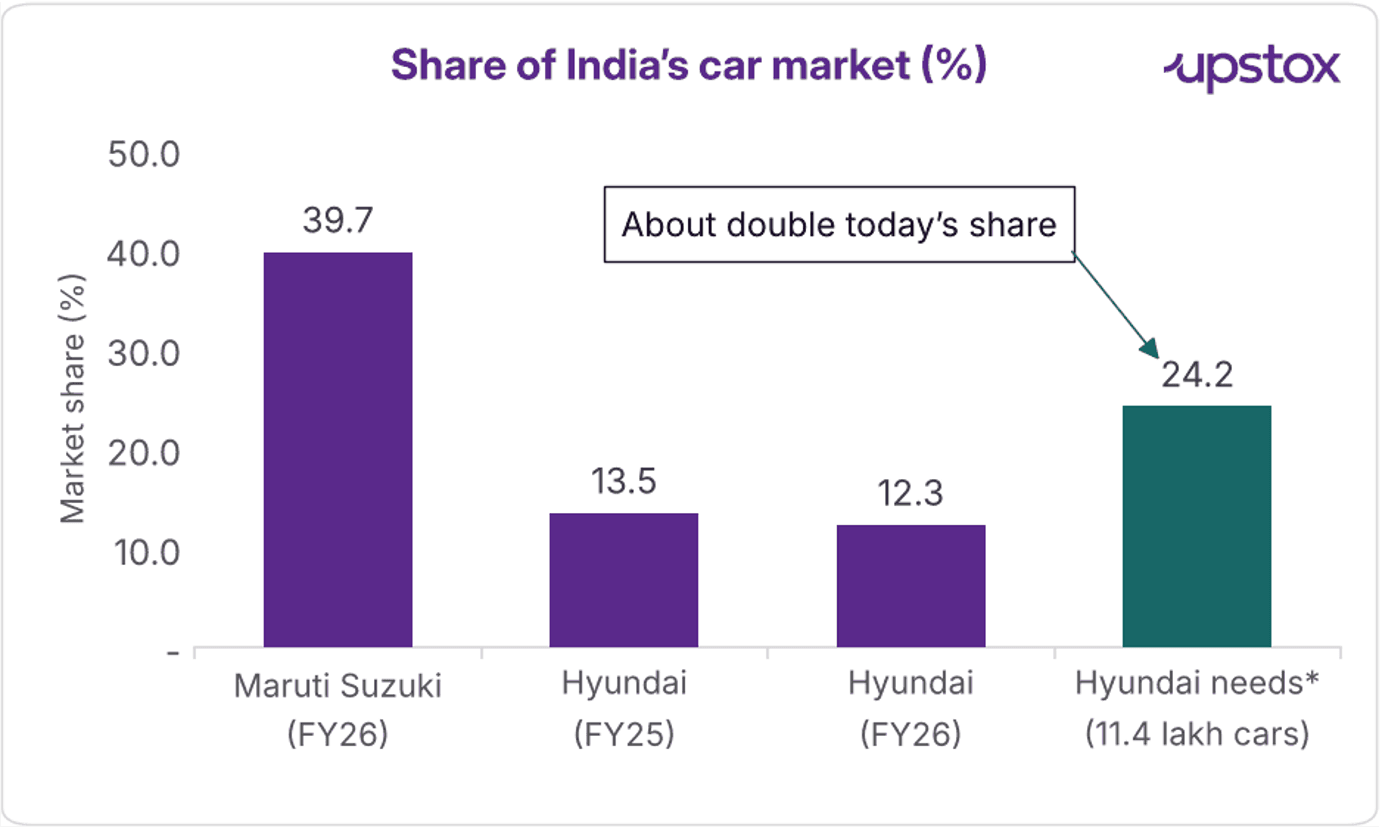
Source: FADA. *Share needed to sell 11.4 lakh cars a year at FY26 market size
Hyundai’s own plan is to export around 30% of what it makes in India by 2030. That works out to about 3.4 lakh cars a year. At its current pace, it exports about 1.8 lakh a year, so exports would need to almost double. HMIL is not there yet. Exports made up about 23% of its sales in H1 FY27, down from about 27% a year earlier. The share is moving the wrong way.
What is holding exports back?
HMIL’s exports lean heavily on the Middle East and Africa, which took about half of its exports in Q2 FY27. When shipping to the Middle East ran into trouble this year, Hyundai’s exports took the hit. H1 FY27 exports fell 7.6% YoY. The recovery has started. October exports jumped 21.1% YoY, and management expects high double-digit growth in exports in H2 FY27. Hyundai is also spreading its bets: Mexico and Latin America together took nearly half of its exports in Q2 FY27.
Can this momentum last long enough to reverse a falling export share? Only time will tell.
Does India have design skills, not just manufacturing skills?
Not all of the $15.5 billion is for factories. About $700 million will go into an R&D centre with a vehicle testing track. Hyundai already designs cars in India. Its local engineering arm helped develop the Creta and the Venue, and a bigger R&D hub is planned by 2028. The real test is whether Indian teams get to lead full car programmes for emerging markets, not just support them.
In summary
In the end, all eyes are once again on Pune. The next car that rolls off the line could end up in a showroom in Delhi or in Mexico City. Where it is sold has a direct bearing on HMIL’s profit. Three things to watch:
- Export share: can it rise from about 23% towards 30%?
- PAT margin: can it recover from 5.8%?
- R&D: is the new hub up and running by 2028?
India has already proved it can build Hyundai cars. The next seven years will show whether it can also design them and sell them to the world.
About The Author
Next Story