
Upstox Originals
India's biggest iron ore miner changed its price 9 times in 2026; 5 things investors should know

5 min read | Updated on November 25, 2026, 10:00 IST

SUMMARY
NMDC has changed its prices nine times since the beginning of the year. Its customers would have had little say in those prices. This may, of course, change with a mineral exchange. But it will depend largely on participation by the larger miners, and whether the government decides to charge miners based on the exchange price.
Stock list
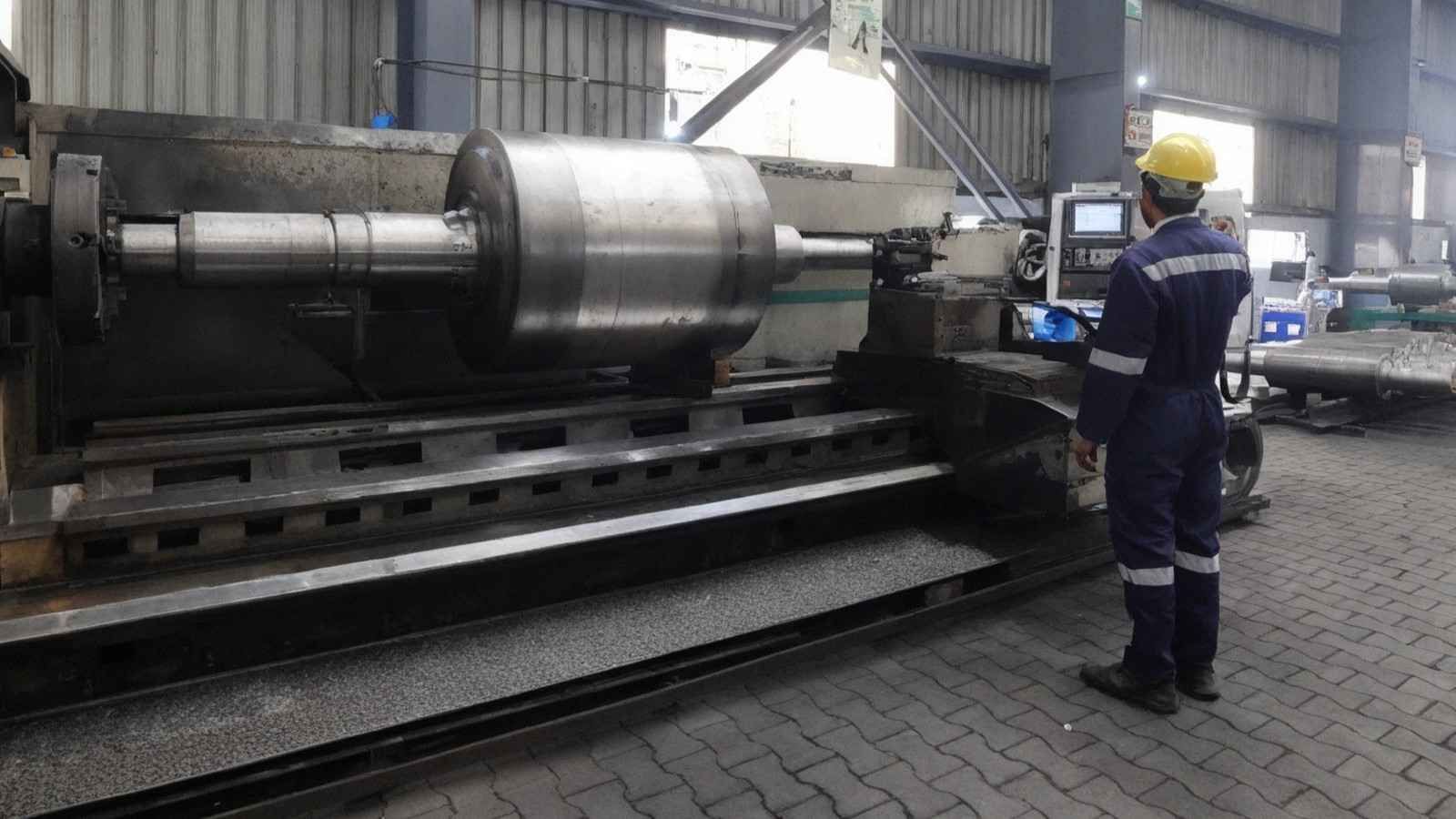
NMDC has changed its prices nine times since the beginning of the year. | Image: Shutterstock
Suppose Ramesh owns a sponge iron unit in Raipur. A big part of his raw material cost is iron ore, and he is told by fellow unit owners, every few weeks, that NMDC has revised its price. After a reset in January, NMDC increased the price of lump ore on five occasions up to June, and reduced it on two occasions before raising it once more in September. And each time, Ramesh would pay the new rate.
####$ With minerals set to trade on an exchange, will sellers still get to decide what ore is worth? Here are five things to know.
1. Who sets mineral prices in India today?
Largely, the producer does. NMDC determines its own sale price, revising it whenever it wants. MOIL announces a price each month for the various grades of manganese ore.
The chart below tracks NMDC's prices. As seen, lump ore went up by almost a quarter from January to June, followed by some reduction. There was no input from the buyer.
A certain quantity of ore is sold by auction. This includes ore auctioned regularly by Odisha's state-run miner and some ore produced by NMDC at its Karnataka mines. Again, each of these is specific to one state. So there isn't really a common benchmark price.
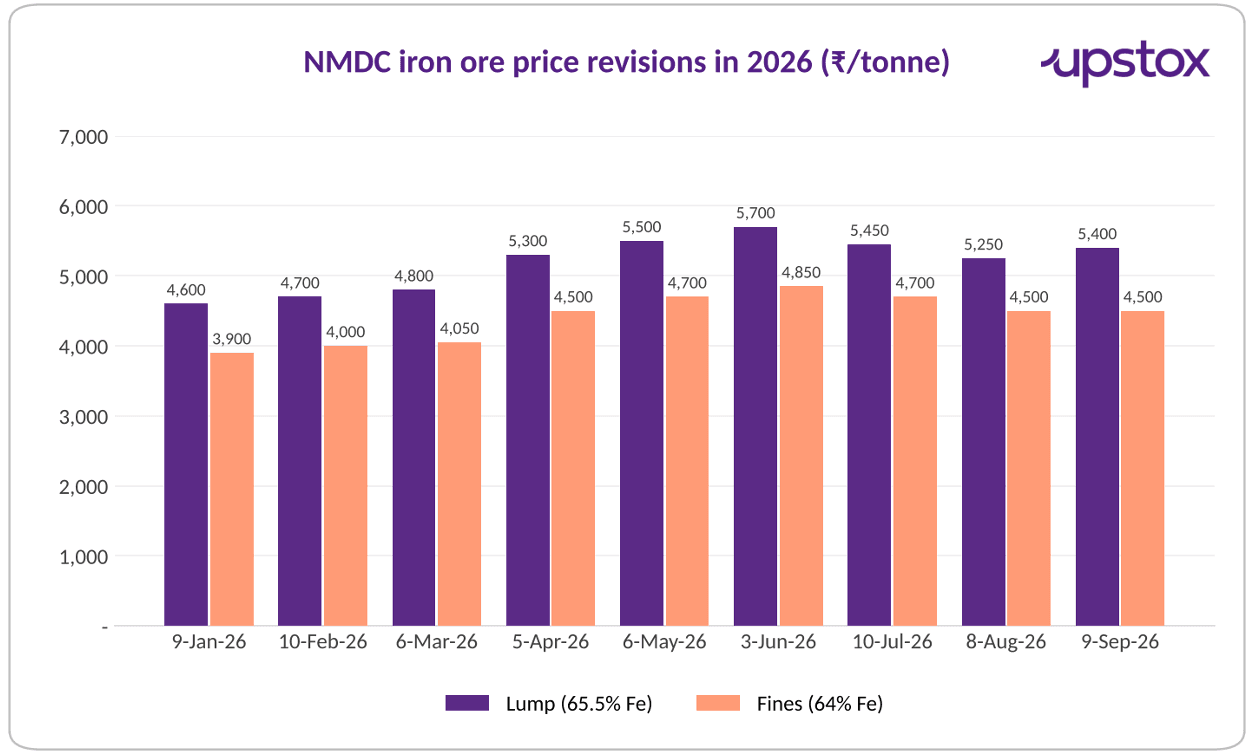
Source: NMDC. Prices are for lump ore (65.5% Fe, 10-40 mm) and fines (64% Fe, below 10 mm), on a free-on-rail basis, excluding royalty, DMF, NMET, cess and taxes. Sample: all nine NMDC price revisions in 2026, from January 9 to September 9; no revision since, as of November 18, 2026.
2. What exactly is being built?
A trading platform with physical delivery. As the name suggests, various minerals can be bid for and delivered, with the quality checked before the deal is finally settled. Initially it is proposed to cover iron ore, manganese ore, chromite, bauxite and limestone.
Regulated by the Indian Bureau of Mines (IBM), the exchange must be able to publish near real-time information about completed trades. Thus there would be a continuously changing price, reflecting completed deals. This would vary depending on the grade of ore and location, given the high cost of rail freight. So there could well be several prices.
3. Will enough ore show up?
This is a major concern. Around a third of the iron ore produced last financial year came from captive mines, run by steel companies for their own plants. Most, if not all, would continue to be consumed by their own steel plants. Surpluses can be sold subject to an additional charge.
They will sell only if the market pays more than using the ore themselves. The relevance of any price would depend upon the volume traded. A few transactions could move prices a lot. While manipulation is banned under the rules, this would be another area for IBM to monitor.
4. Which price will the government use?
That is still unclear. Today, what miners pay the government (at least in the case of iron ore) is calculated from an average price published by IBM, based on what miners declare. This therefore affects not only royalty but also the premium that auction winners pay every month. As seen with the award of an Odisha iron ore mine to Jindal Steel in March, these can be substantial sums. Indeed, in this case the bid was more than the full official value of the ore, before royalty.
It takes about six weeks to work out this price for a month. Nothing in the exchange rules makes clear whether it would be replaced by prices on the exchange. There is also a draft proposal to link it to international prices. So potentially three different prices. Which would apply? Of course, different minerals would be affected differently, as the table below shows.
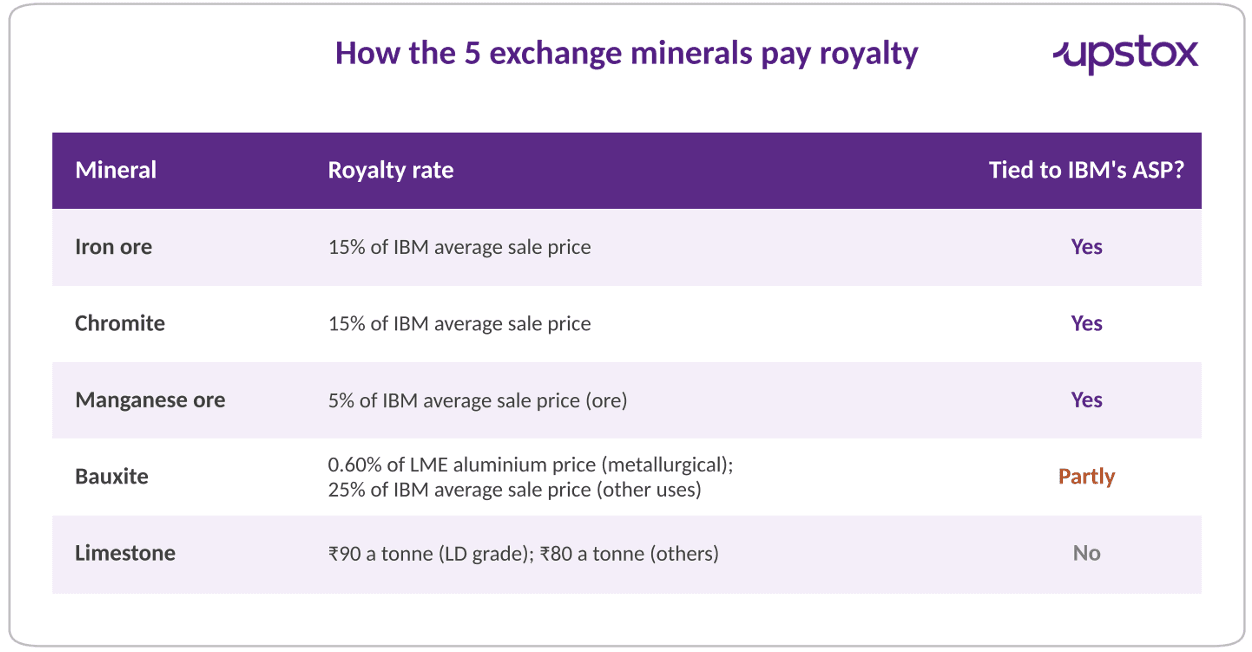
Source: Second Schedule of the MMDR Act, 1957, as published by the Indian Bureau of Mines. Sample: the five minerals allowed on mineral exchanges in IBM's notice of October 1, 2026. LD grade limestone has less than 1.5% silica.
5. Who is betting on it?
Both MCX and PTC India appear keen. MCX has set up a separate company for this and intends to invest up to ₹100 crore. That is modest for MCX, which made a consolidated net profit of ₹455 crore in Q2 FY27 alone. PTC India's board has approved up to ₹65 crore. It has asked for some more time to make its submission.
This would have an impact on NMDC. Most buyers would be expected to benchmark its rates against the exchange, so there could be considerable fluctuation in NMDC's revenue. Even marginal changes would be significant over several million tonnes. Buyers such as Ramesh would be the gainers. It would be even more important for successful bidders in mine auctions, as the official price decides what they pay.
What comes next
December 17, 2026: deadline to file applications (originally November 2) After that: IBM will publish key details of the applications for public comments During FY28: at least one exchange expected to start Six months later: other existing platforms to close down if unregistered Every month: MOIL's prices and the official average price; NMDC revises whenever it wants
In summary
Thus for the time being it will be business as usual for Ramesh. An exchange could at least give him a clear view of prices. But this will depend on the level of trade.
So the applications received, whether the government's charges are linked to the exchange price, and participation by large producers such as NMDC will be the things to watch.
About The Author
Next Story

