
Upstox Originals
Why India’s small-cap companies deserve a closer look

6 min read | Updated on October 27, 2026, 13:04 IST

SUMMARY
India’s small-cap companies have delivered stronger median profit growth over the past decade, helped by greater exposure to domestic sectors and more high-growth businesses. But high valuations, varying company outcomes, and lower liquidity make stock selection critical, rather than relying on broad small-cap outperformance.

Nearly 7 out of 10 multibaggers originated from small caps. |Image: Shutterstock
India’s small caps present an interesting investment opportunity for the long term, supported by multiple factors — greater exposure to domestic growth, emerging sectors, stronger historical earnings growth and a wider pool of high-growth businesses.
Given that nearly 7 out of 10 multibaggers originated from small caps, it is worth examining what makes this segment an important source of wealth-creation opportunities. In this article, we take a closer look at the key factors shaping the small-cap investment opportunity, including their exposure to India's domestic growth, presence in emerging sectors, historical earnings performance, growth potential and current valuations.
Small Caps: more linked to domestic growth story
India’s domestic non-financial economy, spanning manufacturing, healthcare, retail and infrastructure, accounts for 59% of small-cap profits, compared with 32% for large caps. Large-cap earnings have relatively greater exposure to financial services, global commodities and IT.
The sector mix reflects this difference. Small and mid-caps have higher exposure to healthcare, industrials and consumer-focused businesses, while financials, energy, IT and utilities account for 51% of large-cap market value, compared with 30% for small and mid-caps.
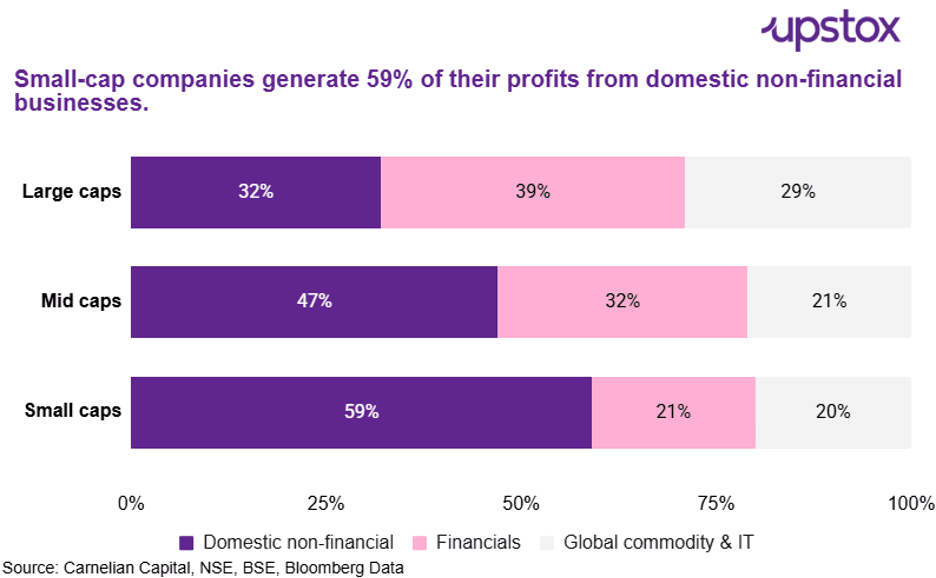
The distinction matters because domestic demand has recently grown faster than some globally exposed businesses. Even within the large-cap universe, revenue growth from domestic businesses was substantially higher than growth from businesses tied more closely to global conditions. Between FY23 and FY26, global-facing businesses within the large-cap universe recorded annual revenue growth of just 1.8%, compared with 12.4% for domestic businesses.
| Large-cap business group | Revenue CAGR, FY23–FY26 |
|---|---|
| Domestic-oriented businesses | 12.4% |
| Globally exposed businesses | 1.8% |
Source: AMFI, Bloomberg, AMC NFO Presentations
Small caps offer greater exposure to emerging sectors
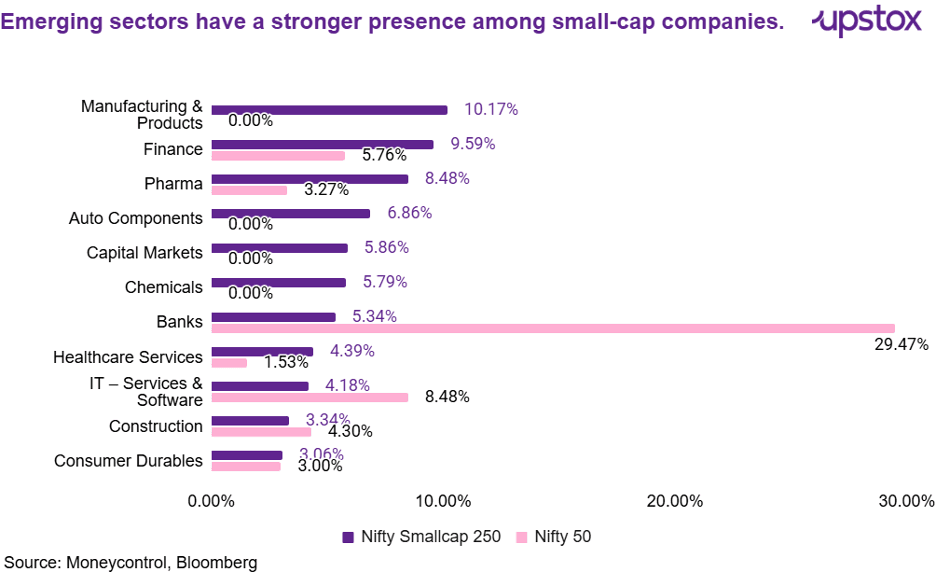
India’s small-cap companies offer greater exposure to growing sectors such as manufacturing, auto components, chemicals and healthcare, which have relatively limited representation in large-cap indices.
For instance, manufacturing and products account for 10.17% of the Nifty Smallcap 250, while auto components and chemicals contribute 6.86% and 5.79%, respectively. In comparison, these sectors have no direct representation in the Nifty 50 under the chart’s classification.
Similarly, pharmaceuticals account for 8.48% of the small-cap index, compared with 3.27% of the Nifty 50. Healthcare services also have a higher share at 4.39%, against 1.53%.
These emerging sectors have also demonstrated strong earnings growth. According to Carnelian Capital, selected small-cap companies operating in emerging themes recorded a median profit CAGR of 33% between FY20 and FY26.
A deeper pool of high-growth businesses
Beyond sector exposure, small caps offer a wider pool of companies delivering strong earnings growth. Between FY16 and FY26, 279 small-cap companies recorded profit growth exceeding 20% annually, compared with 27 mid-caps and 13 large caps. This represented 39% of the small-cap universe, against 23% for mid-caps and 16% for large caps. During the same period, 196 small-cap companies increased their profits tenfold, compared with just 8 large caps.
| Measure | Large | Mid | Small |
|---|---|---|---|
| Companies with PAT CAGR above 20%, FY16-26 | 13 | 27 | 279 |
| Share of the bucket | 16% | 23% | 39% |
| Companies that grew PAT 10x, FY16-26 | 8 | 16 | 196 |
| Companies with PAT CAGR above 20%, FY22-26 | 42 | 48 | 397 |
Source: Economic Times, Moneycontrol, Bloomberg, Carnelian Research
Small-cap valuations: Growth expectations matter
Small-cap valuations have expanded significantly since April 2023, with P/E multiples rising from 18.8x to 32.5x, while large-cap valuations have remained around 21x. This indicates that a meaningful portion of small-cap returns has come from valuation re-rating, making future earnings growth increasingly important.
Consensus estimates project median small-cap profit growth of 26.6% annually over FY26–28, compared with 18.7% for large caps. If these expectations materialise, the valuation gap could narrow considerably on FY28 earnings.
Sector composition also influences valuation comparisons. Large-cap indices have substantial exposure to financials, commodities and IT, which generally trade at lower multiples. In contrast, domestic non-financial large-cap businesses trade at a median of around 42x FY27 estimated earnings.
| Domestic, non-financial businesses | Large | Mid | Small |
|---|---|---|---|
| P/E on FY27E earnings | 33.0x | 35.6x | 30.1x |
| P/E on FY28E earnings | 27.2x | 28.8x | 23.7x |
| Median company P/E, FY27E | 39.9x | 37.8x | 29.1x |
| PAT CAGR, FY26-28E (aggregate) | 16.3% | 19.4% | 21.8% |
| PAT CAGR, FY26-28E (median company) | 19.8% | 22.2% | 26.9% |
| PEG (FY27E P/E ÷ FY26-28E growth) | 2.0 | 1.8 | 1.4 |
Source: Economic Times, Moneycontrol, Bloomberg, Carnelian Research
When comparing businesses within the domestic non-financial economy, small caps offer relatively higher expected earnings growth at lower valuation multiples than comparable large caps. This makes selective small-cap opportunities worth evaluating, although the investment case remains dependent on earnings delivery, valuation discipline and business fundamentals
The other side of small caps: volatility, liquidity and business risk
Small caps also show much wider investment outcomes. Some businesses achieve rapid market-value expansion, while others fall despite a favourable broader industry story. The dispersion makes the quality of research and the ability to tolerate losses unusually important.
A smaller float can make it harder to exit when sentiment deteriorates. Companies with fewer customers, narrower product ranges or weak governance may be more vulnerable to shocks. The problem is not merely price volatility: in some cases business value itself is permanently impaired.
There is also a data limitation. The historical study excludes companies that no longer meet its market-capitalisation threshold. Firms that failed or shrank considerably are under-represented, which can make the apparent small-cap growth record look stronger than a full investable history would show.
A larger opportunity set, but no shortcut
The evidence suggests that smaller listed companies give investors access to more domestic-facing businesses and a wider set of companies with historically strong earnings growth. Yet those characteristics do not remove the risks of valuation, weaker governance, uneven profitability or difficult exits in falling markets.
The more useful approach is to look for companies that can turn demand into sustained earnings and cash flow, then judge whether their share prices already reflect that future. In small caps, the quality of the business and the price paid for it may matter more than the market-cap label.
About The Author
Next Story

