
Upstox Originals
Rising costs, delayed payments - can India’s MSMEs cope?

6 min read | Updated on April 15, 2026, 16:05 IST


SUMMARY
A disruption thousands of kilometres away is tightening the screws on India’s MSMEs. Shipping delays, rising logistics costs, and stalled consignments are stretching business cycles, leaving exporters with cash stuck for longer than usual. In response, the RBI has extended export credit to 450 days, giving businesses more time to manage repayments. Does this really solve the problem?

Shipping costs that once hovered between $200–$300 have now shot up to nearly $3,000. | Image source: Shutterstock
These months, it’s all about freight costs and stalled trade.
And for MSMEs, often called the backbone of India’s economy, this is turning into a working capital crisis. How?
Well, here’s what’s happening:
Shipping costs that once hovered between $200–$300 have now shot up to nearly $3,000. That’s almost 10–15x higher!
Maritime war risk insurance premiums have surged by as much as 1,000%.
Due to this, payment cycles across sectors have stretched from 30–40 days to 90–120 days. That basically means MSMEs are getting their money much later, which is hitting their cash flows and working capital.
Overall, nearly 50% of the export cycle is disrupted.
And many MSMEs don’t have access to formal credit, which makes managing this delay even harder. It’s something we had broken down in one of our articles, Why can't MSMEs escape the credit crunch?
At the same time, growth isn’t strong enough to cushion the blow. HSBC’s flash India PMI slipped to 56.5 in March from 58.9 in February, the lowest since October 2022.
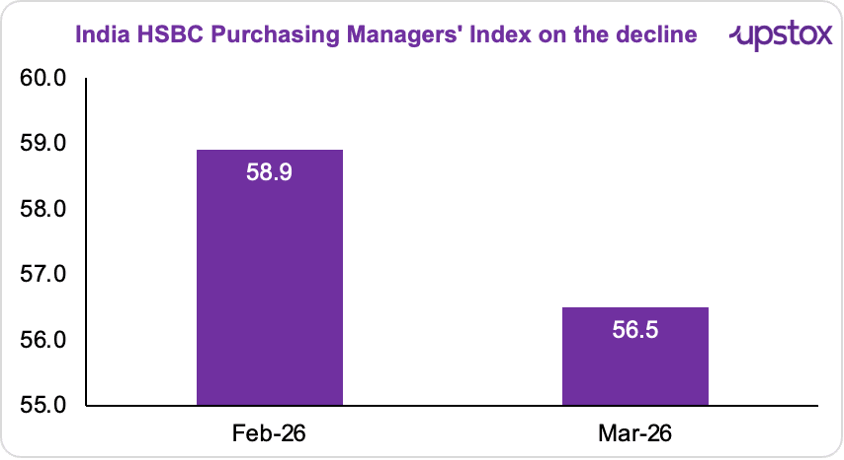
Source: BS
So now, MSMEs are caught in a tough spot.
Costs are rising. Cash is stuck. And growth isn’t picking up fast enough.
So how is this playing out across industries? And this is hitting multiple MSME-heavy sectors, from basmati rice to ceramics to healthcare supplies.
Let’s start with basmati rice
According to DGCIS data, India exported basmati rice worth ₹50,312 crore (about $5.87 billion) in 2024–25. In terms of volume, exports stood at 60.65 lakh metric tonnes (LMT) in 2024–25.
And, 7 out of the top 10 importers are from the Middle East, so even a small disruption in the region can quickly turn into a much bigger problem for exporters.
As per the latest news reports, about 1 lakh tonnes of basmati worth ~₹1,000 crore is now stuck at ports.
On top of that, around 400 basmati containers were damaged in a shipment tied to a Saudi buyer that imports nearly 1.5 lakh tonnes annually from India, due to rising tensions.
The exact losses are still unclear, but exporters are already facing disruptions, and of course, payments are getting delayed too.
In fact, Crisil estimates that basmati exporters may now need 10–15% more working capital debt just to keep operations running.
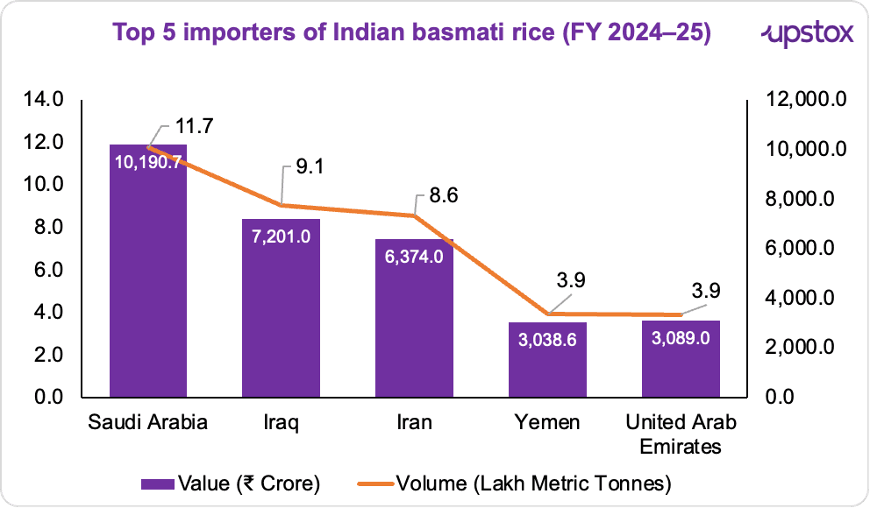
Source: TOI
Now let’s look at ceramics
Head to Morbi in Gujarat, a vibrant industrial hub that produces 80–90% of India’s ceramic tiles. But for the past few weeks, it’s been unusually quiet.
The ₹650 billion ceramics industry depends heavily on a steady gas supply. And that’s where the disruption hit hardest.
Because most tile units here run on propane-LPG imported from the Persian Gulf. With supply routes affected, fuel availability dropped.
At one point, 450 out of 650 units suspended operations. Eventually, over 400 factories shut down for weeks, impacting nearly 400,000 workers. Ofcourse, the impact on cash flow was immediate.
According to a Business Standard report, several shop owners reported daily billing dropping from around ₹3 lakh to just ₹25,000–30,000.
But here’s where it gets more complicated.
To keep operations running, manufacturers tried switching to piped natural gas (PNG).
Except, it came at a cost.
Gujarat Gas quoted prices that were ₹23 per cubic metre higher for these switching users. That meant around ₹88 per cubic metre + 6% GST.
Compare that to what they were paying earlier, about ₹52 per cubic metre for propane-LPG. In some cases, this goes up to nearly ₹93 including GST. At those prices, production simply isn’t viable.
Morbi typically ships about one-fourth of its 30,000 monthly containers to the Middle East. Right now, those shipments have come to a complete halt.
And it’s not limited to just a few sectors
And it’s not just one sector feeling the heat. The impact is spreading across industries. In plastics, raw material costs have jumped 45%, while production has fallen 40%, putting nearly 30% of its 5 million workforce at risk. Healthcare supplies aren’t spared either, with costs rising anywhere between 10% and 50%.
Oh, and then there’s the granite industry. In Jalore, a key hub, nearly 50% of factories have shut down, with only 600 out of 1,032 units still running. Production has dropped from 13 lakh sq ft/day to just 4.55 lakh, and with work drying up, about 10% of workers are migrating daily.
What’s being done about it?
The response has been swift and targeted.
-
RBI move (export credit relief): Announced on March 31, exporters now get more time, up to 450 days, to repay export loans (till June 30, 2026). Also, they now have up to 15 months to get paid by foreign buyers, instead of the earlier 9 months. It's an extension of a November 2025 measure, now stretched as disruptions continue.
-
RELIEF scheme (March 19, 2026): A government-backed insurance and cost-support scheme to help exporters manage rising risks and expenses. It covers past shipments (Feb 14–March 15) with up to 100% additional risk coverage for those with ECGC insurance, and upcoming shipments (March 16–June 15) with up to 95% coverage, but only if exporters take ECGC insurance. MSMEs without insurance get limited support, with up to 50% reimbursement (₹50 lakh cap) for past shipments. The scheme has an outlay of ₹497 crore.
Do these measures fully ease pressure on exporters?
These measures offer valuable short-term liquidity and cost relief.
However, the challenges here go far beyond routine day-to-day business hurdles that most firms manage with predictable buffers:
-
Irreversible quality and relationship damage: As per the latest RBI move to extend timelines, exporters now get more time to repay loans and receive payments. But what about perishable and time-sensitive goods? If ships are delayed or stuck, items like seafood, fresh produce, or even pharma products can lose quality or become unusable. Buyers may reject them or ask for discounts; and in some cases, may not return at all. Seafood exporters alone expect losses of ~₹1,500 crore.
-
Compounding costs on razor-thin margins with zero buffer: MSMEs operate on 5-10% margins and hold almost no cash reserves or hedging tools. While payments are delayed, interest keeps accruing, and freight and insurance costs (in some cases up sharply) continue to rise. More time helps, but doesn’t recover lost revenue.
-
Limited coverage and temporary nature: The RELIEF scheme is time-bound (till June 15) and applies only to specific shipment windows. Also, a large part of the support is linked to ECGC insurance, so exporters without it get only partial relief. If disruptions continue beyond these timelines, the same pressures could return.
Way forward
The immediate fixes are in place. Along with RBI’s credit support, they buy time and ease short-term pressure.
But, the real issue isn’t just higher costs or delays, it’s how quickly cash flows break. And that means the solution can’t just be temporary relief.
It has to be about helping MSMEs access cash faster and handle shocks better, because the challenge isn’t avoiding disruptions, it’s surviving them.
About The Author
Next Story

