
Upstox Originals
India is ordering more – just not spending more each time

5 min read | Updated on October 23, 2026, 14:50 IST

SUMMARY
Indians are placing more festive orders, but each basket is getting smaller. Smaller cities are driving more of that volume, while smartphones, once the engine of festive spending, are losing momentum as higher prices squeeze affordability.

Mobile is still the biggest festive category. | Image: Shutterstock
Festive shopping often starts weeks before the sale itself. You spot a phone, appliance or pair of shoes you want, look at the price and think: might as well wait a few weeks -- the discounts are coming. The purpose of discounts ideally is to get people to shop more. However, while Indians are buying more things – they seem to be spending lesser.
According to Unicommerce, e-commerce order volumes rose 31% YoY in the first week of the 2026 festive sales, while average order value fell 10%. Yet gross merchandise value (GMV), or the total value of goods sold, still increased 17%. Business Standard
That may sound contradictory, but it isn’t. GMV depends on both how many orders are placed and how much each order is worth. So if orders rise fast enough, total GMV can still grow even while the average basket gets smaller.
So, the interesting question this year is not whether festive e-commerce will grow. It is what happens when that growth comes from more orders rather than bigger baskets.
More orders, not bigger baskets
The festive sale is no longer just a big-city event. A growing share of shoppers clicking into India’s largest e-commerce platforms are coming from smaller towns and cities. Non-metro India’s role in festive e-commerce
Source: Amazon India, Flipkart, news articles.
That wider reach is helping push volumes higher. Unicommerce says Tier-III towns alone accounted for 42% of e-commerce orders during the first week of festive sales.
But here is where it gets interesting. A broader EasyEcom study of 209 million orders found that markets outside India’s 96 largest cities generated 57.2% of orders, but only 39.3% of total order value. Their average order value was also less than half that of the 96 largest cities.
In other words, smaller cities are bringing plenty of new transactions into Indian e-commerce, but those transactions tend to be worth less.
That helps explain how order volumes can surge without the same increase in value. But geography is only part of the story. What Indians are buying is changing too.
What Indians are buying is changing
For years, festive e-commerce had a familiar hero product: the smartphone. That grip is starting to loosen. Mobile is still the biggest festive category, but it is expected to add only around ₹2,500 crore to GMV in 2026, even as the overall market adds roughly ₹30,200 crore.
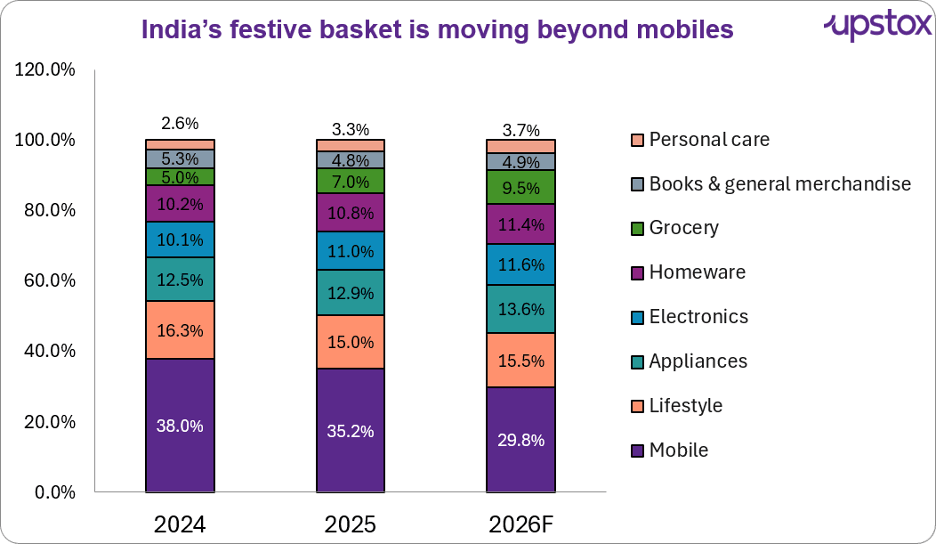
Source: Datum Intelligence
The shift matters because a phone can mean one large checkout, while grocery, beauty and household purchases create smaller but more frequent orders.
There is also an affordability angle. Counterpoint Research says smartphone prices rose 16% on average in H1 2026, while shipments below ₹10,000 fell 65% YoY and the ₹10,000–₹15,000 segment fell 20%.
That does not necessarily mean pricing power has disappeared. Prices are still rising. But it does suggest consumers are becoming less willing to absorb those increases. So the smaller festive basket appears to be coming from two forces at once: a shift towards lower-ticket categories, and greater resistance to higher prices in big-ticket ones.
The economics of a volume-led boom
And once baskets get smaller, the economics change too. Every extra order still has to be picked, packed, and delivered. When each order is worth less, platforms need more of them to generate the same sales value.
The festive build-up shows how much extra capacity that can require:
-
14 million cu ft additional warehousing capacity added by Ekart ahead of the festive season, taking its overall storage capacity up around 50%.
-
900+ additional Ekart delivery hubs added to handle festive demand.
-
1.6 lakh+ seasonal work opportunities created by Amazon across its operations network.
-
47% vs 41%: quick-commerce orders per day grew 47% YoY in August, faster than the - 41% rise in GMV, another example of volume running ahead of value.
None of this means more orders are bad. It means the cost of handling them matters more.
If platforms can process this additional volume without fulfilment costs rising at the same pace, smaller baskets can still produce attractive growth. If they cannot, booming order counts may look much better on paper than they do in the P&L.
What it means for investors and industry
India’s festive e-commerce story is still one of growth. But the character of that growth is changing.
That shifts the question from “How fast is GMV growing?” to “How efficiently is that growth being generated?”
For platforms, fulfilment costs and order economics matter more. For brands, pricing power cannot be taken for granted, particularly in discretionary categories where consumers are showing greater resistance to higher prices.
The festive boom is not disappearing. It is becoming a different kind of boom, one built on more shoppers, more transactions and smaller baskets.
And the real winners may not be the companies generating the most orders, but the ones that can turn those orders into profitable growth.
About The Author
Next Story

