
Upstox Originals
Women driving a change in India’s car market
.png)
6 min read | Updated on July 17, 2025, 14:31 IST


SUMMARY
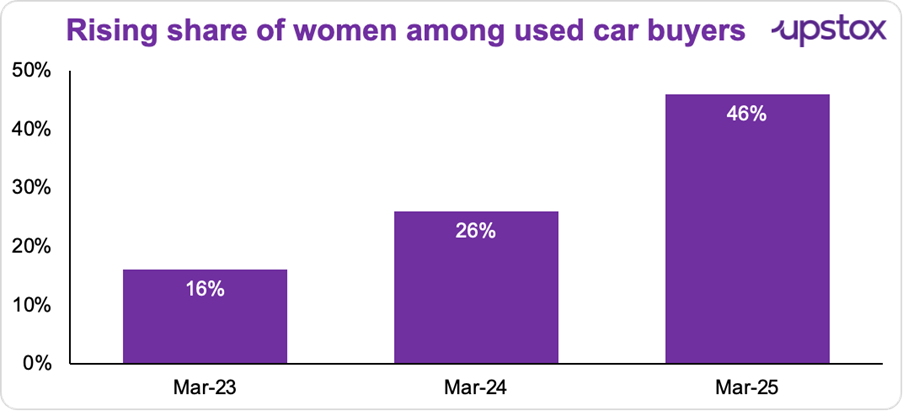
More women in India are getting behind the wheel, and the numbers prove it. Used car purchases by women have jumped from 26% in March 2024 to 46% in March 2025. But it’s not just about buying cars. Companies like Tata Motors, MG Motor India, and Hyundai are taking note and creating more inclusive spaces. This steady shift is shaping the future of mobility to reflect India’s true driving force.

. Used car purchases by women have jumped from 26% in March 2024 to 46% in March 2025
India's automobile market has seen its fair share of twists and turns. After enjoying a strong run, the industry faced a slowdown during the pandemic years but has since made a steady comeback. While the current pace is slightly more measured, one trend is truly gaining speed: women are no longer just in the passenger seat.
They are emerging as a growing force in the auto sector – not only as leaders within companies but also as confident car buyers shaping market demand. This shift is creating new opportunities and changing how the industry thinks about its consumers.
Surge in women car buyers
Women in India are confidently taking the wheel – both on the road and in the auto market. Platforms like Spinny have seen a sharp rise in women buying not just new cars but used ones too, signalling a clear shift in preferences.
Source- Media Brief
What’s driving women’s car choices?
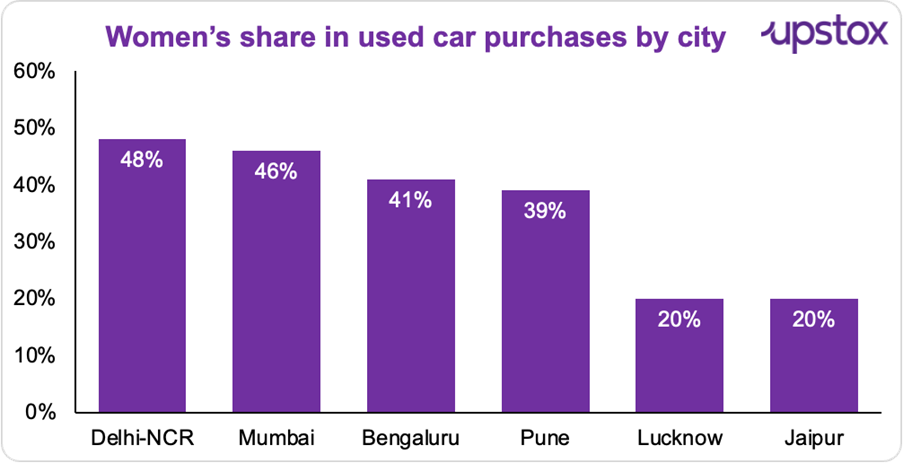
So, where are women buying these cars the most? Delhi-NCR tops the list, followed by Mumbai, Bengaluru, and Pune. Interestingly, it’s not just metros - cities like Lucknow and Jaipur are seeing more women buyers too. Around 60% of women prefer automatic hatchbacks for their simplicity and ease, while 18% go for compact SUVs for added versatility and road presence. Popular choices include the Renault Kwid, Hyundai Grand i10, and Maruti Suzuki Swift.
With this growing trend, brands are adding features like better safety tech, intuitive controls, and ergonomic designs, while even advertisements are shifting from macho tones to stories celebrating women’s independence and confidence on the road.
Source- MediaBrief
The average age of female car buyers ranges between 30 and 40 years, highlighting how young professionals are prioritising personal mobility and independence in their daily lives.
Increasing gender inclusion across companies
Auto companies are opening more doors for women – not just to work, but to lead. How? By backing their growth and placing them in key roles where their expertise drives real decisions.
-
Tata Motors: Tata Motors is driving change by empowering over 1,700 women—many from rural Maharashtra—to lead production lines for the Harrier and Safari, which are assembled entirely by women at the Pune plant, marking an industry first. Women now make up around 15% of all automobile buyers, a figure that’s growing rapidly. In 2022, Tata Motors also launched an all-women dealership, strengthening its commitment to inclusivity for both employees and customers.
-
MG Motor India: MG Motor India’s ‘Drive Her Back’ initiative supports experienced women in re-entering the workforce, with over 60 women hired and 2,000+ applications received. Women now make up 35% of MG’s workforce, including 20% in senior positions. They work across departments like Legal, Sales, Engineering, and Manufacturing. The company also produced its 50,000th MG Hector with an all-women crew at its Halol plant. MG aims to reach 50% women in its workforce, focusing on long-term inclusion.
-
Hyundai Motor India: Hyundai’s ‘Drive4Progress’ initiative has trained and employed 250 women drivers in Delhi-NCR through partnerships with Navjyoti NGO and BluSmart. With 30% female participation, it offers driver training, soft skills, licensing, and job placement – creating real economic opportunities and signalling Hyundai’s commitment to reshaping the mobility workforce.
These initiatives by Tata Motors, MG Motor India, and Hyundai show that women are not just participating but leading the change in India’s automotive industry
Empowering women entrepreneurs in India’s automotive services
Mahindra WE Hunnar Project (July 2024)
Mahindra launched the Women Entrepreneurs (WE) Hunnar Project in July 2024, aimed at skilling women in driving 3W/4W vehicles, customer care, and EV repair and maintenance. The initiative focuses on empowering women to become self-reliant and enter the mobility sector, addressing the industry's need for skilled professionals.
Zitrix Car Services – Women-Led Tech-Driven Mobility
Founded by a woman entrepreneur, Zitrix Car Services is a technology-driven automotive mobility platform that offers services such as vehicle maintenance, fleet management, and roadside assistance. The company leverages technology to provide efficient and customer-centric solutions in the automotive services industry.
Anu Lall – Managing Director, Classic Kia
Anu Lall serves as the Managing Director of Classic Kia, a prominent automobile dealership in India. Under her leadership, the company has expanded its operations and strengthened its presence in the automotive retail sector, demonstrating the increasing involvement of women in leadership roles within the industry.
Women-Led startups
In 2024, women-led startups in India raised over $930 million across 136 deals, marking a 93.75% increase from the previous year. While the majority of these ventures were in sectors like fintech and e-commerce, the automotive sector saw a growing number of women entrepreneurs launching startups focused on electric vehicle services, auto repair, and mobility solutions.
Women shaping the future of India’s auto sector
As India’s auto sector shifts gears, women aren’t just along for the ride – they’re driving the change. Their growing presence is a shift the industry can’t ignore.
-
Women currently make up between 11-15% of India’s EV workforce, with projections suggesting this could rise to 50% by 2030-33.
-
There has been a noticeable increase in women securing mid-level managerial roles between 2022-23 and 2023-24.
-
In campus hiring for 2023, fresh talent from colleges accounted for 20-25% of design domain recruits, with 30% being women in fields like design engineering, development, and CADD.
-
At the leadership level, women now represent 12-15% of directors and C-suite executives in the automotive sector.
With every milestone crossed, women are reshaping the very fabric of India’s automotive industry. The road ahead looks promising, but the journey towards true inclusion is only just beginning.
Final thoughts
As India’s auto industry evolves, the rising presence of women signals a powerful cultural and economic shift. No longer limited to traditional roles, they’re now influencing buying trends, design choices, and leading on the factory floor. With companies like Tata Motors, MG Motor India, and Hyundai championing inclusion, the question isn’t whether the sector is ready for change — it’s how fast it can accelerate toward a more diverse future.
About The Author
Next Story



