
Upstox Originals
Can India's first blue bond open new doors for the maritime sector?

7 min read | Updated on June 16, 2026, 14:25 IST


SUMMARY
What if building ports wasn’t the hardest part—but paying for them was? India’s first blue bond hopes to solve this problem, bringing long-term money into a sector defined by volatility and massive funding needs. Globally, these bonds have funded everything from reef protection to debt swaps; in India, they could back ships, ports and strategic trade hubs. But the real test isn’t ambition—it’s execution.

Sagarmala Finance Corporation has announced plans to issue India's first blue bond, targeting up to ₹1,000 crores. | Image: Shutterstock
Building a maritime powerhouse sounds great on paper. Funding it is a different story altogether.
Which is why India is trying something new, with the launch of the first-ever blue bond. So, what are blue bonds? They work much like green bonds, except the money is earmarked for oceans, seas, coasts, rivers and other water-based ecosystems.
And that's exactly what Sagarmala Finance Corporation, India’s first government backed maritime NBFC, is looking to tap into. Fresh off receiving its NBFC licence in June 2025, the company recently announced plans to issue India's first blue bond, targeting up to ₹1,000 crores.
As per the government, India has nearly ₹89 lakh crore worth of maritime investments to make by 2047. This bond issuance is a step in that direction.
For context, the world’s first sovereign blue bond were launched only in 2018. Yet, global issuances have already crossed $15 billion, according to World Bank data.
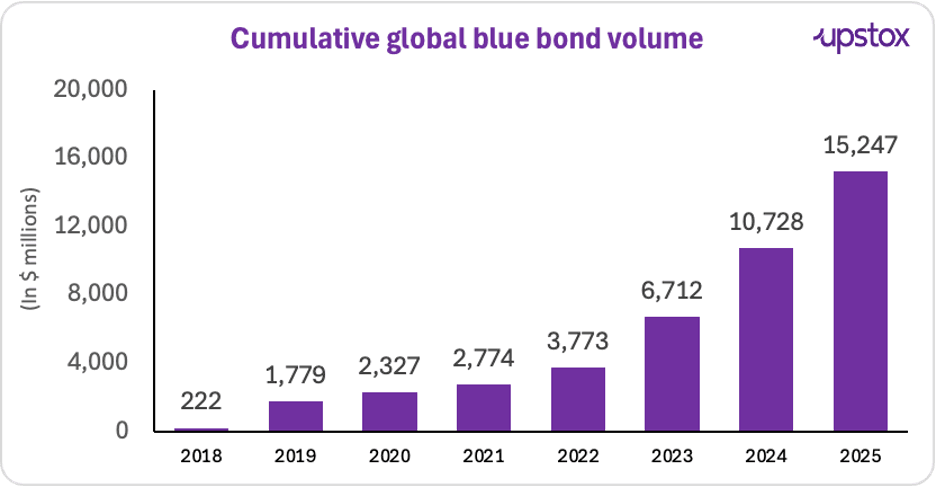
Source: World Bank based on Environmental Finance Data. Note: Data as of 15 June 2025.
This isn't a new idea, so what have other countries actually done with it?
The Seychelles planted the flag first. In 2018, the tiny island nation issued the world's first sovereign blue bond, a modest $15 million, backed by World Bank guarantees, to create marine protected areas covering 30% of its ocean territory. Did it help? Yes. Marine protection coverage expanded from 5 million hectares to about 22 million. Fisheries monitoring improved. Access to domestic finance for the fisheries sector widened.
Since then, over 100 blue bonds have been issued globally, with a few showcased in the table below:
| Country / Issuer | Year | Amount | Notes |
|---|---|---|---|
| Bank of China | 2020 | ~$940M | Asia's first blue bond; dual-currency (USD + offshore RMB); sustainable blue economy |
| Belize | 2021 | $364M | Debt reduced 12% of GDP; $180M conservation over 20 years |
| Barbados | 2022 | ~$150M | IDB + TNC guaranteed; savings to marine conservation fund |
| Bahamas | 2022 | $385M | Dual-tranche; oversubscribed; blue economy reforms conditional |
| Ecuador | 2023 | $656M | World's largest swap; $1.6B debt bought back; Galápagos conservation |
| Indonesia | 2023–24 | ~$1.1B+ | First publicly offered ICMA-aligned sovereign blue bond |
| Fiji | 2023 | ~$8.7M | 3x oversubscribed |
Source: ESG News, Reuters
What happens if India joins the blue bond club? A funding fix? Shipping moves 80% of world trade. But you see, one year, freight rates are through the roof. The next, they've collapsed. Wars, trade disputes, commodity cycles, new regulations; all of it moves the needle, often without warning.
The Baltic Dry Index (BDI), the industry's go-to health check, captures this volatility perfectly. Over the past 15 years, it has swung from a low of 290 to a high of 5,650. And if you need a recent example, during the Middle East tensions, it touched nearly 3,200 in June 2026.
So it's hardly surprising that long-term financing is difficult to secure. By 2047, Shipping alone is estimated to require $388 billion to improve India’s ship tonnage. Blue bonds could help by bringing in patient capital that's better suited to funding ships, ports and maritime infrastructure.
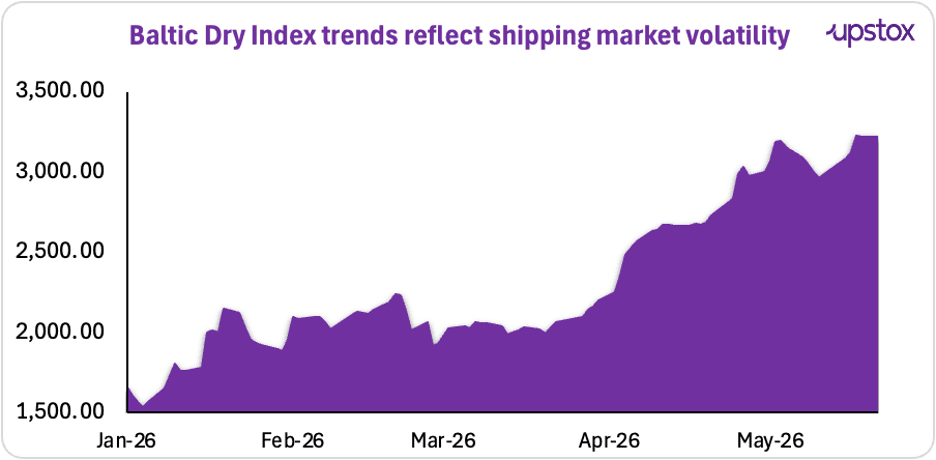
Source: Trading View *Data as on 1 June, 2026
The tenure advantage?
Sagarmala Finance Corporation, India's first maritime-focused government-backed NBFC, plays a key role in financing the country's maritime ambitions. But while its borrowings have an average tenor of 3.5 years, the loans it extends run for around 12 years.
That creates an asset-liability mismatch. A longer-tenor blue bond could help bridge this gap by better aligning its funding with the long-term nature of maritime infrastructure projects while attracting ESG-focused investors.
A strategic advantage?
Building world-class ports, logistics hubs and coastal infrastructure requires enormous amounts of capital. And while government spending will do much of the heavy lifting, blue bonds could provide a complementary source of long-term funding.
How? Well, take the Andaman and Nicobar Islands. They sit close to the Strait of Malacca, one of the world's busiest shipping corridors. More than 90,000 vessels pass through it every year, carrying roughly 30% of global trade. And here's the interesting part: some Southeast Asian ports are less than 50 km away.
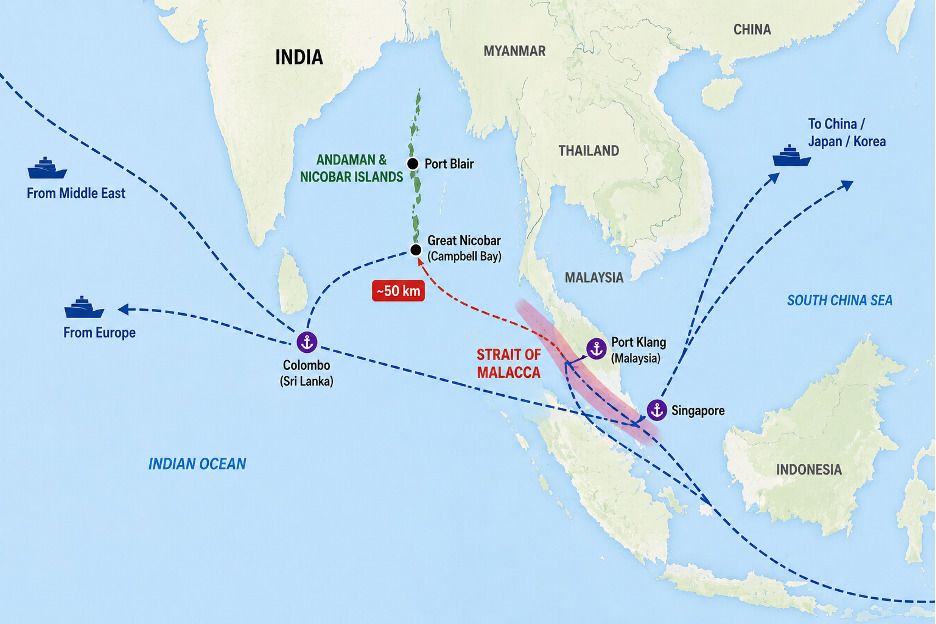
Source: Author’s creation
So what does that mean? With better ports, warehousing, bunkering and transshipment facilities, India could capture a larger share of regional trade while reducing its dependence on hubs like Singapore, Colombo and Port Klang.
Oh, and it's not just about trade. More than 23 million barrels of oil per day passed through the Strait of Malacca in the first half of 2025, accounting for nearly 29% of global seaborne oil trade.
And that's where blue bonds could help by mobilising the long-term capital needed to unlock these opportunities.
A win-win for conservation?
Blue bonds could also help channel capital towards marine conservation efforts that often struggle to attract long-term funding.
Take India's coral reefs. Long-term surveys in Lakshadweep show live coral cover has nearly halved, falling from 37.2% to 19.6% over recent decades due to climate change and human interference.
In some cases, they can be structured as debt-for-nature swaps, allowing countries to reduce debt obligations while committing funds towards long-term conservation. When conservation meets capital markets, what are the pitfalls India should watch for?
The best blue bond stories have typically combined a clear framework, strong backing and investor confidence. Seychelles had all three when it launched the world's first sovereign blue bond in 2018 to protect 30% of its ocean territory, backed by World Bank guarantees.
But was it all smooth sailing? Not quite. Structuring costs were high, stakeholder coordination was complex, and getting the deal off the ground took considerable effort. There's the market backdrop. India's benchmark 10-year bond yield has risen above 7% since the start of the US-Iran conflict, making debt issuances more challenging. Launch into a volatile market and borrowing costs could quickly rise.
So what's worth watching? Timing. Because even a promising idea can become a lot more expensive if the market isn't on your side.
What does this all mean for investors?
India's first blue bond could give investors a new way to participate in the country's maritime growth story.
Now, while the proposed ₹1,000 crore issuance by Sagarmala Finance Corporation is expected to hit the market by the end of this fiscal year, key details such as the coupon rate and tenor are still under wraps. According to the management, the timing will largely depend on market conditions and interest-rate stability.
So how can investors invest? Well, that depends on how the bond is eventually issued. If it comes as a public issue and is listed on exchanges, retail investors could potentially subscribe through their demat accounts or purchase the bonds later in the secondary market. If it's issued through a private placement route, participation may initially be limited to institutional investors such as mutual funds, insurers and pension funds.
And, India is estimated to require $885–940 billion in maritime investments by 2047 across ports, shipping, logistics and coastal infrastructure. So if the first issue is successful, it could open the door to a much larger blue bond market in the years ahead.
Of course, that's still a big "if". The success of the inaugural issuance will depend on pricing, investor demand and execution. But every new asset class starts somewhere. And India's first blue bond could be the first step towards giving investors a dedicated way to tap into the country's maritime ambitions.
About The Author
Next Story

