
Upstox Originals
Will AI deflation wipe out $10 billion from India’s IT industry?

5 min read | Updated on May 25, 2026, 14:49 IST


SUMMARY
AI was supposed to make IT companies more efficient. But what if that very efficiency starts hurting the industry itself? That’s the fear now haunting India’s IT giants. “AI deflation,” a trend that could potentially shave nearly $10 billion off annual revenues. Early signs are already visible in valuations, hiring trends, and shrinking deal sizes. So, what does this mean for Indian IT giants?
AI could push IT service prices down by 3.5% every year through FY2027–28. | Image: Shutterstock
A $100 million outsourcing deal earlier may now be worth only $80 million today. That's the new math for Indian IT firms, according to HCLTech's CEO. As companies use AI to deliver projects faster and with fewer people, clients are increasingly pushing for lower prices. The industry has a term for this trend: AI deflation.
Is this just a theory? Hardly. Reports from Kotak Mahindra Bank, HCLTech, and industry analysts estimate AI could push IT service prices down by 3.5% every year through FY2027–28. That's nearly $10 billion in lost revenue annually.
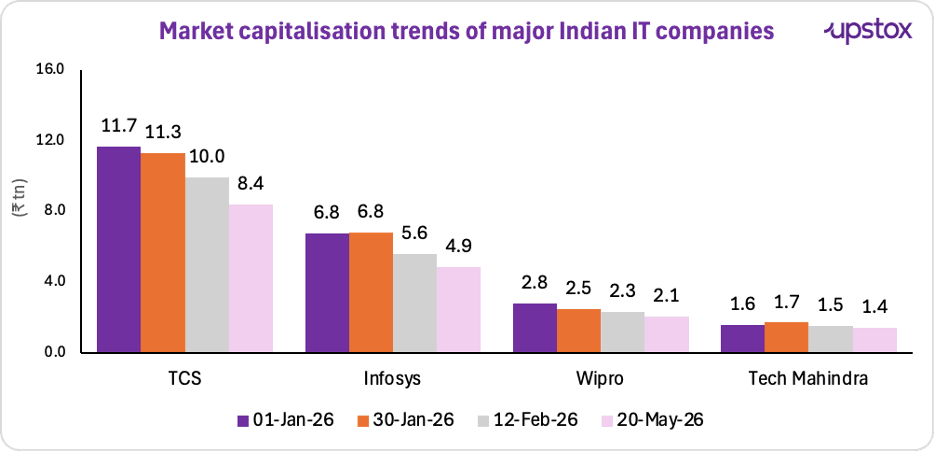
So, is the market already reacting to these fears? Well, yes. Since January, India's top IT stocks have lost over ₹6 trillion in value. The Nifty IT Index has dropped 26%, hitting its lowest point since 2023. The sector's weight in the Nifty? It collapsed from over 17% in early 2022 to just 8% now.
Source: Mint
AI deflation, explained simply
AI deflation simply means AI is making IT services cheaper to deliver, and naturally, clients now want a share of those savings.
So, a project that earlier required 100 engineers may now need only 70 because AI tools can automate coding, testing, debugging, and documentation much faster. But, haven’t we seen this before? Or is this something different?
To be fair, technology reducing costs is not new.
The Industrial Revolution mechanised production and made goods cheaper. The IT boom of the 1990s and 2000s lowered costs across industries. And every single time, the fear was the same: jobs will disappear.
History is full of examples. In the 1600s, Dutch shipbuilding dramatically reduced the cost of global trade. In the mid-1800s, Cyrus McCormick’s mechanical reaper cut grain harvesting costs by nearly 90%.
And despite the fears, new industries eventually emerged. But AI may be different. Previous disruptions took decades to unfold, AI is reshaping entire job categories in months.
So now, is the impact visible on Indian IT giants?
Valuations under pressure
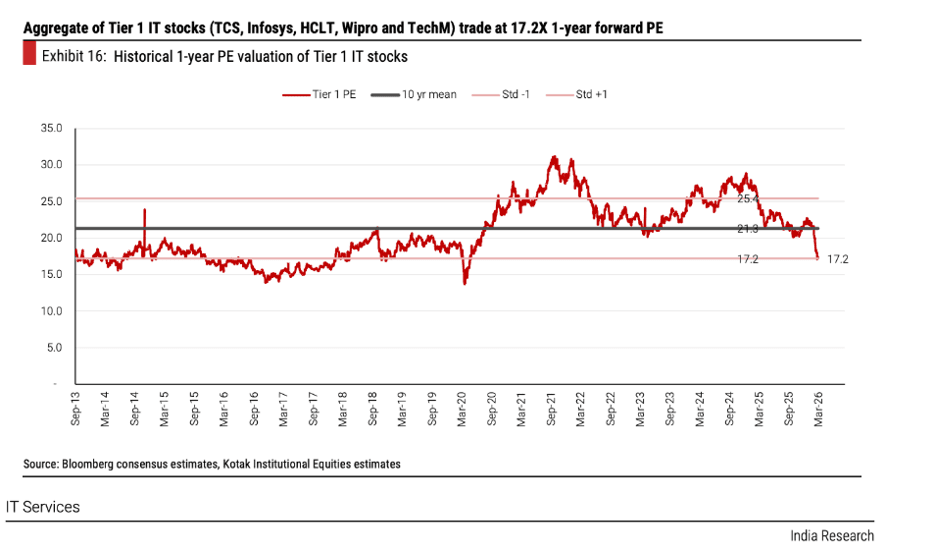
Indian IT valuations are now approaching levels last seen during periods of deep stress.
As the chart below shows, as of March 2026, Tier-1 IT stocks were trading near 17.2x one-year forward PE, signalling that investors are sharply lowering growth expectations for Indian IT companies amid fears.
Interestingly, this is close to the valuation levels seen during the COVID-19 period, highlighting how sharply investor expectations for Indian IT growth have reset
Source: Kotak Research
Deals? Shrinking.
Executives at Infosys and HCLTech revealed that they had walked away from certain AI-led contracts because pricing had become too aggressive and the economics no longer made sense.
Clients are also increasingly preferring shorter-duration contracts, signalling caution around long-term spending.
In Q4 FY26, Wipro reported total bookings of $3.5 billion, down 13.9% YoY, while its large deal TCV fell 18.5% to $1.4 billion. During the same quarter, Infosys saw TCV decline 33% to $3.2 billion, while HCLTech reported a 35% drop to $1.93 billion.
But here’s the twist: what if the number of contracts actually goes up?
Sure, AI is shrinking deal sizes. But if software becomes dramatically cheaper and faster to build, companies may start undertaking far more projects than before. In that case, Indian IT firms may not face a demand problem at all, the business model could simply shift from a few giant contracts to a much larger number of smaller, faster-moving ones.
Hiring growth stalls
With just 17 net hires in the first nine months of FY26, India’s top five IT companies have almost completely slammed the brakes on hiring, highlighting how AI-led delivery models are making the industry far leaner than before.
| Company | Net Addition (Q1+Q2+Q3) FY25 | Net Addition (Q1+Q2+Q3) FY26 |
|---|---|---|
| TCS | 5,080 | -25,816 |
| Infosys | 6,139 | 13,456 |
| HCLTech | 1,354 | 1,885 |
| Wipro | 158 | 9,740 |
| Tech Mahindra | 5,033 | 752 |
| Total | 17,764 | 17 |
Source: BS
But doesn’t that expand margins? At first glance, collapsing headcounts should expand operating margins for IT companies.
Well, not necessarily.
Traditional software delivery required relatively low capital expenditure. But AI delivery is far more infrastructure-intensive. Companies now have to spend heavily on SaaS licensing fees, cloud compute infrastructure, GPU-heavy workloads, and recurring payments to foundational model providers like Microsoft, OpenAI, and Amazon Web Services.
Now, what can offset this?
One option is moving toward outcome-based pricing instead of billing clients purely by the hour. Another is building more AI-led platforms and IP-driven offerings that can generate better margins than traditional outsourcing.
AI can also help firms improve internal productivity and keep costs under control. But if projects start requiring fewer engineers and less time, clients will naturally expect part of those efficiency gains too.
And that is what makes this transition challenging. Indian IT companies are simultaneously trying to protect margins, adapt their business models, and invest for the next phase of growth, all while the industry itself is evolving rapidly.
About The Author
Next Story

