
Upstox Originals
Why is the RBI bringing India’s gold back home?

6 min read | Updated on May 29, 2026, 14:22 IST


SUMMARY
With gold prices hovering near record highs, many investors are wondering whether the metal has become too expensive to buy. But while retail buyers have turned cautious, the RBI has been bringing a growing share of India’s gold reserves back home from the Bank of England and other overseas vaults. So, why is this happening? What explains this shift? Does it signal any deeper concerns?

Back in March 2023, only 38% of gold was stored within India and today it is around 77%. | Image: Shutterstock
You know that feeling when your gold is sitting in a bank locker two cities away, and you think, "what if I actually need it someday?" So you move it to a locker closer home, where you can walk in and grab it anytime.
Turns out, the RBI has been thinking exactly the same way. For decades, a big chunk of India's gold sat in vaults in London. Now, the central bank has been quietly accelerating gold repatriation, bringing it home bit by bit.
In the 2nd half of FY26 alone, the RBI flew back 104 tonnes from the UK; bullion moved across continents in high-security operations.
Here's the part that catches most people off guard, though: the RBI isn't really buying much new gold. It's bringing back the gold India already owns.
| Month | Total Forex Reserves (₹ crore) | Gold Reserves (₹ crore) |
|---|---|---|
| Sep-25 | 61,89,683 | 8,17,376 |
| Oct-25 | 61,77,971 | 9,54,886 |
| Nov-25 | 61,55,363 | 9,32,008 |
| Dec-25 | 61,96,356 | 9,86,293 |
| Jan-26 | 65,23,645 | 11,31,929 |
| Feb-26 | 65,83,899 | 11,59,988 |
| Mar-26 | 65,43,246 | 10,98,021 |
| Apr-26 | 65,34,629 | 11,34,738 |
| May-26 | 65,86,217 | 11,42,009 |
Source: RBI *Note: Forex Reserves = India’s total foreign currency war chest, including dollars, gold, SDRs, etc.
India's total gold holdings have stayed ~878 tonnes.
Back in March 2023, only 38% of it was stored within India. Today, that's jumped to 77%, about 680 tonnes now locked away in high-security vaults in Mumbai and Nagpur. Just 198 tonnes remain abroad with the Bank of England and the Bank for International Settlements.
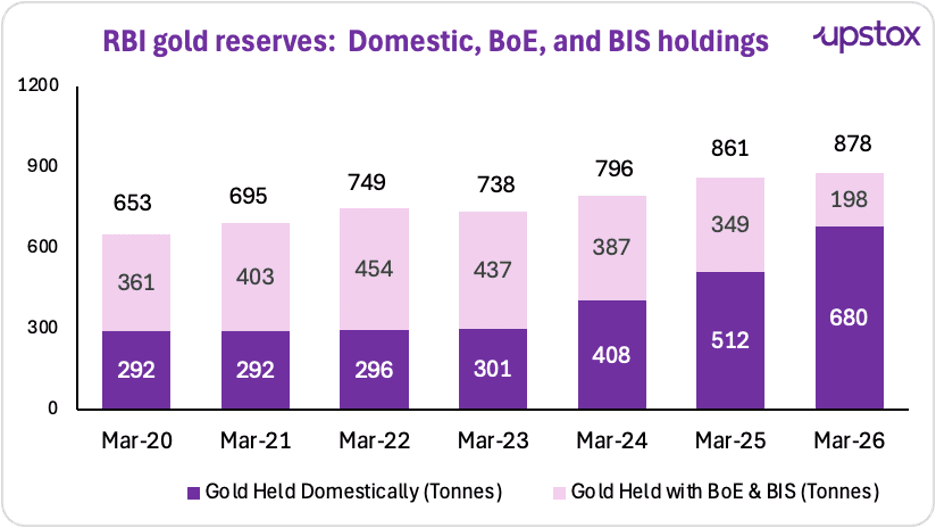
Source: Dataful
The shift in RBI’s gold reserves
For decades, the RBI kept a significant portion of its gold reserves in London and New York because that’s where the global gold market operated.
The Federal Reserve Bank of New York stores over 500,000 gold bars, while the Bank of England holds around 430,000 bars and acts as a custody hub for more than 60 central banks. Gold stored there could be instantly swapped for dollars, used as collateral, leased into bullion markets or mobilised during periods of currency stress.
What does India actually gain from this?
Quite a bit, actually.
Gold is not just an inflation hedge sitting on the RBI’s balance sheet. Increasingly, central banks see it as a strategic backup, something they want closer home and firmly under their control.
That shift also comes with practical benefits.
Storage costs reduction
The RBI pays custody fees to the BoE and BIS for the privilege of keeping its bullion in their vaults. According to the Bank of England Museum, the BoE charges around 3.5 pence (£0.035) per gold bar, per night.
Let's do some quick math. A standard gold bar weighs about 12.4 kg, so one tonne is roughly 80 bars. Currently, India has about 198 tonnes stored abroad, that's nearly 15,840 bars.
- At 3.5 pence per bar per night, that works out to:
- 15,840 bars × £0.035 × 365 days
- ≈ £202,000 a year (~₹2.3 crore)
So, every tonne brought home reduces foreign custody dependence and gives the RBI greater direct control over its gold.
Sovereign credit risk
Gold reserves are key to India’s financial health. Agencies like S&P and Moody’s look at gold when rating a country’s financial stability. This means better ratings can lead to lower interest rates for loans and mortgages.
A 10% rise in gold reserves can lower sovereign credit default swaps (CDS) by 1.2–3.2%, a risk measure.
Cutting dollar risk
At the start of 2026, central banks globally held nearly $4 trillion worth of gold, overtaking their US Treasury holdings (~$3.9 trillion) for the first time ever. When central banks bring gold home, they also reduce their reliance on the dollar system. Each tonne repatriated is one less tonne tied to dollar-based channels or exposed to US sanctions risk.
With US debt hitting ~125% of GDP, central banks worldwide are rethinking their dollar exposure.
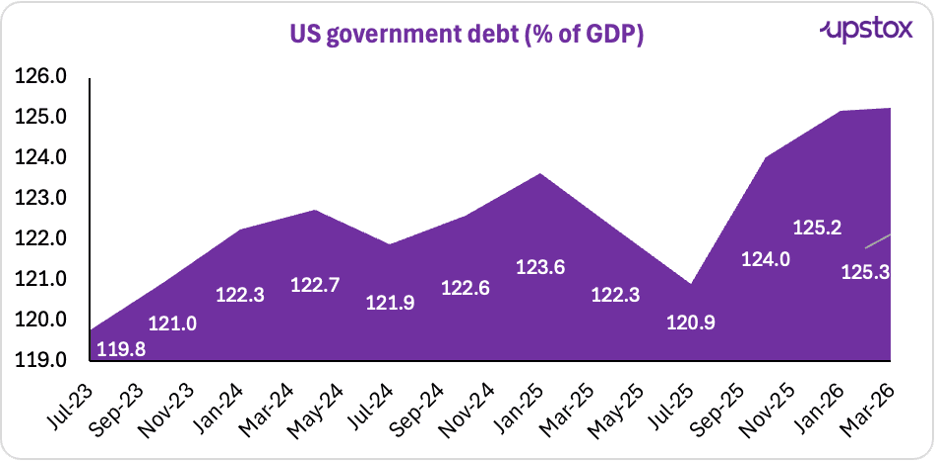
Source: Trading Economics
India seems to be moving in the same direction too. According to US Department of Treasury data, India's holdings in US securities have come down 18.96%, from $225.7 billion in January 2025 to just $182.9 billion by December 31, 2025.
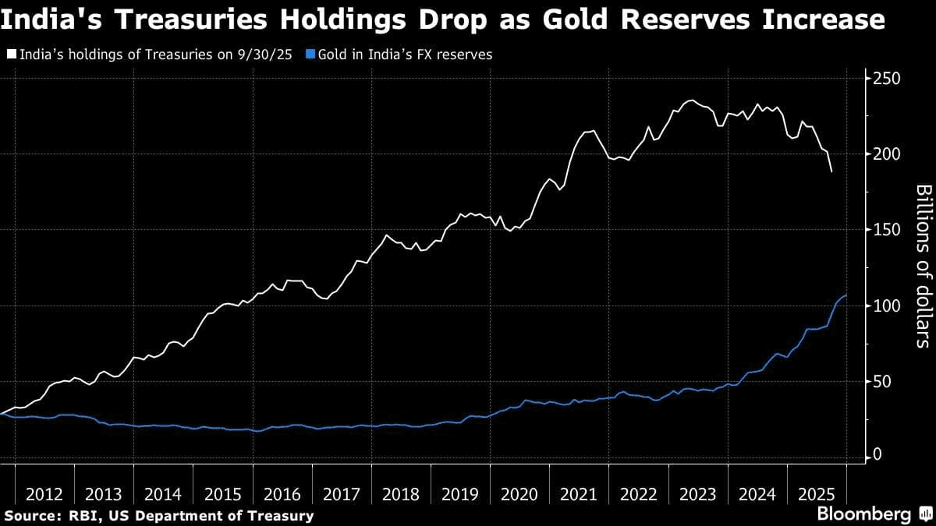
Source: Bloomberg
So, is it just the RBI?
Nope.
Take France. It moved 129 tonnes from New York back to Paris. Serbia went further, hauling its entire $6 billion stock home in July 2025, leaving global custody hubs altogether. Poland, Turkey, and Nigeria have all made similar moves. Then there's China, playing an entirely different game. It's not just buying gold aggressively; it's building its own custody hub through the Shanghai Gold Exchange's "gold corridor," offering to store other countries' gold on Asian soil.
Central banks: Gold and US treasuries holdings
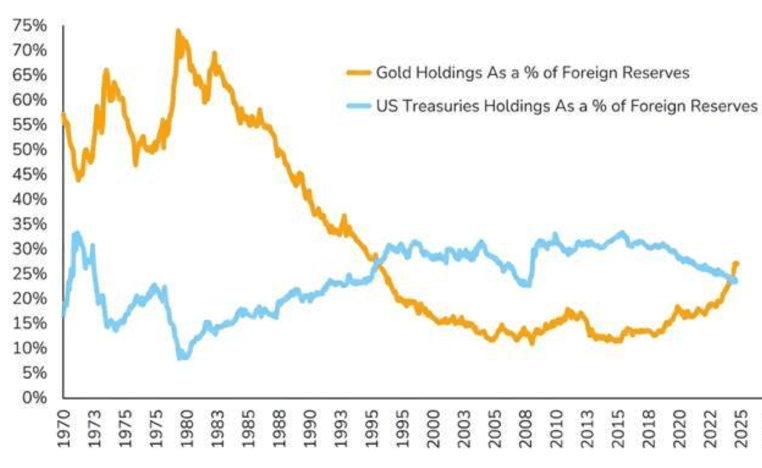
Source: Bloomberg
But, can too much repatriation create trouble?
Repatriation doesn't change how much gold exists globally, but it changes how accessible it is. As more gold shifts into domestic vaults, the pool of readily tradable bullion tightens. That can push up borrowing costs, create premiums for physical delivery, and weaken the effectiveness of paper-based gold markets.
India has direct historical experience with this. During the 1991 economic crisis, the government had to physically airlift 47 tonnes of gold to the Bank of England and the Bank of Japan to pledge it as collateral for an emergency IMF loan.
What does all this mean for India’s reserve strategy?
With US debt crossing $38 trillion, countries simply don’t want excessive dependence on a single financial system anymore.
While it also carries some risk, bringing more gold home could also offer another long-term advantage. Over the last few years, BRICS nations have increasingly discussed building alternative payment and settlement systems that reduce dependence on Western financial networks. While a common BRICS currency still remains speculative, what if something like that eventually takes shape?
In that scenario, countries with larger and more accessible gold reserves could enter from a position of greater financial credibility and strategic leverage. Investor confidence also improves when a country is seen as less vulnerable to sudden external interventions or geopolitical disruptions.
For now, the RBI appears to be balancing both priorities, increasing domestic control over reserves while still retaining enough flexibility for global financial operations.
About The Author
Next Story

