
Upstox Originals
Why is no one building the houses that people actually need?

6 min read | Updated on July 09, 2026, 17:50 IST


SUMMARY
The dream of owning a home is slipping away for millions across the world. But why are affordable homes disappearing even as cities keep expanding? And this is not only an India story. We explore the forces driving the global housing crisis, how the affordability crunch is playing out in India, and why solving it could unlock one of the world's biggest economic opportunities.

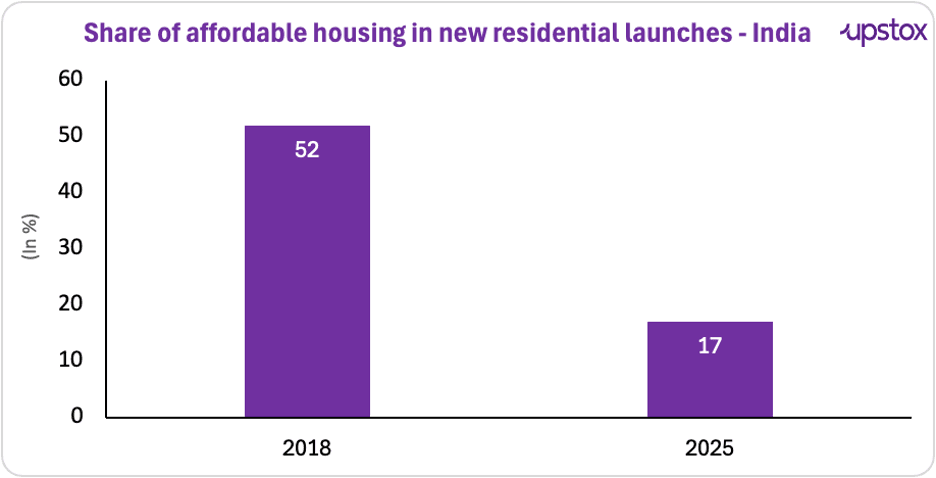
By mid-2025, that share of affordable housing has fallen to ~17%. | Image: Shutterstock
Owning a home was once considered a milestone. Today, it's become one of the biggest financial decisions most people will ever make.
But, housing crises aren't exactly new, are they? Cities have grappled with overcrowding, homelessness and housing shortages for decades. Developers have built millions of homes. And yet, the conversation around housing never really seems to end.
So, has the housing crisis actually gotten worse over the years? Well, the data suggests it has.
Back in 2018, affordable homes (priced below ₹50 lakh) made up ~52% of all new residential launches across India's 8 largest cities. By mid-2025, that share had fallen to just 17%, according to Knight Frank India.
Source: Magicbricks, the UN report
At the same time, the supply-to-demand ratio collapsed from 1.05 in 2019 to just 0.36 in 2025. Put simply, the market is now delivering barely one affordable home for every three that are needed.
You'd expect investors to spot an opportunity here, wouldn't you?
That hasn't happened.
Between 2011 and 2024, affordable housing attracted just $1.9 billion in private equity investment, only 7.8% of total residential inflows. Foreign investors contributed just 10% of that amount.
So, where does that leave homebuyers? Well, with a difficult choice.
Stretch their finances to buy a home, or continue renting.
When you look at the numbers below, the choice almost makes itself. Across India's biggest cities, buying a typical home often means paying an EMI that's 2-4x the monthly rent for a similar property.
| City | Avg. Price/sq ft (2025) | 2 BHK Rent (typical) | Typical EMI | EMI-to-Rent Multiple |
|---|---|---|---|---|
| Mumbai (MMR) | ₹17,350 | ₹40,000–60,000 | ₹1.76–2.03 lakh | ~2.9–5.1x |
| Bangalore | ₹9,100 | ₹32,000–45,000 | ₹92,000–1.07 lakh | ~2.1–3.3x |
| Delhi-NCR | ₹9,300 | ₹50,000–70,000 | ₹94,000–1.09 lakh | ~1.3–2.2x |
| Hyderabad | ₹7,830 | ₹25,000–33,000 | ₹79,500–91,700 | ~2.4–3.7x |
| Pune | ₹8,050 | ₹30,000–38,000 | ₹81,700–94,300 | ~2.2–3.1x |
| Chennai | ₹7,100 | ₹12,000–18,000 | ₹72,000–83,200 | ~4.0–6.9x |
| Kolkata | ₹6,120 | ₹16,000–22,000 | ₹62,100–71,700 | ~2.8–4.5 |
Source: ANAROCK Research (Indian Residential Real Estate Sector: Annual Report 2025, Typical monthly 2 BHK rental ranges are aggregated based on premium micro-market tracking from Magicbricks Research
So, is it just India?
No. You see, today, 3.4 billion people, roughly four in every 10 people worldwide, do not have access to adequate housing. More than 1 billion of them live in informal settlements such as slums, the highest number ever recorded, according to the latest report by the UN-Habitat.
The world is estimated to be short of 268.8 million homes across 64 emerging economies, affecting around 1.26 billion people, or roughly one in every six people globally. Developing regions account for the largest share of this deficit.
By 2030, nearly 3 billion people are expected to require adequate housing. To keep pace, the world would need to build 96,000 affordable homes every single day, according to UN-Habitat.
So, what's behind the crisis?
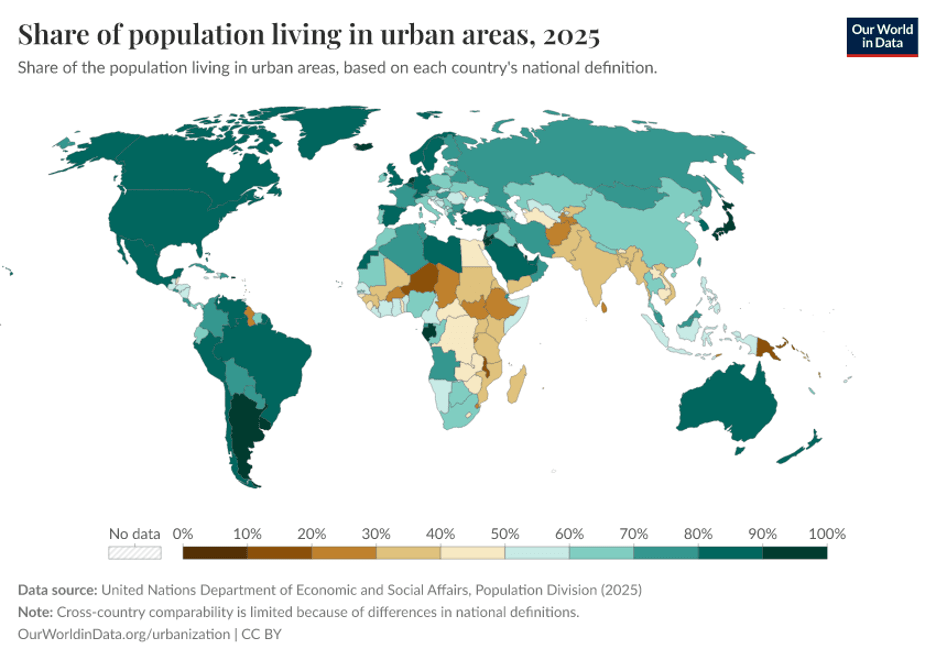
For starters, the world is urbanising at a breakneck pace. According to the UN’s World Urbanisation Prospects 2025, in 1950, only 20% of the global population lived in cities. Today, cities are home to 45% of the world's 8.2 billion people, while another 36% live in towns.
By 2050, seven in every ten people are expected to live in urban areas, adding nearly 2 billion new urban residents. It's no surprise that housing supply is struggling to keep up.
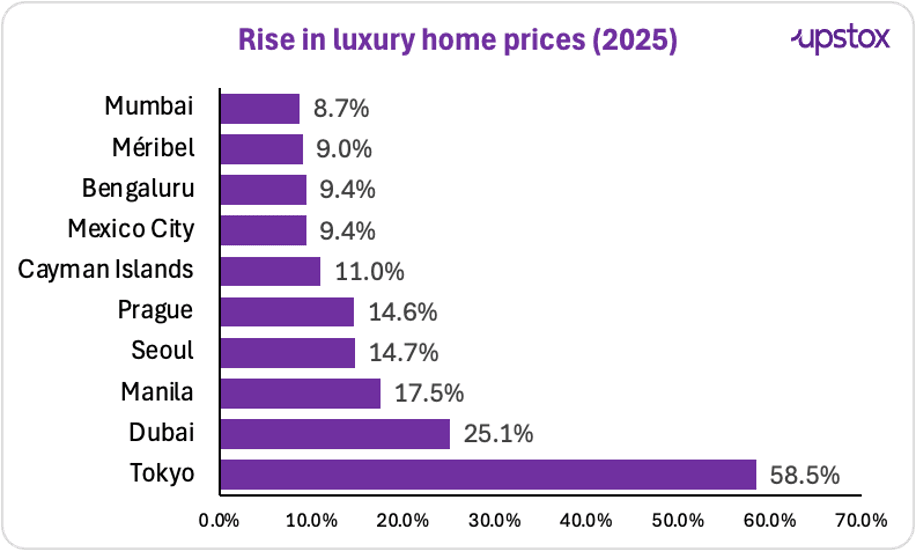
Then, luxury homes offer far better margins. So developers have increasingly shifted towards premium projects instead. In fact, Tokyo's luxury home prices surged nearly 60% in 2025, while cities like Dubai and Manila also posted strong double-digit gains.
Source: Visual Capitalist
And even if developers wanted to build affordable homes, it isn't getting any cheaper. Land prices are climbing. Construction materials cost more. Suddenly, low-cost housing doesn't look very profitable.
Oh, and there's one more thing.
Climate change. Extreme weather caused $280 billion worth of housing damage in 2023 alone. Most of it wasn't insured, leaving governments and households to shoulder the losses.
Was housing ever affordable?
For much of the 20th century, housing affordability in richer Western countries was supported by social housing, rental construction, and mortgage-backed homeownership.
In Canada, social housing production averaged 18,000 units per year from 1966 to 1995, more than 10 times pre-1964 levels, while the UK’s average house price was about 4 times annual income in 1957. By 2022, that ratio had widened to about 9 times income, reflecting how housing shifted from a social necessity toward an investment asset.
Could fixing the housing crisis become an economic opportunity?
Well, here's the interesting part.
Housing isn't just a social necessity; it's also a powerful economic engine. Think about it. Every home that's built creates demand for cement, steel, bricks, paint, furniture, transport and labour. In other words, building homes creates jobs far beyond construction sites.
In India, an additional ₹1 lakh in residential construction demand is estimated to generate 2.61 jobs (including 2.57 informal and 0.04 formal jobs). Once the broader ripple effects across the economy are included, that rises to 4.06 jobs (3.95 informal and 0.11 formal).
The story is similar elsewhere. In the United States, building a typical single-family home supports an estimated 2.9 jobs, while constructing an average rental apartment creates around 1.25 jobs.
According to the UN, the cost of construction per square metre is significantly lower in India and China, thanks to economies of scale.
So, can this be fixed?
Well, yes, but not by simply building more homes. The world needs to build more affordable ones through better land policies, faster approvals and incentives for budget housing.
Take Vienna, for example. The city has around 220,000 municipal homes and 200,000 government-subsidised homes, together housing roughly 50% of its population. That large stock of affordable housing has helped keep rents in check across the wider market while also supporting around 20,000 construction jobs through continuous urban renewal.
Perhaps that's the biggest lesson. When affordable housing is treated as long-term infrastructure, not just another real estate project, the dream of homeownership doesn't have to keep slipping away for people like Mr. X.
About The Author
Next Story

