
Upstox Originals
One vehicle, two fuels: Can India's flex-fuel bet actually pay off?

6 min read | Updated on July 02, 2026, 14:29 IST


SUMMARY
One car, two fuels sounds like the perfect solution. India hopes flex-fuel vehicles will reduce dependence on imported crude, create a new market for farmers and make transport cleaner. But can the country produce enough ethanol sustainably, build the required fuel network and keep ethanol cheap enough for people to use?
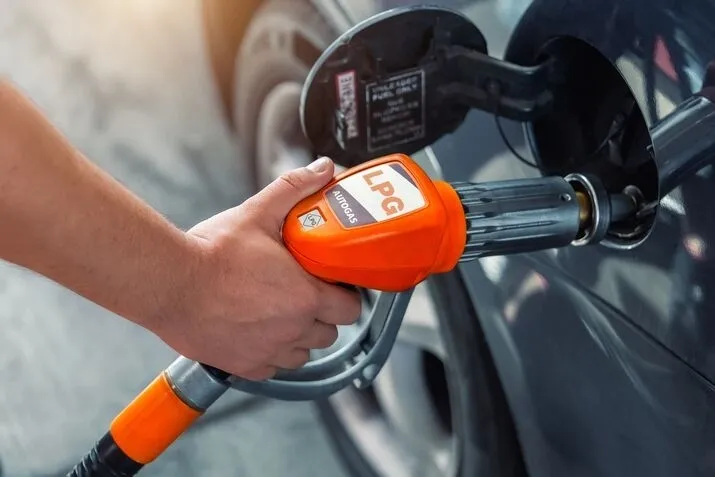
India is gearing up for cars that can run on 100% ethanol. | Image: Shutterstock
Every time tensions flare up somewhere in the Middle East, your fuel bill quietly creeps up a few rupees. India's new plan is designed to make that connection a little weaker.
That's not a hypothetical anymore. India is gearing up for cars that can run on 100% ethanol, a fuel that's almost entirely ethanol instead of petrol. In practice, however, E100 isn't literally pure ethanol. For safety, the approved fuel contains about 93–93.5% ethanol, 5% petrol, and 1.5% co-solvent. The small amount of petrol makes flames visible in case of a fire, reducing safety risks.
And this isn't some far-off concept-vehicle thing. Toyota has a flex-fuel Hyryder. Hero's selling flex-fuel motorcycles right now. Maruti Suzuki has launched the WagonR Bioflex, India's first passenger car capable of running on ethanol blends from E20 all the way to E100, priced at ₹7.24 lakh.
So somewhere between the sugarcane fields of Maharashtra and your neighbourhood Maruti showroom, India is trying to pull off something only one country has managed at scale, building a car that doesn't care what's in its tank.
What even is a flex-fuel vehicle?
Think of a regular car as a picky eater, it mostly runs on petrol. A flex-fuel vehicle (FFV) is much more flexible. It can run on petrol, ethanol, or any mix of the two, from E20 to E100. It has special parts and a smart engine that automatically detects the fuel in the tank and adjusts itself. So, drivers don't have to do anything, they can simply fill up with whichever fuel is available or cheaper.
Why is India pushing this?
It's a farm income story in disguise
If half of all newly sold two-wheelers and four-wheelers go flex-fuel, that alone could generate demand for over 311 crore litres of ethanol, translating into nearly ₹12,403 crore of extra income for Indian farmers, and a cut of roughly 66.4 lakh metric tonnes in carbon dioxide emissions. Oil companies have already paid out close to ₹87,500 crore directly to farmers through the ethanol programme.
####Less crude, less crisis India imports nearly 88% of the crude oil it consumes, among the highest dependency ratios of any large economy. When the West Asia conflict flared up this year, India's crude basket jumped from a steady $62-70 a barrel to over $113 within weeks.
Forex math?
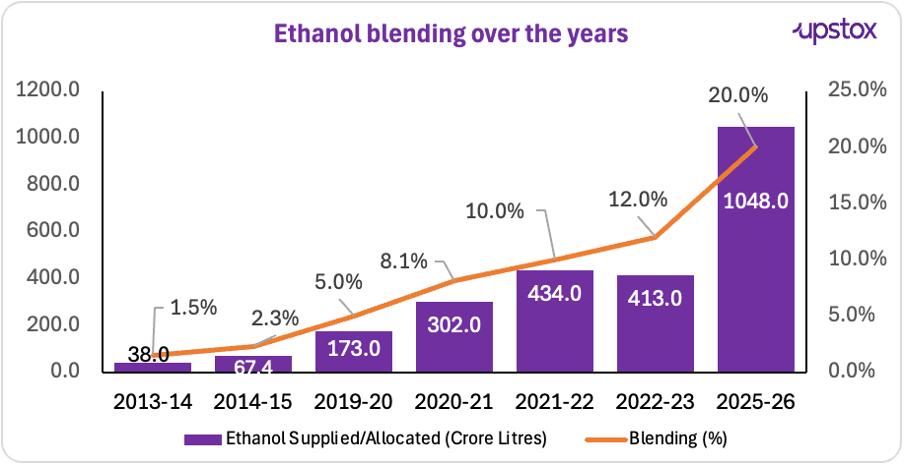
Ethanol blending has already saved India over ₹1.4 lakh crore in forex since 2014, simply by swapping a slice of imported petrol for locally-made ethanol. Blending went from a token 1.5% in 2014 to a full 20% by November 2025, five years ahead of the original 2030 deadline.
Source: PIB
India built a surplus it doesn't know what to do with
India's distilleries have built more capacity than its cars can actually use. Annual ethanol production capacity has crossed roughly 2,000 crore litres, but the E20 mandate only requires oil companies to buy around 1,200 crore litres a year. India built itself a surplus with nowhere to go, and flex-fuel vehicles are the new pipe meant to drain it.
But is the transition really that straightforward?
Not quite. Three big questions still remain.
Are India's cars actually ready?
Not all of them. While new flex-fuel vehicles (FFVs) are designed to run on blends up to E100, most existing petrol vehicles are built for E10 or, at best, E20. Running significantly higher blends like E85 or E100 without engine modifications can corrode fuel lines, damage rubber seals, reduce fuel efficiency by around 25–30%, and lead to expensive repairs.
Can India produce enough ethanol sustainably?
Every litre of ethanol needs feedstock. At the industry's typical yield, one tonne of sugarcane produces around 70 litres of ethanol, and producing that litre takes anywhere from 2,000 to 3,630 litres of water. As demand rises, so will that pressure, unless production keeps shifting towards grain, which already supplies roughly 72% of the ethanol oil companies buy.
What about pending cane dues?
The government estimates that widespread FFV adoption could generate demand for 311 crore litres of additional ethanol and boost farmer incomes by about ₹12,400 crore. But, Delayed payments remain a persistent issue for farmers. Take July 1 2026, sugarcane farmers in Chhattisgarh protested over more than ₹30 crore in pending cane payments.
Where does the infrastructure stand today? Mixed bag, honestly.
E20 is now available at more than 15,600 fuel stations nationwide, roughly 17% of India's fuel retail network. In June 2026, the government cleared excise exemptions for the next rung of blends, E22, E25, E27, E30, and days later, legalised E100 for road use entirely. E85 and E100 currently exist at a handful of pilot pumps around Delhi-NCR and the Maharashtra-Pune-Nagpur belt.
The government's own roadmap targets just 500 flex-fuel-ready outlets by December 2026, scaling to roughly 5,000 by end-2027, against India's 90,000-plus total fuel stations. Even at the optimistic end, that's barely 5% coverage, eighteen months out.
Brazil. By a landslide.
Brazil launched its first flex-fuel car in 2003. Within five years, FFVs made up nearly 88% of new car sales, rising to 94% by 2009. Today, the country has over 30 million flex-fuel cars and light trucks.
Its success came down to two things: ethanol was consistently 30–40% cheaper than petrol, and the government spent decades building the ecosystem through mandatory blending, tax breaks and guaranteed procurement. Together, these helped Brazil replace roughly half of its petrol demand with ethanol.
But Brazil also offers India a lesson. Between 2009 and 2013, ethanol prices rose as supplies tightened, and the share of flex-fuel owners choosing ethanol fell from 66% to 23%. People didn't stop buying FFVs, they simply switched back to petrol.
That's the real takeaway. Building flex-fuel cars is the easy part; making ethanol cheap, widely available and reliable is much harder. India isn't there yet. E85 costs around ₹82/litre at Delhi's pilot pumps, compared with ₹102/litre for E20, a 20% discount. But the industry says the gap needs to be 30% or more for ethanol to become the obvious choice.
About The Author
Next Story

