
Upstox Originals
Glittering reserves: The global gold-buying spree
.png)
5 min read | Updated on June 09, 2025, 16:39 IST


SUMMARY
When global markets wobble, where do you think countries turn? Hint: it’s something that glitters. Major economies, including India, are racing to increase their gold reserves. Between 2019 and 2024, India added a massive 241.2 tonnes, ranking second globally. So, what’s behind this golden rush? And how does it shape India’s financial future? Let’s dive in.

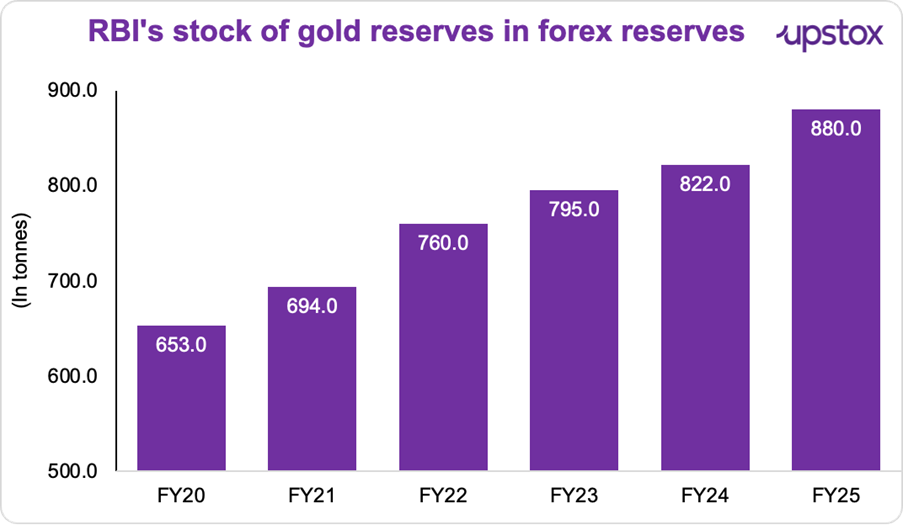
From 653 tonnes in FY20 to 880 by March 2025, RBI has been pilling up gold reserves, like many central banks
880 tonnes. A 35% surge since FY20. That’s not just a number, it’s the RBI’s glittering signal to the world. From 653 tonnes in FY20 to 880 by March 2025, this isn’t a casual stock-up - it’s a strategic climb that’s catapulted India from 10th to 7th in global gold rankings. Amid shifting currencies and global volatility, India’s central bank is turning back to an old, trusted friend: gold.
FY25 alone saw the RBI scoop up a staggering 57.5 tonnes—the second-biggest annual haul since 2017. Safe-haven demand is soaring, fueled by fears of a global trade war after the US administration's latest tariff plans. The gold meter is rising for India. Let’s track the glow-up!
Source: RBI
Fascinating, isn’t it? But hang on, there’s more to the story.
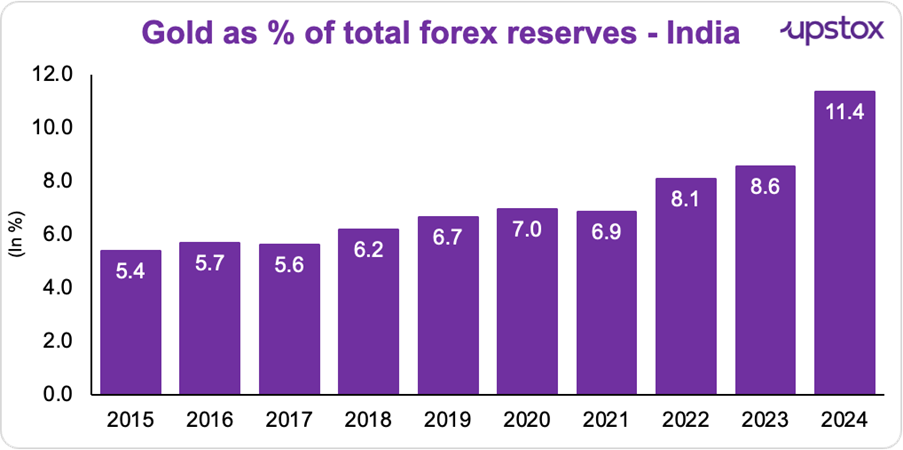
According to the World Gold Council, gold now makes up 11.35% of India’s total forex reserves, up from just ~6.86% in 2021. That’s almost doubled in four years!
Source: Economic Times
But are we the only one building gold? Absolutely not, There are other major economies increasing their gold reserves.
The global context
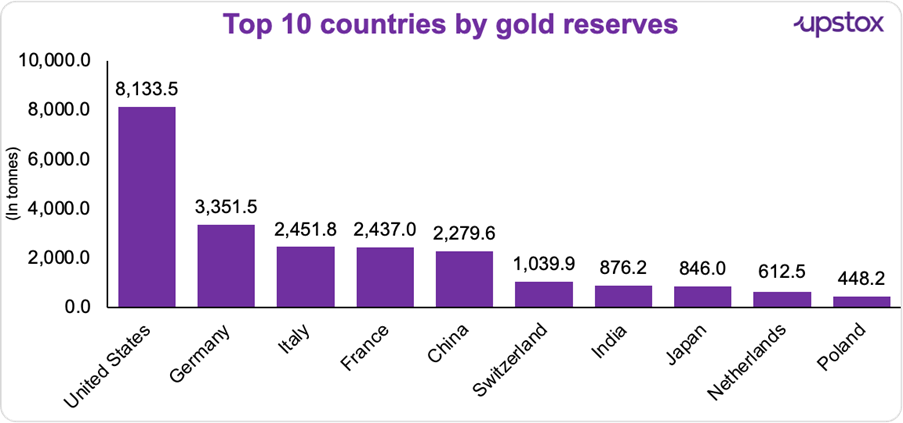
Ever wondered who’s hoarding the most gold? Let’s dive into the global leaderboard.
Source: World Gold Council; Gold Reserves Data for December 2024 end
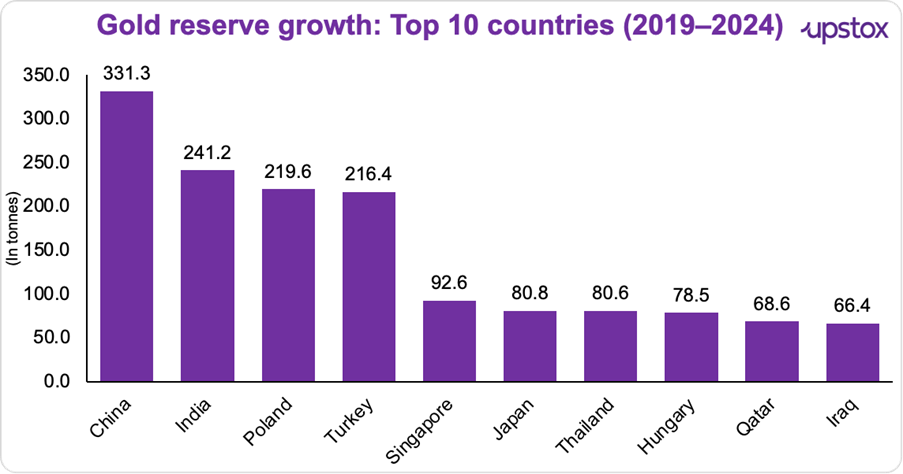
While the above chart spotlights the largest gold reserves, several other countries, including the top 10, have been quietly adding to their stockpiles since 2019. Let’s check out who’s been stacking up!
Source: BullionVault
This snapshot reveals China added a whopping 331.3 tonnes of gold from 2019 to 2024. But let’s zoom out: what’s driving countries like China and Japan to pile up gold in their reserves? Let’s find out!
China
China is buying more gold. Reserves have rocketed to 2,292.3 tonnes - now 6.5% of official assets. Meanwhile, Beijing’s US Treasury holdings have nosedived - from over $1.3 trillion to just $759 billion by Q1 2025.
Why? Trump’s 145% tariff on Chinese goods sparked a quick retaliation. The US Treasury’s latest TIC report (May 16) shows: for the first time this century, China’s holdings fell below the UK’s, dropping it to third place.
Japan
For nearly 20 years, Japan’s gold reserves sat still at 765.2 metric tons - then in 2021, boom! They quietly grabbed an extra 80.76 MT in one bold move.
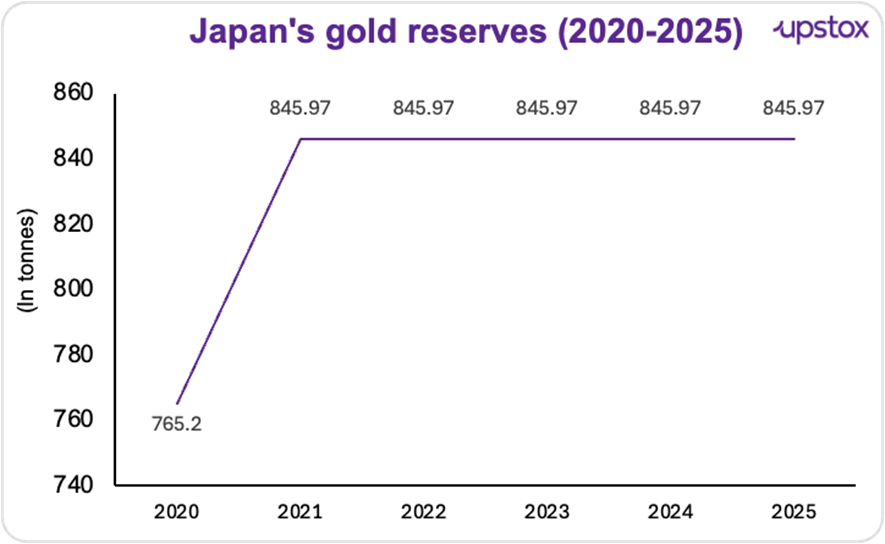
Source: Trading Economics
Japan is buying more gold, but gold isn’t its only ace. The country also holds a massive $1.13 trillion in US Treasuries, the biggest foreign stash out there. But here’s the twist: after 34 years, Japan lost its spot as the world’s top creditor to Germany, triggering a recent sell-off of its Treasuries.
In April 2025, treasury prices took a dive. Why? Investors shifted from hoping tariffs would boost US revenue to worrying about a downturn, which could mean more government borrowing. Makes you think, right?
But…Why are countries buying more gold and how does it help?
Central banks are snapping up gold to shield themselves from currency volatility and reserve value shocks. Curious why else gold is the go-to? Let’s dive into a few more reasons!
Cutting Dollar Risk
With US debt hitting 124% of GDP, central banks are rethinking their exposure. Goldman’s Thomas notes, “Many hold most reserves in US Treasuries and are watching fiscal risks closely.” Mohamed El-Erian, former CEO of PIMCO, explains the goal: “Gradually diversify away from large dollar holdings.” The dollar remains dominant with 58% of global reserves, down from 65% a decade ago. More gold = less dollar risk, stronger reserves, and a sturdier financial foundation.
Inflation control
In 2024, RBI added 13.3 tonnes to cut dollar dependence, mirroring China and Russia’s 150% gold boost since 2018. Gold also acts as an inflation shield because it retains its value even when fiat currencies (government-issued money like the rupee or dollar that isn’t backed by a physical commodity) lose purchasing power due to inflation. Why? Because gold is priced globally in dollars and is considered a finite asset, it helps preserve purchasing power.
The last resource
Gold isn’t just glitter - it's strategy. Well, the real reason is trust. Gold backs confidence - not just in dollars, but in America's economic and geopolitical muscle. “Gold offers a more stable hedge,” says Madan Sabnavis, Chief Economist at Bank of Baroda.
Rates vs. rally
Gold usually dips when interest rates rise because it yields nothing. But this time? Gold surged even as rates climbed, defying norms. David Wilson of BNP Paribas says, “Central bank buying has fed through to the psyche of speculative investors. If central banks buy gold, investors say, ‘we should be buying too.’
In summary
Gold isn’t just a relic of the past - it’s a dynamic tool shaping the country's financial future. As global uncertainties persist, the RBI and other central banks’ gold strategy signals a smart, forward-looking approach to stability and strength. Watching this unfold will reveal how India balances tradition with modern economic challenges. The real question: how far will gold take India in the coming decade?
About The Author
Next Story



