
Upstox Originals
Economics of space data centres: AI’s next frontier

8 min read | Updated on July 15, 2026, 15:13 IST


SUMMARY
We think of AI as code. In reality, it's becoming an energy business. As the world struggles to build enough power and data-centre capacity for the AI boom, companies are exploring a radical solution: moving compute into orbit. This article examines how power shortages, not software limitations, could reshape the future of AI infrastructure.
Infosys Chairman Nandan Nilekani said on Tuesday that artificial intelligence (AI) will not replace companies like Infosys but amplify those moving with purpose and speed. Image: Unsplash
AI is not just about the software.
It is software sitting on a very physical industrial stack: land, buildings, chips, cooling systems, high-voltage substations, water, backup power and increasingly dedicated renewable or gas generation.
Every new AI model needs training. Every AI product needs inference. The first is computer-heavy. The second is volume-heavy.
AI workloads use dense clusters of GPUs or TPUs (Tensor Processing Units) running in parallel. These chips need large quantities of electricity, fast networking and stable cooling.
The demand curve is steep. By 2050, the power consumption by data centres is expected to reach 5000 TWh, which is 8x of all the electricity being consumed currently on the earth as per Bloomberg NEF predictions.
Why is AI demand outpacing power and data-centre supply?
AI power demand is outpacing supply because AI training requires massive, continuous computing clusters that demand more electricity and specialised hardware than traditional workloads. As a result, global data center demand reached 21.1 GW against only 8.9 GW of operational supply, creating structural deficits. Key constraints include:
-
Massive power density requirements: Training large language models involves running thousands of GPUs continuously for weeks or months. This drives power density per rack far beyond what legacy data centers can handle.
-
Supply chain bottlenecks: Constructing new facilities is slowed by extreme shortages in electrical equipment, particularly high-voltage step-down transformers, which can take years to procure.
-
Grid connection lags: Even where sufficient power generation exists, physical grid connection queues suffer from years-long permitting backlogs.
-
Cooling limitations: Advanced cooling systems are needed to keep AI server farms from overheating, adding another massive drain on the overall energy budget of these facilities.
To overcome the problem of power deficit and expensive land on Earth, a few companies like SpaceX are now exploring ideas of building data centers in space.
Why could this make sense?
At first glance, a data centre in space sounds absurd. Sending servers into orbit is expensive. Repairing them is difficult. Radiation can damage electronics. Cooling in a vacuum is not simple. But the concept starts making sense when viewed through the lens of AI’s power problem.
Space offers four theoretical advantages.
| Advantage | Explanation |
|---|---|
| Continuous solar energy | Space-based solar power offers a way by placing solar arrays in near-constant sunlight. This could generate up to 5x more energy than traditional solar systems on Earth |
| No terrestrial land bottleneck | In space, the land-use problem disappears. The new bottleneck becomes orbital slots, debris risk and satellite coordination. |
| Lower cooling-water dependence | In space, data centres can release waste heat directly into the cold vacuum. |
| Better fit for delay-tolerant AI workloads | Not every computer task needs millisecond response. This is where orbital computers may find their first real market. |
Source: News articles
The technology making this possible
A space data centre is not simply a server rack bolted to a satellite. It is a complete computer-power-communications system. At scale, the architecture would involve five layers which is summarized below.
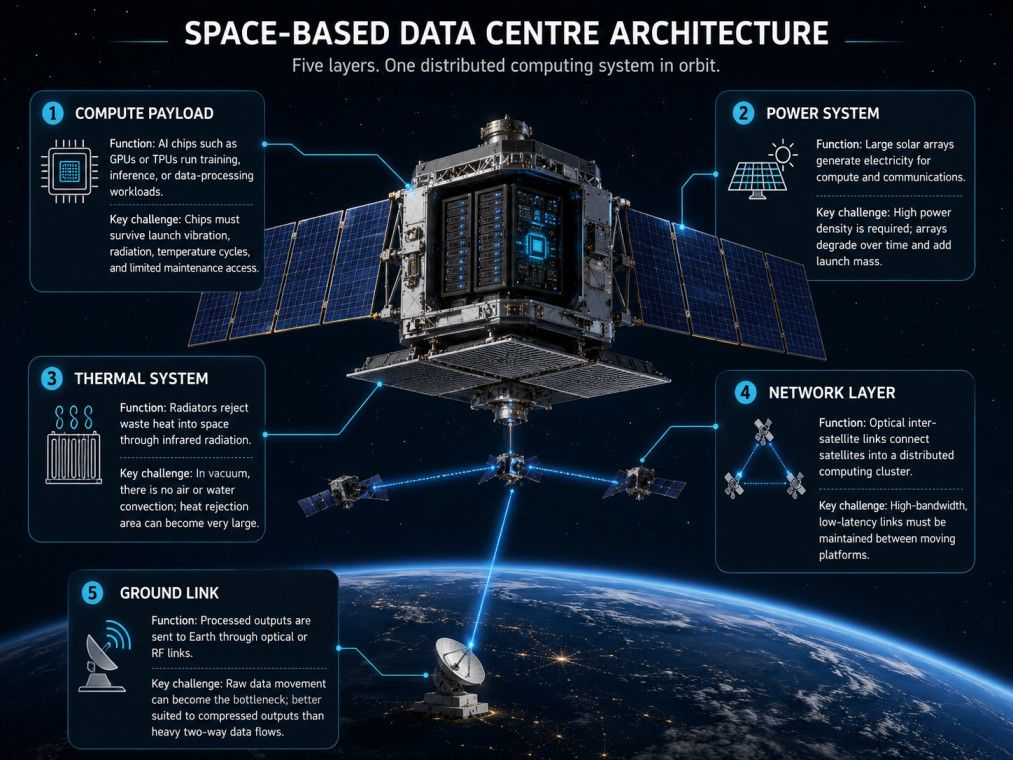
Source: Axion, Google, Media Articles
Simply put, space-based data centers work by migrating heavy computing hardware into orbit, drawing direct energy from the sun, and transmitting data back to Earth via laser beams.
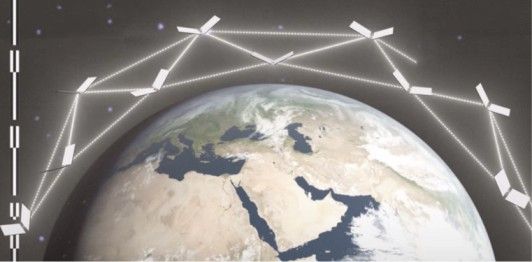
The current satellite launched (more details in next para) is a prototype designed to prove that high-performance AI hardware can survive and operate in space. When fully deployed, a connected constellation of these satellites will form a unified network known as an orbital compute cluster.
Source: Bloomberg Original
Starcloud and Google: From concept to early proof
Starcloud: the startup experiment
Starcloud is one of the earliest visible companies trying to commercialise orbital AI compute. NVIDIA's October 2025 blog said Starcloud’s satellite carried an NVIDIA H100 GPU, marking the first time a data-centre-class GPU was sent to space. NVIDIA also said the satellite was expected to offer 100x more powerful GPU compute than previous space-based operations.
Starcloud’s own positioning is aggressive: it says space data centres can deliver 90% lower electricity costs and 24/7 solar-powered efficiency.
| Aspect | Details |
|---|---|
| The Pioneer | A 60-kilogram prototype satellite launched aboard a SpaceX Falcon 9 rocket. |
| The Hardware | Carries an NVIDIA H100 GPU, offering 100 times the computing power of prior space computers. |
| The Milestone | Successfully trained Andrej Karpathy's NanoGPT and ran inference on Google's Gemma model in orbit. |
| The Cluster | Future mass deployments will link satellites into a synchronized orbital compute cluster. |
| The Next Step | A second-generation launch in Oct 2026 will add NVIDIA Blackwell architecture to the network. |
| The Benefits | The system utilizes raw solar power and the vacuum of space for zero-water cooling. |
Source: News articles
Why SpaceX is the frontrunner?
SpaceX has three advantages that few companies can combine: reusable rockets, satellite manufacturing experience through Starlink, and deep operating knowledge of LEO networks with optical inter-satellite links.
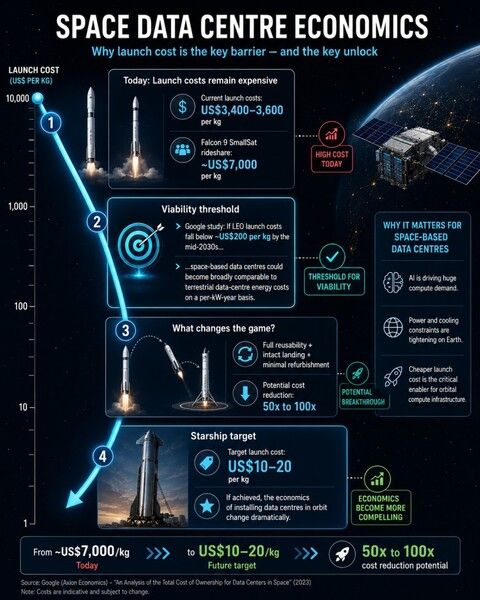
Falcon 9 is the bridge. Its SmallSat rideshare programme allows satellite operators to launch payloads at about $7,000/kg, making early experimentation cheaper. SpaceX has also sought FCC approval for a constellation of up to 1 million solar-powered AI data-centre satellites, according to Reuters.
But the real bet is Starship. SpaceX says Starship is designed to carry more than 100 metric tonnes to orbit in a fully reusable configuration. If it achieves high launch frequency and low refurbishment cost, it could sharply reduce the cost of placing heavy compute infrastructure in orbit.
The practical reading is simple: Falcon 9 makes testing possible. Starship could make orbital compute scalable.
The biggest roadblock: Economically viable launch
The biggest roadblock is not the idea. It is the mass. A data centre needs chips, power electronics, solar arrays, radiators, batteries or storage support, structural frames, communications equipment and propulsion/attitude systems. Every kilogram has to be launched, insured and operated.
Source: Axion, Google, Media Articles
Orbital Compute: Cost Collapse + Capacity Shift
The key message is that orbital compute may become meaningful only after 2030, but once it scales, the economics could change sharply. AI compute costs are expected to fall from around $38.4/watt in 2025 to $3.7/watt by 2040, mainly because space-based data centres can reduce recurring power and cooling costs. In the early years, terrestrial GPU capex and data-centre infrastructure dominate costs. But over time, orbital GPU capex, satellite capex and launch costs become the larger part of the stack.
Where does India stand in the Space Data Centre theme?
CEEW estimates India’s installed data-centre capacity has nearly tripled from about 520 MW in 2020 to almost 1.5 GW by mid-2025 and could reach 4.5–6.5 GW by 2030. It also highlights that India’s data-centre electricity and water usage are expected to more than double by 2030, making siting, power sourcing and cooling choices critical.
The Economic Times reported that Reliance Jio is planning a LEO constellation of around 1,600–1,650 satellites at about 650 km altitude over the next 2-3 years for broadband and direct-to-device connectivity. The report adds that Jio has submitted a proposal to IN-SPACe, and experts estimate the investment requirement at US$10–15 billion, or about ₹95,000–141,500 crore.
For India, the near-term opportunity is not to place hyperscale AI data centres in orbit tomorrow. The opportunity is to build the stack: launch capability, satellite manufacturing, optical communications, space-grade power electronics, sovereign LEO networks, ground-station capacity and edge AI for Earth observation. If global orbital compute becomes viable, countries with domestic LEO capability will have a strategic advantage.
Conclusion: Not science fiction, not yet mainstream
Data centres in space sit at the intersection of three curves: AI compute growth, power scarcity and launch-cost deflation. If only the first curve plays out, terrestrial data centres win. If all three move together, Orbital Compute becomes a credible infrastructure layer.
The clearest way to frame the opportunity is this: Falcon 9 makes orbital AI experiments possible. Starship-class economics may make orbital AI infrastructure investable. Until launch costs move meaningfully closer to US$200/kg, space data centres remain an ambitious option. If that cost curve breaks, AI infrastructure may no longer be bound by Earth’s grid.
About The Author
Next Story

