
Upstox Originals
Central government capex hits all-time high, what does it mean?
.png)
5 min read | Updated on July 01, 2025, 18:44 IST


SUMMARY
India’s capex in FY25 reached an all-time high, with the central government exceeding its target, focusing on long-term infrastructure projects like roads, railways, and defence. The strong push in Q4, especially in March 2025, set a record. State governments are also increasing their capital spending, further boosting infrastructure development and supporting long-term growth.
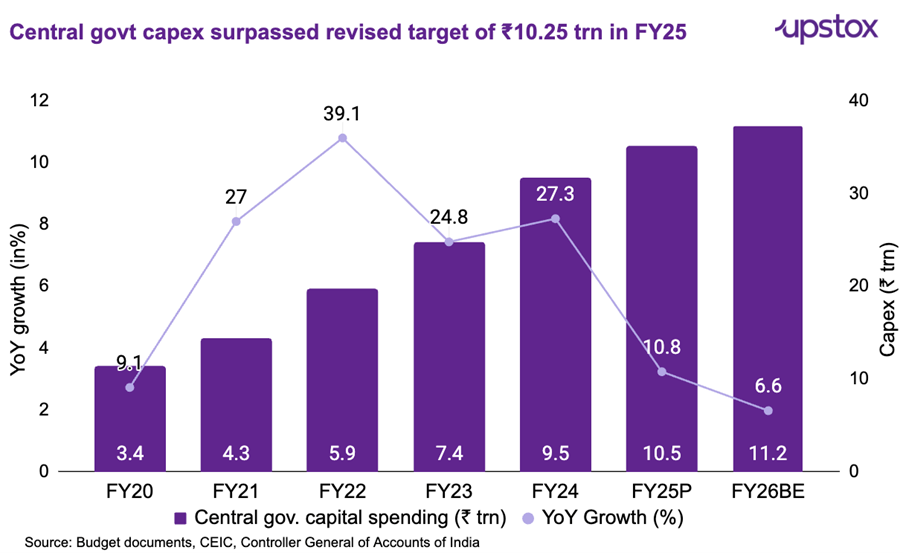
The Centre’s capex touched ₹10.5 trillion in FY25, exceeding its revised estimate of ₹10.2 trillion.
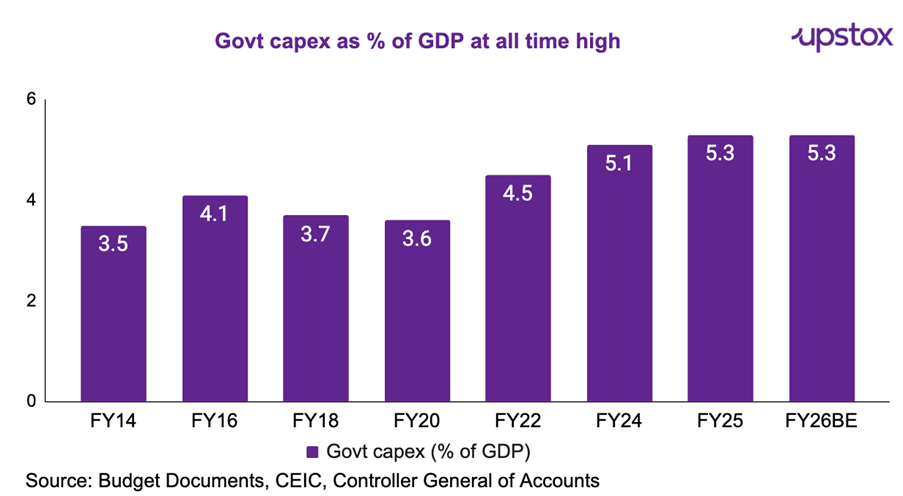
In FY25, India’s combined capital spending by the Centre, states, and public sector companies reached an all-time high of 5.3% of GDP. The central government alone spent 3.2% of GDP, the highest in over two decades. This shift shows a clear move toward building long-term assets-roads, railways, power infrastructure-rather than spending heavily on short-term subsidies.
Surpassed FY25 estimates
The Centre’s capex touched ₹10.5 trillion in FY25 (up 10.8% YoY), exceeding its revised estimate of ₹10.2 trillion. While the first half saw a 15.4% YoY dip due to election-related delays, spending surged 39% YoY in the second half, driven by a strong infrastructure push.
Capex in March-25 was more than entire FY15/16
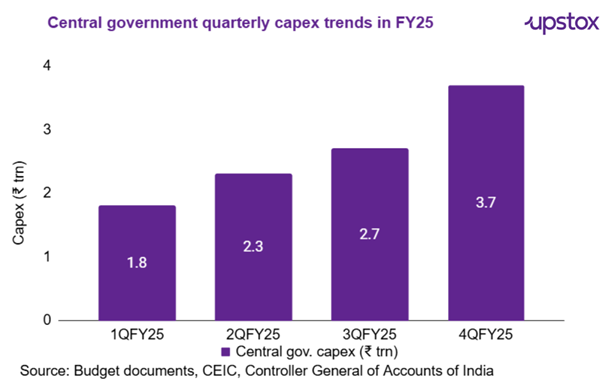
What’s interesting is that most of this push came in the Q4FY25, which saw the highest ever capex done during any quarter, especially capex in March 2025, when spending hit a record ₹2.4 lakh crore - more than what the government spent in the entire year of FY15 (₹1.7 lakh crore) or FY16 (₹2.3 lakh crore).
This sharp rise was supported by:
-
Lower subsidy bills due to falling global prices across commodities, including crude oil.
-
A strategic decision to boost investment-led growth in H2FY25 to overcome the election-led slowdown in capex spend in H1FY25.
-
RBI dividend amounting ₹2.7 lakh crore gave the Central Government leeway to spend almost ₹0.8 trillion more for FY26. If the full amount is used for capex, the total capex would rise to ₹12.0 trillion from the budgeted₹ 11.2 trillion, raising its growth to 14.2%, compared to 6.6% currently.
Where is the money going?
A major share of the Centre’s capital spending continues to go into transport infrastructure, especially roads and railways.
-
₹2.8 lakh crore went to the infrastructure (roads and highways)
-
₹2.5 lakh crore to the railways for improving logistics infrastructure in India and increasing overall connectivity
-
₹1.7 lakh crore to the defence for pushing local manufacturing
Together, these three accounted for 67% of total capex in FY25.
Over the last five years, capex on roads has grown by 21% per year, and railway investment has gone up by 29% per year. These numbers reflect the government’s focus on improving connectivity and logistics.
Capex contribution by sector
| Sector | FY23 | FY24 | FY25P | FY26BE |
|---|---|---|---|---|
| Telecommunications (%) | 7.4 | 6.3 | 7.0 | 4.6 |
| Transfers to states (%) | 12.5 | 12.9 | 15.8 | 15.2 |
| Roads and highways (%) | 21.5 | 25.6 | 23.9 | 22.5 |
| Railways (%) | 27.8 | 27.8 | 27.1 | 24.3 |
| Defence (%) | 20.4 | 17.3 | 16.2 | 17.2 |
| Others (%) | 10.3 | 10.1 | 9.9 | 16.2 |
| Total Capex (₹ trillion) | 7.4 | 9.5 | 10.5 | 11.2 |
Source: Budget documents, CEIC, Controller General of Accounts of India
How are states spending?
States’ capital spending hit an eight-year high of 3% of GDP in FY25, reflecting strong infrastructure momentum. Based on provisional data from 20 states, capex grew 22% YoY in FY25 - the fastest in three years. For FY26, states have budgeted a 14.9% YoY increase.
This consistent rise in state-level spending signals a broad-based public investment push across the economy. However, state-level spending has been slower than the Centre’s, partly due to elections and fiscal limits.
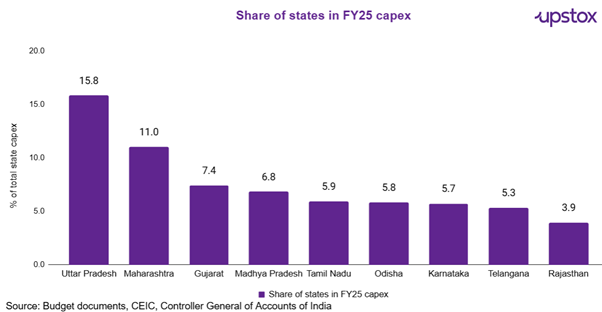
Among states, Uttar Pradesh led the capital spending pack in FY25, accounting for 15.8% of total state capex. It was followed by Maharashtra (11%), Gujarat (7.4%), Madhya Pradesh (6.8%), and Tamil Nadu (5.9%).
Notably, nine states-including Maharashtra, UP, Assam, Rajasthan, Chhattisgarh, Punjab, Gujarat, Himachal Pradesh, and Odisha-expanded their share of total capex compared to FY24, while the remaining 11 states saw a decline in their contribution.
Why this matters
The strong capex push is important for several reasons:
- It fills the gap while private companies are still cautious about investing.
- It improves infrastructure, making India more efficient and competitive.
- It creates jobs, especially in sectors like construction and manufacturing.
Capex is important because it has a higher multiplier effect-every ₹1 spent adds about ₹2.45 to GDP over time. It also helps pull in private investment and builds long-term productive capacity. If this momentum continues-and project execution improves-India could see long-term benefits in both economic growth and quality of life.
What to expect in FY26?
As we move into FY26, here’s what the outlook looks like:
-
Capex push will continue, but focus will now shift toward better project execution, asset monetisation, and efficiency.
-
In April 2025 alone, the Centre spent ₹1.6 lakh crore, which is 14.3% of the year’s target - a strong start.
-
Sectors like roads, railways, power, renewables, and defence will remain the focus.
-
The government may also invest in new areas such as EV charging stations, port-linked logistics hubs, and green hydrogen projects.
-
States are likely to increase spending with better fiscal space and more central support.
-
Private companies are also expected to slowly increase investments in chemicals, cement, auto parts, and data centres, as capacity utilization improves.
Insight for investors : Capex-led growth with fiscal room intact
-
Capex without fiscal stress: The government’s fiscal deficit is projected to drop below 4.5% of GDP in FY26, falling under its long-term average. This gives policymakers the comfort to continue aggressive capital spending without endangering macro stability.
-
E&C order books at record highs: India’s top engineering-construction and defence companies now hold a record $213 billion in order book, with 23% YoY growth to give revenue visibility and expected to drive earnings momentum going forward.
About The Author
Next Story



