
Upstox Originals
Are BRICS still relevant in 2025?
.png)
7 min read | Updated on July 03, 2025, 16:48 IST


SUMMARY
What happens when legacy power meets rising ambition? On one side: the G7 — established, coordinated, and still wealthy. On the other: BRICS+ — a growing coalition reshaping trade flows, energy ties, and financial norms. The question however remains, have the BRICS made a meaningful mark so far and given internal frictions, are they still a relevant force in 2025?
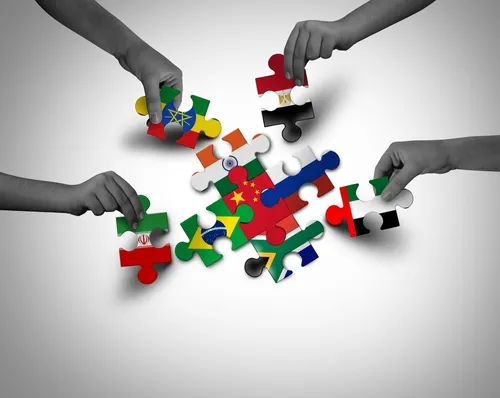
BRICS+ accounts for over 40% of the global population
Two very different clubs. Two very different strategies. But both are now central to the rules shaping currency, climate, and global influence.
Meet the G7, born in the 1970s with the US, UK, Japan, Germany, France, Italy, and Canada, has long shaped the global playbook on trade and finance. But it’s no longer the only table that matters.
Enter BRICS+ — once just Brazil, Russia, India, China, and South Africa, now joined by Egypt, Ethiopia, Iran, the UAE, and Indonesia as of 2024. A bloc with scale, ambition, and a growing appetite to shift the rules.
Both now central to the rules shaping currency, climate, and global influence. So how do they measure up on the fundamentals — GDP, trade, debt, and population? Let’s take a closer look.
Key fiscal aggregates
| Metric | Group | 2002 | 2024 |
|---|---|---|---|
| % of global population | BRICS+ | ~42% | ~45% |
| % of global population | G7 | ~12.0% | ~9.7% |
| % of global merchandise exports | BRICS+ | 10.7% | 23.3% |
| % of global merchandise exports | G7 | 45.1% | 28.9% |
| GDP (USD) | BRICS+ | ~$3.0 Tn | ~$29.9 Tn |
| GDP (USD) | G7 | $22.53 Tn | ~$49.3 Tn |
| % of GDP (In PPP terms) | BRICS+ | ~24.1% | ~36.7% |
| % of GDP (In PPP terms) | G7 | ~42.1% | ~29.6% |
| Debt to GDP ratio (Weighted average) | BRICS+ | 68.9 | 78.2 |
| Debt to GDP ratio (Weighted average) | G7 | 139.6 | 126.5 |
| Fiscal deficit to GDP ratio | BRICS+ | 11.3 | 8.4 |
| Fiscal deficit to GDP ratio | G7 | 18.4 | 6.3 |
| Interest payment to GDP ratio | BRICS+ | 1.7 | 2.1 |
| Interest payment to GDP ratio | G7 | 1.6 | 2.5 |
Source: Statista, World Bank, Development Cooperation Review, Business Standard, EY
So, when did BRICS+ actually overtake the G7 in their share of global GDP (in PPP terms, which adjusts for differences in price levels across countries)? It happened in 2018, and the snapshot below shows how their lead has widened since then.
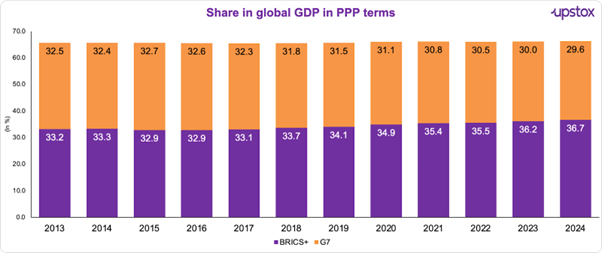
Source: EY
But… What have BRICS achieved together?
The New Development Bank (NDB)
Launched in 2014, the NDB was BRICS’ answer to the World Bank. As of 2025, it has approved over $30 billion in financing — with newer Gulf members expanding its capital and reach. What makes the NDB stand out isn’t size — it’s intent. The 2022–2026 strategy lays out:
-
30% of financing in local currencies
-
30% in non-sovereign operations
-
20% of projects co-financed with partner multilateral banks
-
40% of funds directed at climate action
-
40% of leadership roles filled by women
This is development finance that tries to reflect the Global South’s priorities — not just Western mandates.
$1 trillion+ in Intra-BRICS trade
BRICS+ members now exchange over $1 trillion in trade annually, with deepening collaboration in high-growth sectors: nuclear energy, aviation, robotics, AI, and digital tech. Rather than exit global frameworks like the IMF or WTO, BRICS+ is pushing for reform — more voice, fairer terms, and rules that reflect emerging economies’ realities.
Diversifying currency settlements
While over 90% of global trade still uses the US dollar, BRICS+ countries are building alternatives.
-
Russia and China are promoting BRICS Pay
-
India and UAE have signed rupee-dirham settlement deals
-
Others, including ASEAN countries, are exploring local currency trade
At the 2023 BRICS Summit, Brazil’s President Lula da Silva called for an independent BRICS payment system. Russia’s Foreign Minister Sergey Lavrov added:
The goal isn’t to replace the dollar — it’s to create options.
The expanding circle
Interest in joining BRICS+ is growing. The group now has 13 partner countries, including: Algeria, Belarus, Bolivia, Cuba, Indonesia, Kazakhstan, Malaysia, Nigeria, Thailand, Türkiye, Uganda, Uzbekistan, and Vietnam
Two ASEAN nations, Malaysia and Thailand, are actively exploring full membership. For many emerging economies, BRICS+ is becoming a geopolitical hedge, and a signal of shifting influence.
Behind the BRICS gloss
Sure, BRICS+ is rising — but unity remains a work in progress.
China dominates, expected to drive 22% of global growth over the next five years — more than the entire G7 combined. Tensions between India and China add strain, while the bloc’s mix of democracies and authoritarian regimes leads to diverging views on governance and global priorities.
Foreign policy stances differ too — with Russia and China often challenging the West, while India, Brazil, and South Africa prefer balanced diplomacy.
Still, BRICS+ holds together — thanks to shared economic goals, flexible diplomacy, and the institutional backbone of the New Development Bank.
Still, the West is uneasy. During the 2023 BRICS Summit, Trump warned member states against pursuing an independent trading system outside the US-led global order:
So while challenges persist, BRICS+ continues to function — not through cohesion, but through calculated coordination.
BRICS without China: Still a force?
The elephant in the BRICS room is undoubtedly China. Without it, the bloc’s economic weight and global clout take a serious hit — but the story doesn’t end there.
- GDP Impact: China contributes $18,748 billion out of BRICS’s combined $27,390 billion GDP — that’s over 68%.
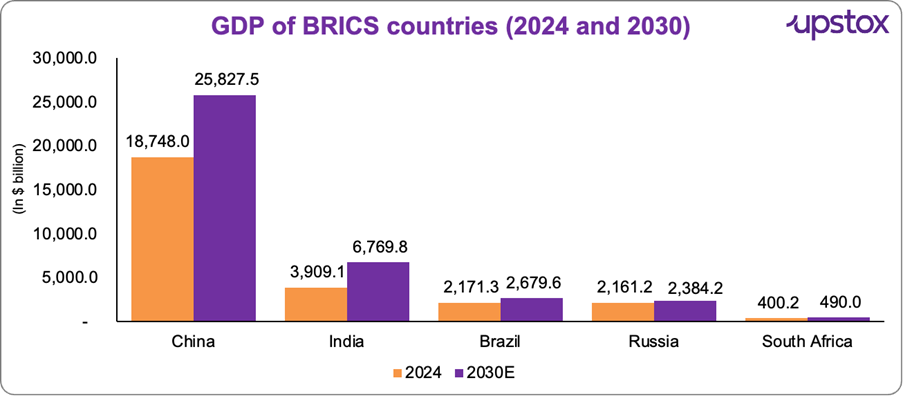
Source: Statista; Note: New BRICS members added in 2024 are excluded to ensure comparability, as their inclusion would distort year-on-year analysis due to recent entry.
-
Without China, the bloc shrinks to just $8,641 billion, pulling its share of global GDP to under 15%.
-
Trade & capital: China is the largest trade partner and a major financier within BRICS. Even the New Development Bank relies heavily on Chinese capital.
-
Diplomatic tensions: China’s assertive stance often contrasts with the more moderate, democratic approaches of India, Brazil, and South Africa.
But BRICS without China still includes rising regional powers, especially India and Brazil, who share a common push for reform, multipolarity, and economic cooperation.
The verdict? It’s a lighter bloc — but still one with ambition and agency.
A shared but uneven future
BRICS+ and the G7 now represent over 70% of global GDP — but their dynamics are very different. The G7 functions as a unified bloc, with shared systems and long-standing coordination. BRICS+ is more diverse, with varying political models and priorities. Still, it has its strengths:
- G7 carries a higher debt relative to GDP.
- BRICS+ has lower interest burdens, offering more fiscal space in downturns.
It’s not a perfectly unified bloc — but BRICS+ is more than just a name. It’s a flexible, evolving group navigating its own path.
Parting thought
BRICS+ or G7 - who’s really shaping the future? That depends on what you’re looking at. The G7 brings coordination, legacy, and institutional muscle. BRICS+ counters with scale, momentum, and a growing appetite to rewrite the rules. They don’t play the same game, but they’re both changing how it’s played. And in this shifting balance, the world isn’t picking sides, it’s watching how both evolve.
About The Author
Next Story

