
Personal Finance News
Home loan EMI calculator: What a 0.25% repo rate hike means for loans from ₹50 lakh to ₹2 crore

4 min read | Updated on October 07, 2026, 16:57 IST


SUMMARY
While RBI has announced the repo rate hike today, this article looks at how the home loan EMI maths work and how a 25 bps rate hike could impact home loan EMIs on different 20-year loan amounts, say ₹50 lakh, ₹75 lakh, ₹1 crore, ₹1.5 crore and ₹2 crore.
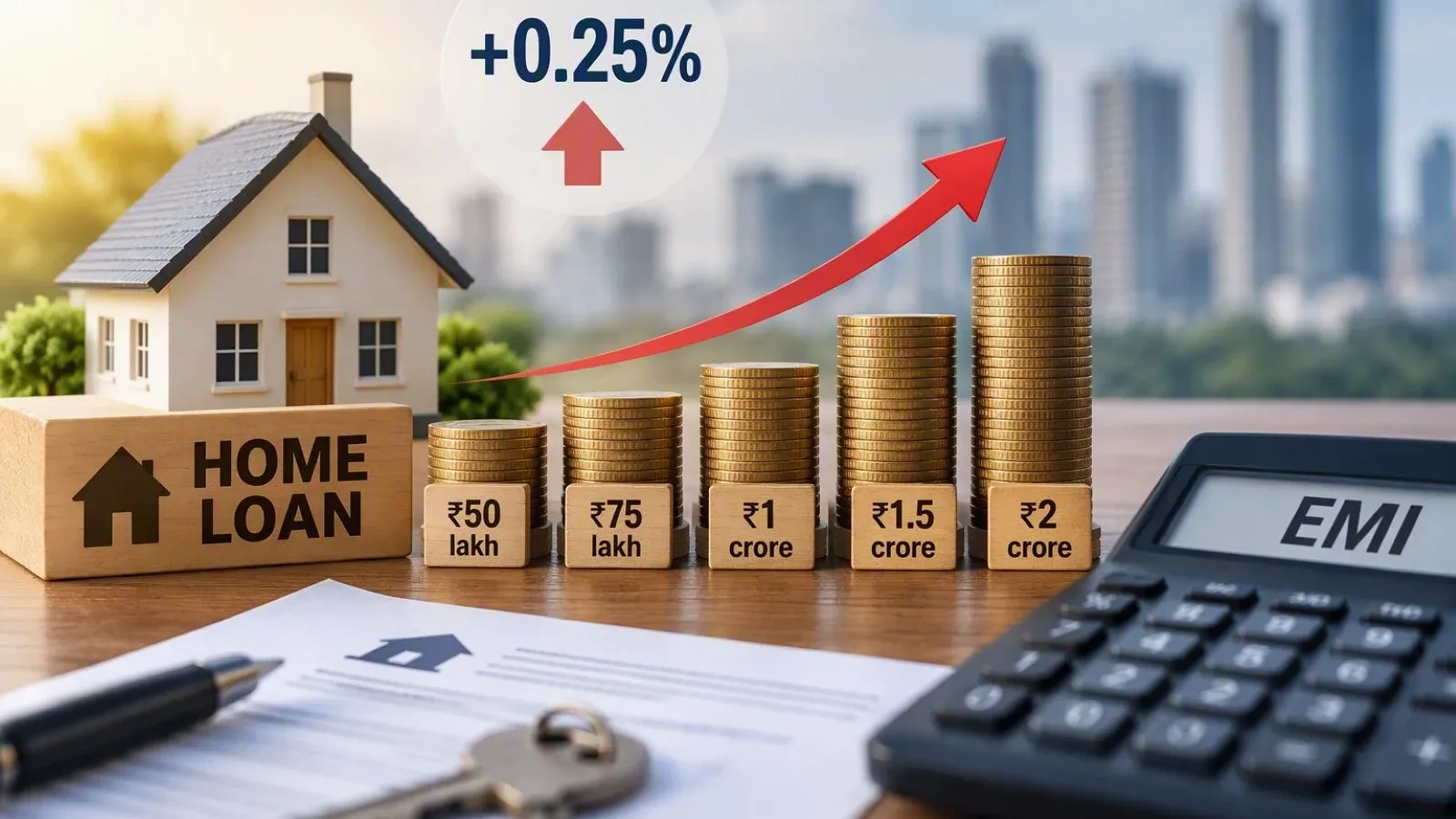
A 25 bps hike means your home loan EMI could rise by ₹794 for every ₹50 lakh borrowed for 20 years. | Representational image/AI generated
Home loan borrowers have a reason to do some calculations this week. The RBI's Monetary Policy Committee (MPC) on Wednesday, October 7, 2026, increased the repo rate by 25 basis points (bps) or 0.25%. This is the first rate by the central bank since February 2023 and the end of a 125-basis-point easing cycle that took the policy rate down to 5.25%.
For borrowers on a repo-linked home loan, 25 bps rate hike will flow almost mechanically into their interest rate. Ahead of RBI MPC, several experts, including SBI Research, had predicted a cautious rate hike. However, there was also a view that the central bank may continue with the current pause. As any hike now would dent festival spending.
While the RBI has announced the repo rate hike today, this article looks at how the home loan EMI maths work and how a 25 bps rate hike will impact home loan EMIs on different 20-year loan amounts, say ₹50 lakh, ₹75 lakh, ₹1 crore, ₹1.5 crore and ₹2 crore.
How the EMI maths works
| Loan amount | EMI at 8.50% | EMI at 8.75% | Monthly increase | Extra interest over 20 years |
|---|---|---|---|---|
| ₹50 lakh | ₹43,391 | ₹44,186 | ₹794 | ₹1.91 lakh |
| ₹75 lakh | ₹65,087 | ₹66,278 | ₹1,192 | ₹2.86 lakh |
| ₹1 crore | ₹86,782 | ₹88,371 | ₹1,589 | ₹3.81 lakh |
| ₹1.5 crore | ₹1,30,173 | ₹1,32,557 | ₹2,383 | ₹5.72 lakh |
| ₹2 crore | ₹1,73,565 | ₹1,76,742 | ₹3,177 | ₹7.63 lakh |
Calculation shows that a 25 bps hike would raise EMIs by about 1.8% across the board, or roughly ₹794 a month for every ₹50 lakh borrowed. If your lender keeps your EMI unchanged instead, the loan would simply run longer. Based on the above assumptions, a borrower holding the EMI steady would need about 253 months, or 21.1 years, instead of 240 months, which is an extra 13 months of payments, to close the loan.
However, at a lower 8.00%, the same 25 bps hike would take a ₹50 lakh EMI from ₹41,822 to ₹42,603, and a ₹2 crore EMI from ₹1,67,288 to ₹1,70,413. And if this is the start of a cycle rather than a one-off hike, the impact would worsen: on a ₹1 crore, 20-year loan at 8.50%, cumulative hikes of 50 bps, 75 bps and 100 bps would push the EMI to ₹89,973, ₹91,587 and ₹93,213 respectively.
What borrowers should check
Borrowers should first check whether their loan is repo-linked (EBLR) or MCLR-linked. Repo-linked loan rates are repriced quickly as banks reset them immediately, often within a month or a quarter; while MCLR-linked loans move more slowly. However, fixed-rate borrowers are untouched by the report rate hike.
Secondly, borrowers should also note that the the spread over repo rate is fixed at sanction. Therefore, the repo rate hike moves only the benchmark part.
Thirdly, on shorter tenures the pain from a rate is smaller. For example, a ₹50 lakh loan over 15 years would see the EMI rise from ₹49,237 to ₹49,972, or about ₹735 only.
Related News


About The Author
Next Story

