Market News
NIFTY50 beats KOSPI, Nikkei, NASDAQ 100 in July: Can India's market rally continue in August?

4 min read | Updated on August 03, 2026, 17:15 IST


SUMMARY
India's outperformance comes at a time when global investors are turning cautious on the AI trade, with market valuations hovering in overheated territory. Some of the best-performing markets of 2026, including the KOSPI, NASDAQ, and Nikkei, have taken a back seat following sharp profit booking in AI-related stocks.

NIFTY50 and SENSEX gained over 2% in July, outperforming their global peers.
Indian benchmark indices emerged among the best-performing global markets after staging a strong rebound from their early-July lows.
The NIFTY50 and the SENSEX gained over 2% in July, extending their rally from June, when both indices had risen by a little over 1%.
The gains came despite heightened volatility and unfavourable movements in currency and crude oil, which remained key headwinds for domestic equities. Investor sentiment also remained cautious amid concerns over the Q1 FY27 earnings season. The June quarter was marked by elevated crude oil prices and an unfavourable geopolitical environment.
Despite these challenges, the benchmark indices managed to deliver gains of over 2% in July, outperforming several major global peers across Asia, Europe, and the US. Here's how global markets fared in July.
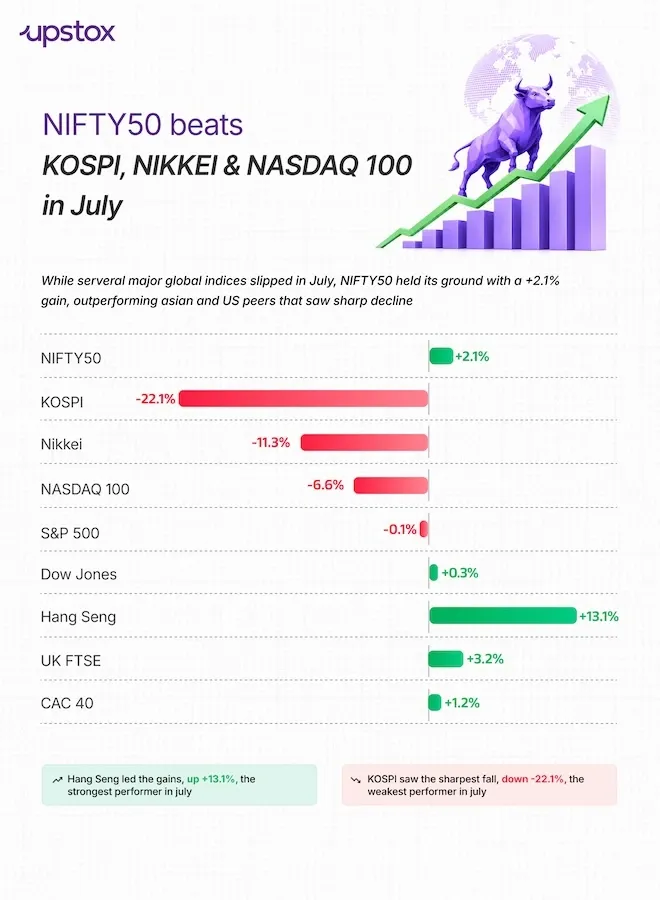
India's outperformance comes at a time when global investors are turning cautious on the AI trade, with market valuations hovering in overheated territory. Some of the best-performing markets of 2026, including the KOSPI, NASDAQ, and Nikkei, have taken a back seat following sharp profit booking in AI-related stocks. Several of this year's top-performing AI stocks have corrected by as much as 50% from their peaks, dragging their respective benchmark indices down by nearly double digits.
FIIs resume buying
Besides the sharp slide in global peers, the Indian market's outperformance was largely driven by strong buying from overseas investors. Foreign Institutional Investors (FIIs) have resumed buying Indian equities as they look for bottom-fishing opportunities in an underperforming yet relatively undervalued market. According to NSDL data, FIIs purchased more than ₹15,000 crore worth of Indian equities in July, snapping a streak of net selling that had persisted for over four months.
Rupee stabilises
The Indian rupee has found a strong foothold near the 95 level against the US dollar in recent months. After depreciating more than 4% during the March-April period, the rupee has largely stabilised despite witnessing sharp swings and touching a record low of around 96.9 against the US dollar. The currency has found support due to the RBI's policy changes on FCNR(B) deposits and the sharp decline in crude oil prices over the past few months. Rating agencies expect Indian banks to mobilise more than $50–60 billion in FCNR(B) deposits in 2026, which could help ease depreciation pressures on the rupee.
Valuation comfort
At a price-to-earnings (P/E) ratio of around 20x, the NIFTY50 is trading comfortably below its five-year median of 22x, offering a meaningful discount to its long-term average. That said, Indian equities continue to command a premium over Asian peers such as the KOSPI and Nikkei, which are trading at around 15x earnings. However, valuations in these markets remain largely skewed towards a handful of technology stocks. On the other hand, Indian benchmark valuations benefit from greater sectoral diversification. The NIFTY 500, which captures a broad universe of companies from large caps to small caps, recorded an 18% year-on-year growth in aggregate earnings in FY26. Media reports suggest that even after excluding IT and banking stocks, earnings growth remained robust at around 14%, underscoring the strength of India's broader economy, particularly the manufacturing sector.
What experts say
Rishabh Nahar, Partner and Fund Manager at Qode Advisors, said, "The story in India right now is pretty simple. Banks are lending well, with credit growth at around 18%, which suggests the underlying economy is chugging along just fine. The IT sector had a rough patch, but it's beginning to recover as some companies are finally putting their cash to work in AI instead of sitting on it."
Commenting on domestic demand, Nahar said the tax collection numbers are the real tell. GST growth has climbed into the mid-teens from barely single digits not too long ago.That's not something you can fake; it indicates that consumers are spending and businesses are transacting. And it's not just one or two sectors; autos, logistics, and several others have delivered solid earnings, the expert stated.
On India's relative resilience, Nahar said, "While the rest of the world got hammered because everyone piled into AI stocks and that trade is now unwinding, India barely participated in that rally. So, we're not dealing with the hangover either. Sometimes, not being invited to the bubble turns out to be the best trade."
About The Author
Next Story