Market News
Sun Pharma to Zydus: Healthcare stocks outperform broader market despite price pressure; can they sustain growth?

6 min read | Updated on September 18, 2026, 15:57 IST


SUMMARY
Healthcare stocks have consistently outperformed the broader markets over the past months as investors focus on sectors with visible earnings potential ahead amid the geopolitical crisis.

Nifty Healthcare outperformed NIFTY50 index delivering close to 15% returns to investors in the last 6 months. | Image: Shutterstock
Indian healthcare sector stocks have significantly outperformed the broader market indices over the past few months, as investors focus on the potential for further growth despite the elevated price pressure and geopolitical supply headwinds in the market.
Companies like Sun Pharmaceuticals, Zydus Lifesciences, Laurus Labs, Aurobindo Pharma, among several other defensive healthcare stocks, have added to the gains, while the broader markets suffer from the impact of the geopolitical crisis in West Asia.
Experts predict that earnings visibility, pricing power, regulatory developments, product pipelines and valuations, among other factors, should remain in focus of investors in the healthcare sector.
While the US business remains important for pharma companies, hospitals and diagnostics firms should be analysed based on their occupancy, realisations, margins and capacity addition factor.
“We believe the market is pricing in domestic market growth and price headwinds in vanilla generics in US market, but not the rainmakers and Emerging Markets growth,” said analysts from Bernstein Research.
Why has healthcare outperformed NIFTY50?
Saikat Kumar, Board Member of Red Lions Capital, ADGM MD & CEO, DIP Market, said that with the stock market facing macro and geopolitical volatility, investors are gravitating towards sectors with relatively visible earnings like healthcare.
“Healthcare’s relative outperformance reflects a combination of defensive characteristics, resilient earnings and improving fundamentals across hospitals, diagnostics and select pharma segments,” said Saikat Kumar.
However, Kumar also highlighted that the impact of the same is increasingly becoming differentiated across companies depending on their product mix, complex generics, speciality portfolio and new launches.
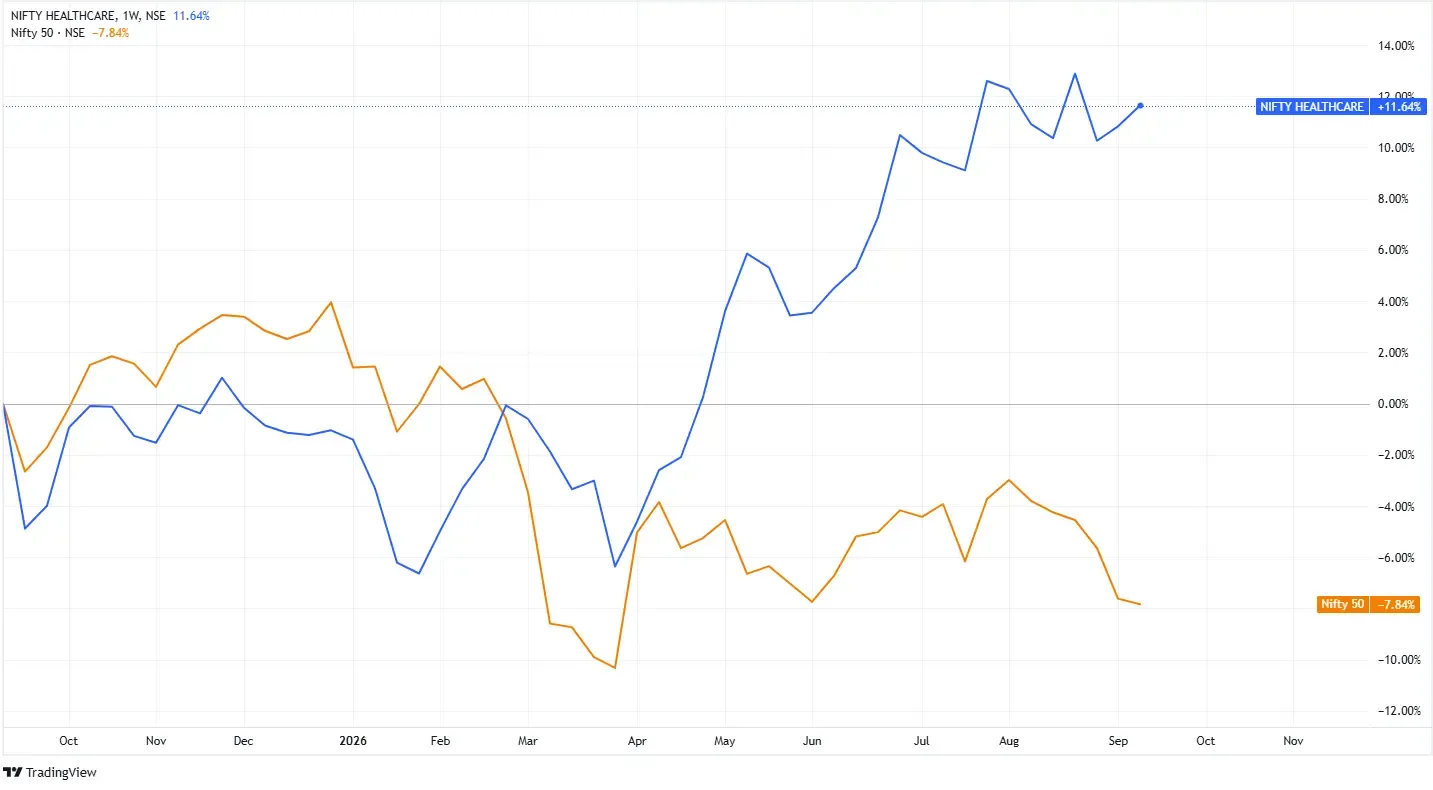
NSE data showed that the sectoral benchmark Nifty Healthcare has outperformed the benchmark NIFTY50 index, delivering close to 15% returns to investors in the last six months, while the broader index lost nearly 2% of its value in the same period.
The chart attached below further showed that on a one-year basis, Nifty Healthcare has gained almost 12% while the benchmark NIFTY50 index has lost around 8%, according to the exchange data.
Challenges & growth prospects
Market experts predict that regulatory concerns, along with pricing pressure from the US generics market, are expected to remain key challenges for Indian healthcare companies in the upcoming period.
Despite the price pressure, the US generics import market remains a key source of revenue for Indian healthcare companies, with domestic companies exporting a major chunk of general prescription drugs and healthcare equipment to America.
“Headwinds include elevated valuations in some pockets, regulatory intervention, pricing pressure in generics and higher input or compliance costs,” said Saikat Kumar.
Investors should also know that factors like increasing patient volumes, along with the premiumisation of healthcare services, capacity expansion, and rising healthcare penetration will act as key tailwinds alongside the ability to adapt with AI and automation.
On the AI use case front, analysts from Japanese investment firm Nomura said that Lupin undertaking artificial intelligence (AI) and automation in multiple use cases and across functions is expected to drive efficiency gains and cost savings that have not been quantified at this stage.
Bernstein analysts expect AI leveraging, a lifestyle shift towards image consciousness, along with a rise in disposable income, will create around $400 billion in opportunities for the sector in the next few years.
Healthcare stocks in focus
| Company name | Stock price | 6-month return | YTD return |
|---|---|---|---|
| Sun Pharma | ₹1,853 | 4.2% | 7.6% |
| Divi’s Lab | ₹9,371 | 52.7% | 47.7% |
| Apollo Hospitals | ₹8,837 | 18.2% | 24.2% |
| Zydus Lifesciences | ₹1,156 | 28.6% | 26.4% |
| Piramal Pharma | ₹208 | 45.3% | 0.7% |
| Laurus Labs | ₹1,976 | 100.8% | 78% |
| Torrent Pharma | ₹4,864 | 13.4% | 26.4% |
| Aurobindo Pharma | ₹1,705 | 33.9% | 43% |
Bernstein predicts $195 billion industry ahead
US-based investment firm Bernstein analysts said India’s Healthcare sector has a constructive outlook for the coming years, with key focus on increasing penetration of health infrastructure in emerging economies.
Six areas including – 505(B)(2) NDAs; Orphan indications; Drug-device combinations; Drug repurposing in niche therapies, metabolic peptides, and RNA; and cellular therapies like CAR-T, will produce rainmakers for Indian biopharma.
Rainmakers are emerging catalyst sectors or business streams which have the potential to bring in higher revenues, in this case, high-growth ventures in the healthcare industry.
“We expect over the next decade these rainmakers to add $70-75 billion to Industry size and total Industry to grow by 4 times to $195 billion,” said Bernstein analysts.
Companies like Zydus, Lupin, and Sun Pharma, among others are key companies which operate in the sector.
Govt’s stem cell crackdown
As per the latest advisory from the Union Health Ministry, the States and Union Territories’ have been directed to oversee and ensure strict compliance on government and private clinics which are involved in stem cell research, treatment, promotion or administration.
The directive also said that the authorities will ensure strict compliance with the applicable framework governing stem cell research and therapy.
This advisory was released on September 17 in response to a Supreme Court ruling in a case which highlighted facilities which failed to comply with the standards now facing consequences, including professional misconduct.
While this move serves as a caution for unproven and experimental stem cell treatments, it also provides a push towards heavily regulated and proven therapies which are offered by several companies that have succeeded in clinical trials.
Long-term outlook for healthcare sector
Capital markets experts predict that the longer-term outlook for the Indian healthcare sector will be supported by several factors like rising demand, increased affordability, innovation opportunities in niche therapies and complex specialities, among other things.
“The long-term case remains supported by structural under-penetration of healthcare, rising affordability, formalisation and increasing demand for quality care,” said Saikat Kumar.
The analyst said that although the sector may have support from the structural tailwinds, outperformance in the stock market will ultimately depend on company-specific earnings growth relative to valuations.
In line with expectations, Bernstein analysts also said that they have a positive sector view on the Indian healthcare sector, with a key focus on niche therapies and complex specialities, which is expected to drive Indian Biopharma’s revenue acceleration and sustainable scale-up in earnings.
Related News
About The Author
Next Story