Market News
Sun Pharma, Cipla, other pharma stocks decline as Trump unveils steep tariff plan on generic drugs: Key FAQs answered

5 min read | Updated on July 22, 2026, 16:28 IST


SUMMARY
Generic drugs are medicines that contain the same active ingredient, dosage, strength, safety, quality, and intended use as a branded (original) drug, but are typically sold at a lower price.
India is one of the world's largest producers of generic medicines.
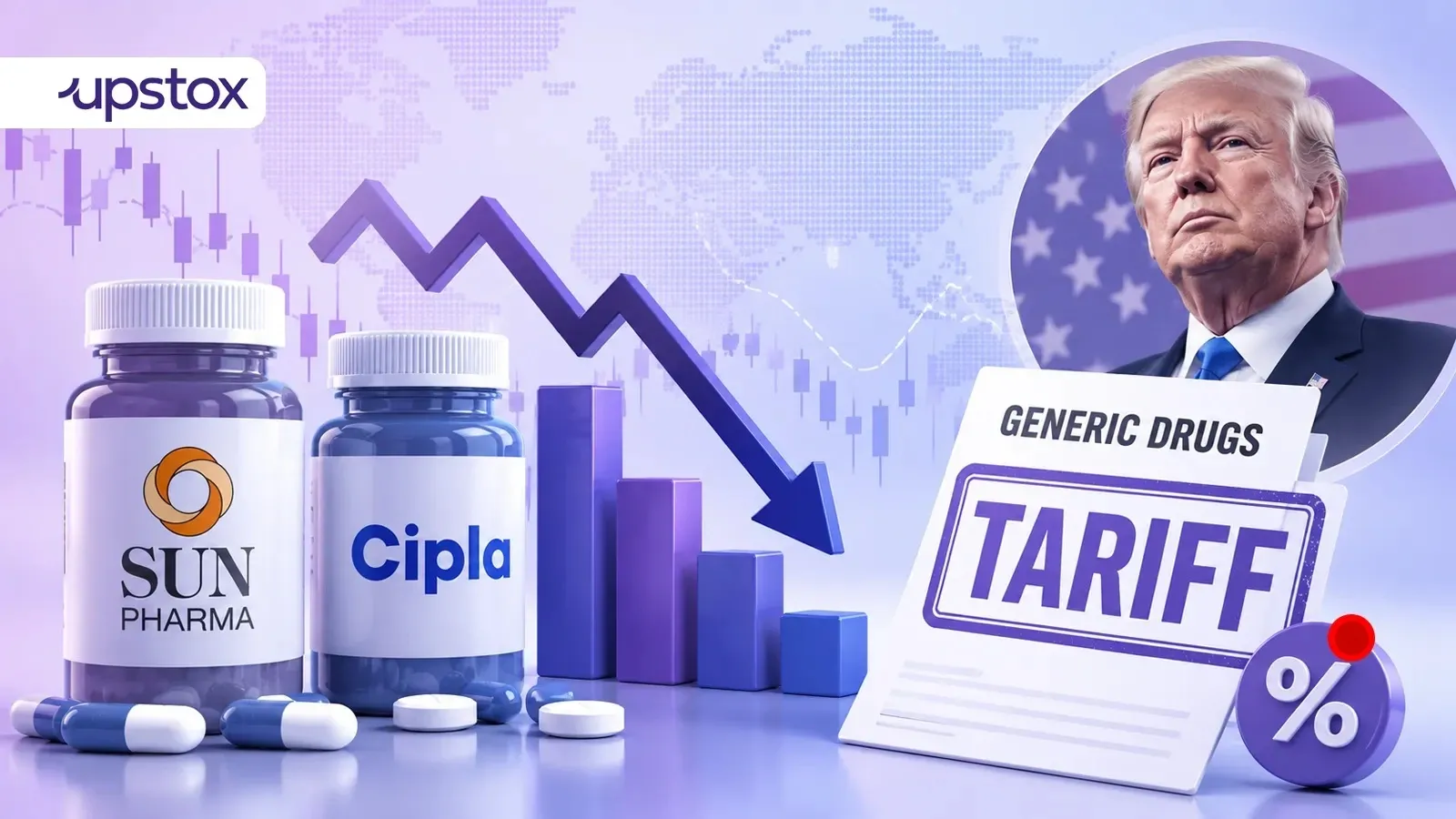
Shares of pharmaceutical companies such as Sun Pharma, Dr Reddy's Laboratories, Lupin, Aurobindo Pharma and Cipla, among others, were trading lower on Wednesday, July 22, after US President Donald Trump proposed tariffs of up to 200% on generic drug imports into the United States following a two-year tariff-free period.
In his post on Truth Social, Trump said, "Effective August 1st, 2026, all Generic Drugs being brought into the United States will continue to have a TARIFF of ZERO PERCENT for a two year period of time, after which the TARIFF will be raised to 100% for a one year period of time, and 200% thereafter. This is done in order to RESHORE Generic Pharmaceutical Production into America, with a penalty to those Companies that decide not to build Plant and Equipment within the stated period of time given to them."
"The objective of this Policy is to protect the people of the United States. The Policy on Patented, Branded, or Innovative Drugs, which has been so successful, will remain as is. Pharmaceutical Facilities are being built, at a level never seen before, all over the United States of America. Thank you for your attention to this matter! President DONALD J. TRUMP," the post added.
Here is how stocks are performing
The NIFTY PHARMA index slipped as much as 1.73% to hit the low of 25,639.70 in the early trade against the previous close of 26,092.85, with 19 out of 20 components trading in the red.
When last seen, Auobindo Pharma shares traded 2.16% lower at ₹1,545.60 apiece on the NSE, while Sun Pharmaceutical Industries was down over 1% at ₹1,941.70. Dr Reddy's Laboratories was trading nearly 1% lower at ₹1,196.40 on the NSE, and Cipla traded over 1.2% down at ₹1,414.40.
Lupin shares traded nearly 2.5% lower at ₹2,453.50 apiece on the NSE.
What are the generic drugs?
Generic drugs are medicines that contain the same active ingredient, dosage, strength, safety, quality, and intended use as a branded (original) drug, but are typically sold at a lower price.
-
A pharmaceutical company develops a new drug and sells it under a brand name after obtaining a patent.
-
Once the patent expires, other manufacturers can produce and sell the same medicine as a generic drug.
-
Before approval, generic drugs must demonstrate bioequivalence, meaning they work in the body in the same way and provide the same therapeutic effect as the branded version.
Generic manufacturers do not bear the high costs of
-
Discovering and developing a new drug.
-
Conducting large-scale clinical trials to establish safety and efficacy (they rely on the original drug's data).
-
Extensive marketing and branding.
As a result, they can sell the medicine at significantly lower prices.
What you need to know
India is one of the world's largest producers of generic medicines. Companies such as Sun Pharmaceutical Industries, Dr. Reddy's Laboratories, Cipla, and Lupin are major manufacturers and exporters of generic drugs.
In short, generic drugs are equivalent alternatives to branded medicines—they offer the same medical benefits while being more affordable.
Impact
If implemented, analysts and news reports suggest that this would be a major policy shift for the global generic drug industry, especially for Indian pharmaceutical companies, which are among the largest suppliers of generic medicines to the US.
Expert View
Harshal Dasani, Business Head at INVAsset PMS, opines that the two-year tariff-free period is not a reprieve. It is a deadline for Indian pharmaceutical companies to rethink their US manufacturing footprint. If tariffs rise to 100% and later 200%, the economics of exporting commoditised generics from India could become unviable. The US contributes more than one-third of India’s pharmaceutical exports, so the earnings risk is meaningful for companies with high exposure to low-margin US generics.
"The immediate impact is likely to be uncertainty rather than an earnings collapse, because companies have time to renegotiate contracts, acquire or build US capacity, enter local manufacturing partnerships and exit unprofitable products. The larger risk is that distributors refuse to absorb the tariff, forcing manufacturers to either raise prices or withdraw certain medicines. That could tighten drug availability in the US and eventually create political pressure to dilute the proposal, given that generics account for the overwhelming majority of prescriptions," Dasani added.
The expert further said that the most vulnerable companies are those dependent on commoditised US generics, with limited local manufacturing and weak pricing power. Relative beneficiaries could include firms with existing US plants, complex generics, specialty portfolios and contract manufacturing capabilities within America.
"Domestic-focused branded formulation businesses may also receive a valuation premium because their earnings are less exposed to US trade policy. The key question is no longer just US revenue exposure. It is how much of that revenue can be localised before the tariff window closes," the expert said.
Commoditised US generics are generic medicines in the US market that are widely available from multiple manufacturers and are largely differentiated only by price.
In other words, these drugs have become commodities—buyers (such as pharmacies and distributors) view products from different manufacturers as interchangeable.
Related News

About The Author
Next Story