Market News
Gold prices fall 28% in 2026, but Titan and Kalyan Jewellers shares rise up to 34%: How jewellers beat the gold crash

8 min read | Updated on November 26, 2026, 12:08 IST

SUMMARY
Gold in India has fallen over 28% from its peak on January 30, 2026, and 11.2% in November alone. Yet Titan, which operates Tanishq stores, Kalyan Jewellers and several other jewellery stocks have risen this year. Here’s how
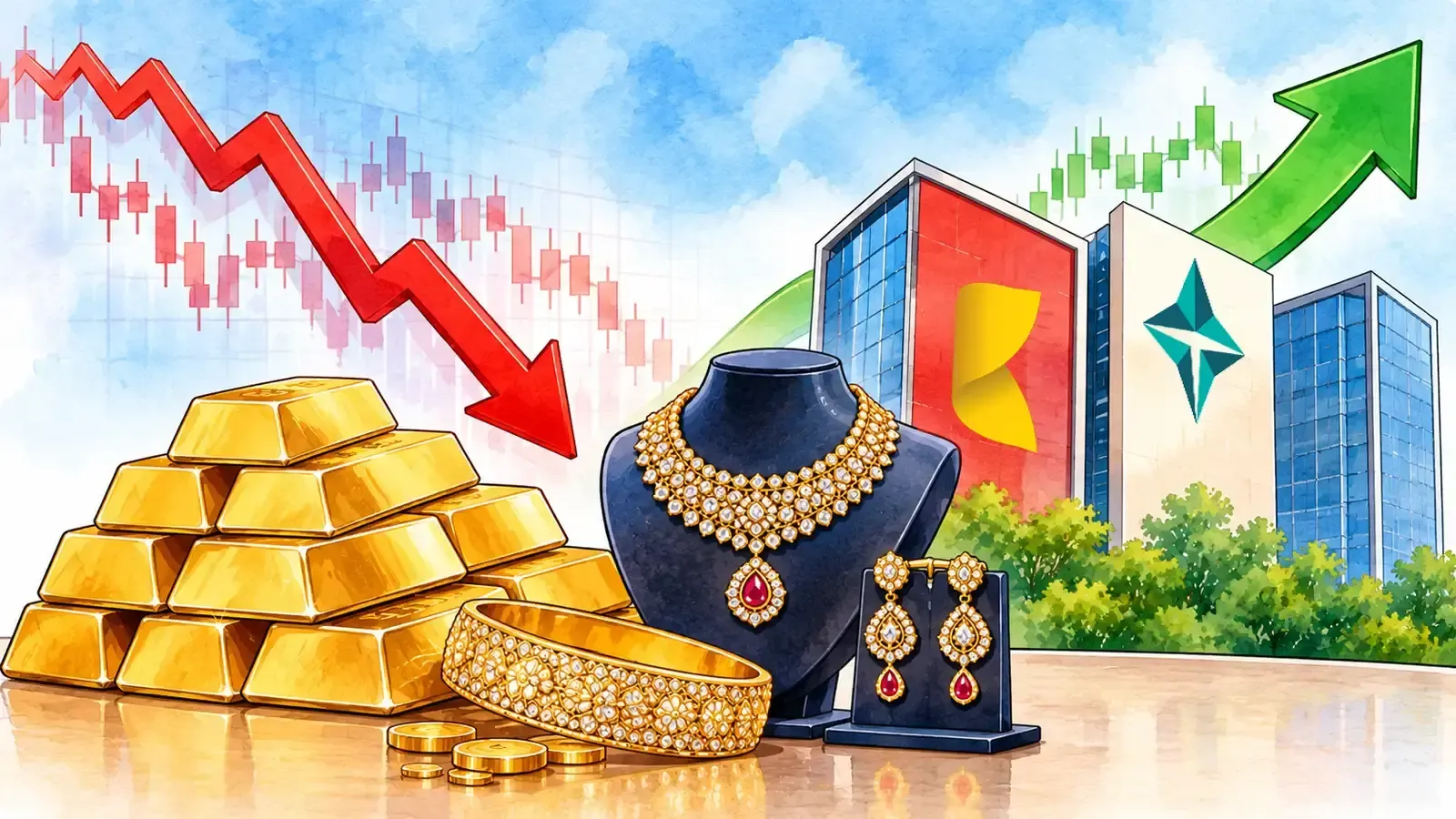
24-carat Gold has lost ₹47,437 per 10 grams, or 28.1% year-to-date.
Gold prices in Mumbai, Delhi and across different states have witnessed a sharp correction in recent weeks. On November 25, 24-carat gold prices (Gold 999) stood at ₹1,21,038 per 10 gram, excluding the GST and making charges. 24-carat gold rate has lost ₹47,437 per 10 gram, or 28.1% compared to the start of this year.
January 30, 2026, was a good day to sell gold and a bad day to buy it. That morning, 10 grams of 24-carat gold cost ₹1,68,475, as per the India Bullion and Jewellers Association (IBJA) website. A small family-run jeweller who stocked up 2 kg of gold as inventory on January 30 would have paid about ₹3.37 crore.
On November 25, the same 10 grams of gold cost ₹1,21,038. The small jeweller who bought 2kg of gold at ₹1.68 lakh per 10 grams earlier this year is now worth ₹0.95 crore less than what it paid
Prominent jewellery chains like Tanishq (owned by Titan Company) and Kalyan Jewellers sell far more gold than any such local shops, yet these companies are making strong profits despite losses from gold inventory purchases. In fact, shares of these companies have given double-digit returns despite a 28.1% fall in gold price on a year-to-date basis.
Both Tanishq and small jewellery shops sell the same metal, and gold has fallen just as hard for both. So why does the fall look so different for the two?
Why did gold prices drop sharply?
From the January 30 high, the 24-carat rate has lost ₹47,437 per 10 grams, or 28.1%. On October 30, Gold was at ₹1,40,891 per 10 grams, so prices have corrected by over 11% in November alone, 9.1% since the start of this year and 28.1% from the January 30 peak price.
Globally, spot gold hit a record of about $5,595 an ounce on January 29. By November 19, it had slipped to around $3,674 after touching a 14-month low, as a strong US dollar and expectations of interest rate hikes by major central banks (including the US Federal Reserve) and rising bond yields raise the opportunity cost of holding non-yielding assets like gold, leading to a recent sell-off. Indian buyers also pay a higher import duty now, after it was raised to 15% from 6% in May, 2026.
Gold price vs jewellery stocks
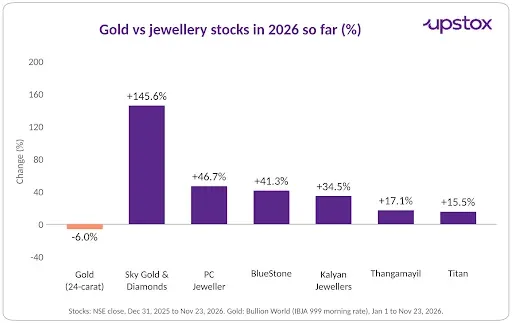
As seen in the table above, companies that sell gold, like Titan Company, Kalyan Jewellers, and PC Jeweller, have seen a surge in their stock prices despite falling gold prices. Kalyan Jewellers is up 34.5% this year and PC Jeweller 46.7%, well ahead of Titan's 15.5%. Smaller organised store operators like BlueStone and Thangamayil have also gained. Not every jewellery stock has done well, though. Senco Gold and PN Gadgil Jewellers are down this year.
These companies' latest earnings are also strong. In Q2FY27, Titan Company reported consolidated net profit of ₹2,393 crore, up 114% YoY, while its revenue from operations rose 10% YoY to ₹20,614 crore. Tanishq brand accounts for more than 85% of Titan’s overall earnings. Kalyan Jewellers' net profit grew 64% YoY to ₹427 crore, while revenue rose 31.4% YoY to ₹10,322 crore.
The September quarter earnings came before November's sharp fall, so Q3FY27 will be the real test for these companies. Meanwhile, jewellery shares have had bad days too. On November 18, as gold prices declined, Titan fell 5.3% and Kalyan Jewellers 4.8% in a single session. So how do big jewellery chains keep on rising despite a fall in gold inventory prices?
Titan and others use hedging to mitigate losses
Think of hedging as insurance on the price of the gold sitting in the shop. The jeweller takes an opposite position that makes money when gold falls. If the gold on the shelves loses value, the hedge gains, and the two roughly cancel out. Big jewellers mainly use two tools.
The table below shows how hedging works for 1 kg of gold for two different set of jewellers.
What does 28.1% fall in gold prices does tp 1 kg of gold
| Jeweller without a hedge | Jeweller with a hedge | |
|---|---|---|
| Value of 1 kg on Jan 30, 2026 | ₹1.68 crore | ₹1.68 crore |
| Value on Nov 25, 2026 | ₹1.21 crore | ₹1.21 crore |
| Change in value of gold held | -₹0.47 crore | -₹0.47 crore |
| Gain on hedge (1 kg sold forward on Jan 30) | Nil | +₹0.47 crore |
| Net impact | -₹0.43 crore | About zero |
The hedged jeweller is largely protected, before considering the hedging costs. The one without a hedge is sitting on a paper loss of ₹0.47 crore on a single kg of gold.
Unhedged jewellers carry the bigger price risk
Around 60% of India's jewellery market is still unorganised, according to Kalyan's management. On Titan's earnings call, one analyst described local and regional jewellers as players "who don't really do hedging". Futures need margin money and daily mark-to-market payments, while gold loans and bank contracts need credit lines that many small shops may not have.
When gold was rising, unhedged stock kept gaining value. Now the same stock loses value every time gold falls. Titan's CFO Ashok Sonthalia put it plainly on the Q2 call: “Softening gold prices act as a structural advantage for Titan Company, allowing it to gain market share from smaller, unorganised jewellers despite the optical dip in per-gram selling prices”.
So how do Titan and other big jewellery chains make money?
If big chains are not betting on gold prices, how do they earn? A large part comes from making charges, design and studded jewellery. Making charges are fees for turning raw gold into jewellery. Leading gold jewellery chains in India have making charges in the range of 7% to 25% of the gold value.
So, a 10-gram gold chain at an illustrative gold rate of ₹12,000 per gram will cost around ₹120,000 excluding the 3% GST and 10% making charges.
- Making charge: ₹120,000 × 10% = ₹12,000
- Subtotal: ₹120,000 + ₹12,000 = ₹132,000
- 3% GST: ₹132,000 × 3% = ₹3,960
- Final bill: ₹135,960 for 10 gram gold chain
However, fall in gold prices do have a side effects. When making charges are set as a percentage of the gold value, a 28.1% fall in gold impacts the overall making charges. On Janurary 30, 10% making charges stood at ₹16,847.5 for a 10 gram of gold chain, while same has fallen to ₹12,103 on November 25, 2026.
Hedging protects the gold on the shelves, not the income from each sale. To make up for it, jewellers need to sell more grams or more studded pieces. Titan's management said customers began coming back from October 31 as gold prices softened. Kalyan said the first 40 days of Q3FY27 were excellent, with growth in volumes.
Conclusion:
For the small jewellery shop that is carrying unhedged gold, likely to make losses if gold prices start falling continuously. Meanwhile, big jewellery chains like Tanishq, Kalyan Jewellers and others who have their gold prices covered by hedging have an advantage in a falling gold price scenario.
Hedging is not completely free altogether. Jewellers pay interest on bank gold loans and costs on hedge contracts, and they give up windfall gains when gold rises. Where making charges are a percentage of the gold value, cheaper gold also means smaller charges per piece unless buyers take home more grams.
About The Author
Next Story