
Upstox Originals
Will India have to pay double for urea?

5 min read | Updated on May 12, 2026, 19:43 IST


SUMMARY
Urea is critical to India’s agricultural growth. India just agreed to pay $959 per tonne for urea — nearly double what it paid two months ago. China, facing the exact disruption, is paying almost nothing extra. Why? The answer lies in its massive coal-based fertiliser ecosystem, while India remains far more dependent on imported natural gas. So, what can India do right now to ease the pressure?
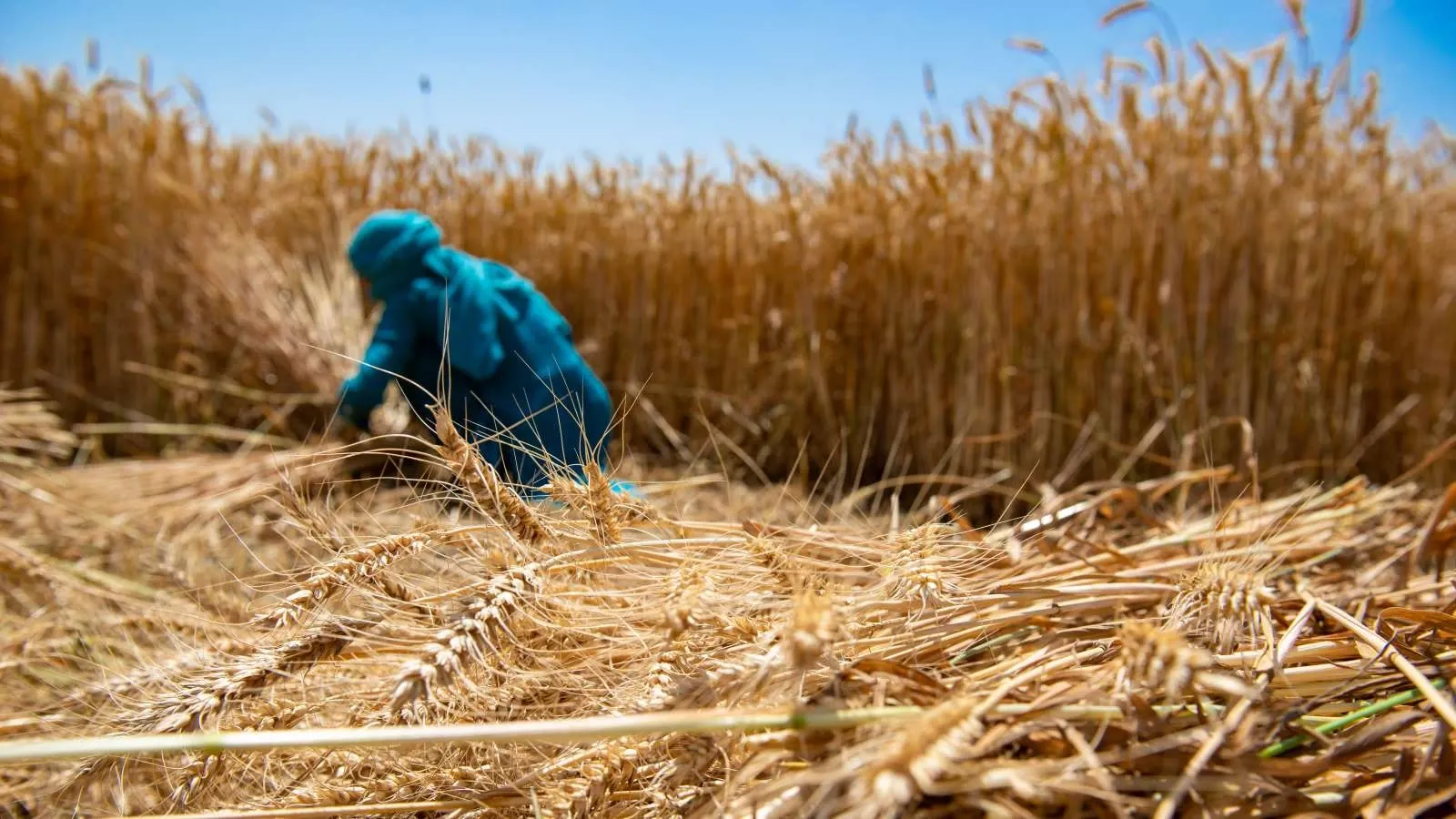
India just agreed to pay $959 per tonne for urea — nearly double what it paid two months ago
Here's a number that should worry you: $959 per ton.
That's what some suppliers are asking India to pay for urea right now. Just two months ago, India was paying just over $500 per ton. In a few short months, the price has effectively doubled.
Now, if you look at the chart below, the global average price for urea in April 2026 sits around $856. But for India, the latest spot prices being quoted by some suppliers remain even higher, due to tightening supply and escalating Middle East tensions. Indian Potash Ltd (IPL) recently agreed to buy 1.5 million tons at $935 per ton for the west coast, and another million tons at $959 per ton for the east coast.
India doesn't have much choice but to pay these prices.
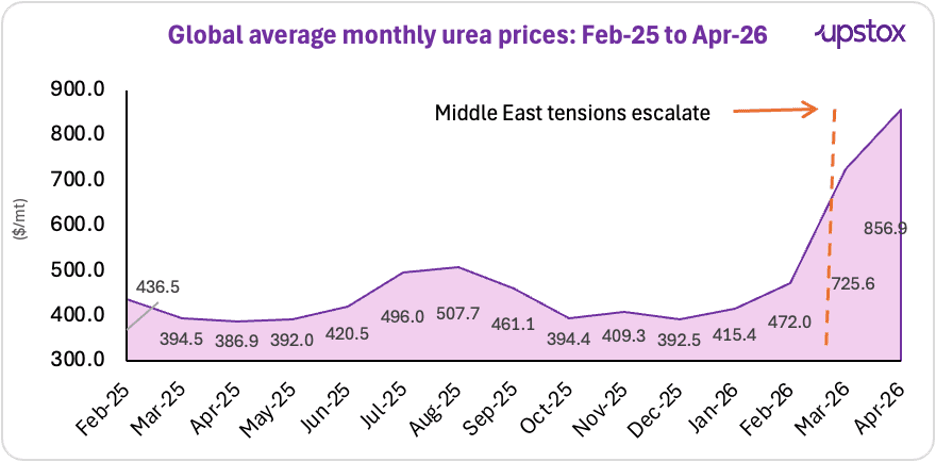
Source: World Bank Commodity Price Data (Pink Sheet)
Why is urea so critical, and how is it even made?
Urea is the world's most widely used nitrogen fertilizer; think of it as the protein that crops need to grow. It contains 46% nitrogen, and without it at the right time, yields collapse.
You can't make urea from scratch, though. First, you make ammonia, and ammonia needs a feedstock; either natural gas or coal. Over 70% of the world uses natural gas for this. That's exactly where India's problem starts.
The timing creates a further challenge
As you can imagine, farmers will be the most impacted by this price rise. The biggest worry for Indian farmers is availability. May-June is critical for planting Khareef crops like rice, and lower urea usage can cut crop yields by up to 20%.
In the face of rising global urea prices, the government has so far absorbed most of the shock through subsidies. But the burden continues to grow heavier. That's likely why, on May 10, PM Modi urged farmers to reduce chemical fertiliser usage by up to 50% even as supply concerns grow.
How dependent is India?
India uses about ~35 - 40 million tonnes of urea every year. But, you see, even though India produces urea inside the country, it still needs natural gas to make it. And where does that natural gas come from? Imports.
Currently, 86% of the natural gas used to produce urea in India is imported. And, about 55-60% of India's LNG imports pass through the Strait of Hormuz. When conflicts erupt in that region, like right now with Iran, supplies get disrupted.
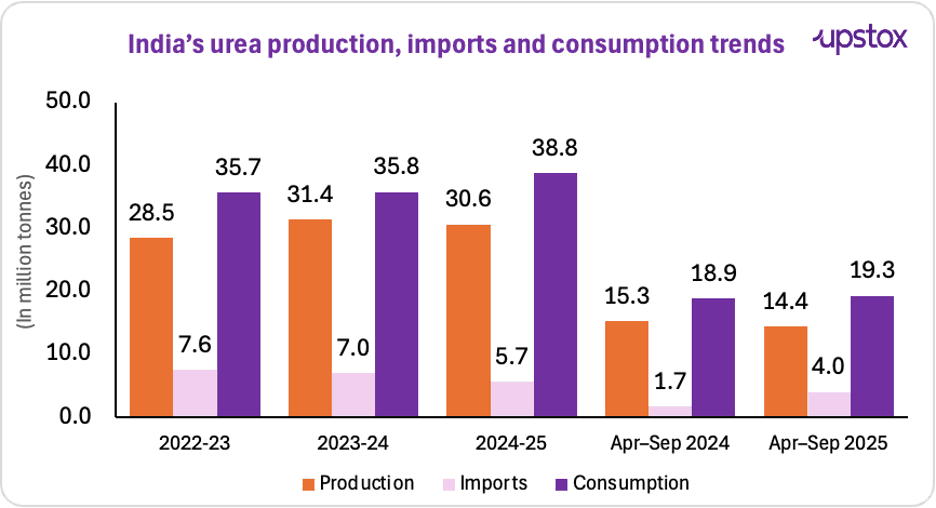
Source: Indian Express
Why India, wouldn’t this affect everyone?
While the rest of the world scrambles, China is barely feeling the heat at all. In fact, the price of urea on the Chinese market has hardly flinched. As of May 11, 2026, prices in China are hovering around $257/ton. Surprising, right? So, why is one neighbour sitting comfortably while India is facing a full-blown agricultural crisis?
So, why is China not as affected?
Decades ago, China made a different choice. China decided to use coal to make urea. Not natural gas. Coal. And that’s how today, it’s the largest producer of urea.
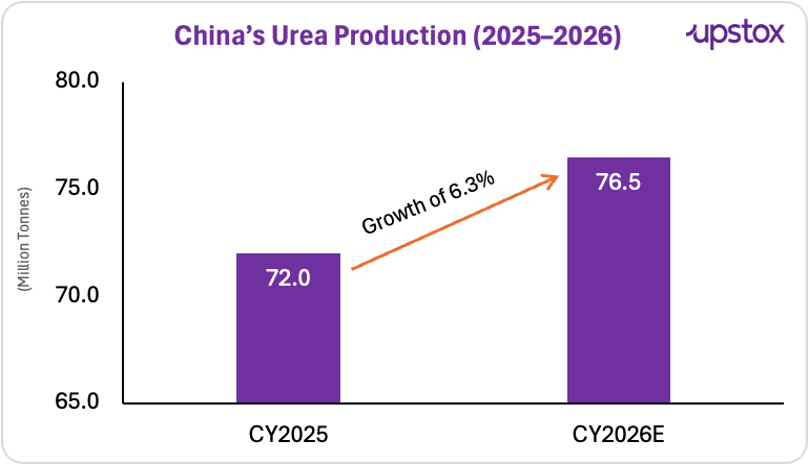
Source: Reuters
Today, 78% of China's urea comes from coal, through a process called coal gasification. China's coal industry has reached massive proportions, consuming about 380 million metric tons of coal to produce chemical and liquid fuels, making it the world's third-largest consumer.
Wait, doesn't India have coal?
India is the world's second-largest coal producer. During FY 2024-25, India produced over one billion tonnes of coal. That's the highest ever. And demand is expected to hit 1.5 billion tonnes by 2030.
So here's the obvious question: If India has so much coal, why doesn't India just do what China did?
The answer lies in the quality.
-
The ash problem: Indian coal is considered "dirty." It has an ash content of 30–45%, compared to the global average of 10–20%, which makes gasification significantly more expensive.
-
The depth problem: About 40% of our coal is buried deeper than 300 meters, making conventional mining capital-intensive.
-
The climate cost: Coal gasification is a carbon heavyweight. It emits roughly 3.8 tonnes of CO2 per tonne of ammonia, compared to just 1.8 tonnes for natural gas.
Now, what is India doing in the short term?
It's pushing farmers toward Nano Urea, a liquid fertilizer developed by Indian Farmers Fertiliser Cooperative Limited (IFFCO). This is sprayed directly onto crop leaves instead of being applied to the soil.
The best part, it's made entirely in India, which means no imports and no dependence on the Strait of Hormuz.
While this is a start, some studies have found that using nano urea tends to result in yield reductions in rice and wheat. So, it's a start, but not a long-term solution.
And what about the long-term?
A technology like China's would definitely be an answer. Yes, coal gasification. It may not be the cheapest or cleanest option. But when global natural gas prices swing wildly and supply chains become uncertain, having an alternative suddenly starts looking valuable. India has already begun taking small steps. The government is exploring Underground Coal Gasification (UCG), where coal is converted into syngas beneath the earth's surface itself.
Then there's the Talcher Fertilizers plant in Odisha, India's flagship coal gasification-based urea project, expected to produce 1.27 million tonnes annually; currently targeted for commissioning by December 2027, though the project has faced multiple deadline slippages since it was first announced. Because in the end, this isn't just a story about coal or urea. It's a story about how far countries are willing to go to secure something as basic, and as critical, as food.
About The Author
Next Story

