
Upstox Originals
After years of pain, is Indian telecom in a sweet spot?

8 min read | Updated on August 21, 2026, 21:14 IST


SUMMARY
India's telecom sector could be moving from a decade of fragmentation, pricing stress and high leverage to a cleaner cycle of ARPU-led monetisation, data-led growth and balance-sheet repair. The next leg of growth would be driven by mass digitisation and accelerated usage of data in AI era.
Stock list
The entry of Jio in 2016 reset the telecom market. | Image: Shutterstock
For years, India’s telecom companies carried more traffic but earned too little from it. Data consumption soared, networks expanded and digital services became essential, yet sector returns remained troubled.
That equation is now reversing. As companies raise tariffs, ARPU is improving, and debt is starting to moderate. Besides that, telecom is evolving from an old connectivity business into the backbone of an AI-led digital economy, powering everything from payments and entertainment to cloud, commerce and intelligent applications.
The sector's journey has been painful, but the outcome is structurally stronger. Driven by four major factors: digital adoption, data growth, rising ARPU and deleveraging. These are not separate themes. Digitisation drives data traffic. Rising traffic improves the case for tariff normalisation. Higher ARPU expands cash flows. Stronger cash flows reduce leverage and improve returns.
From fragmentation to consolidation: Evolution of the sector
The sector's biggest structural change is not technology. It is a market structure. A decade ago, India had too many operators, too little pricing power and a high-cost spectrum regime.
The entry of Jio in 2016 reset the market. It accelerated 4G adoption, brought down data prices, forced weak operators out and compressed the industry into a rational structure. As shown in the table below, this did lead to some stagnation in the ARPU growth initially.
| Period | Event | Sector impact |
|---|---|---|
| 1995–2005 | Telecom liberalisation and private sector entry | Subscriber expansion begins; voice becomes mass market. |
| 2008–2012 | Licence boom, spectrum costs and regulatory uncertainty | Balance sheets weaken; sector becomes litigation-heavy. |
| 2016 | Reliance Jio launches nationwide 4G network | Data prices collapse; incumbents are forced into tariff cuts and capex catch-up. |
| 2017–2019 | Smaller operators exit or merge | Industry moves towards consolidation; Vodafone-Idea merger becomes a survival response. |
| 2020–2025 | Tariff repair phase begins | ARPU starts rising as operators regain pricing discipline. |
| FY26 onward | Monetisation and deleveraging phase | Higher ARPU, lower capex intensity and free cash flow recovery drive return improvement. |
Source: Media Articles, Forbes India, Moneycontrol
But over the past years, slowly yet definitely, this critical measure has been improving.
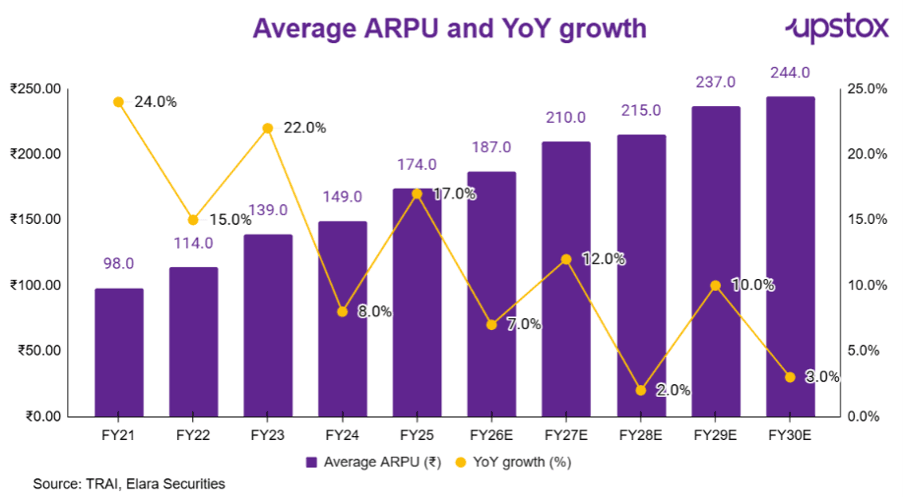
ARPU: The most critical variable
ARPU, or average revenue per user, is one of the most important numbers in telecom. Subscriber growth matters, but once most people already have mobile connections, future earnings depend more on how much each user spends.
India’s ARPU is expected to rise from ₹187 in FY26 to ₹244 by FY30E. This growth can come from tariff hikes, better plans, higher data usage and stronger pricing discipline. As internet usage becomes habitual, telecom customers become increasingly sticky.
This gives operators greater pricing power, supporting tariff hikes and higher ARPU. The impact on profitability can be significant because network costs do not rise at the same pace as revenue. As a result, every increase in ARPU can drive a much larger improvement in EBITDA and free cash flow.
Further, despite a significant increase in ARPU in the last few years, India commands low ARPU compared to global peers.
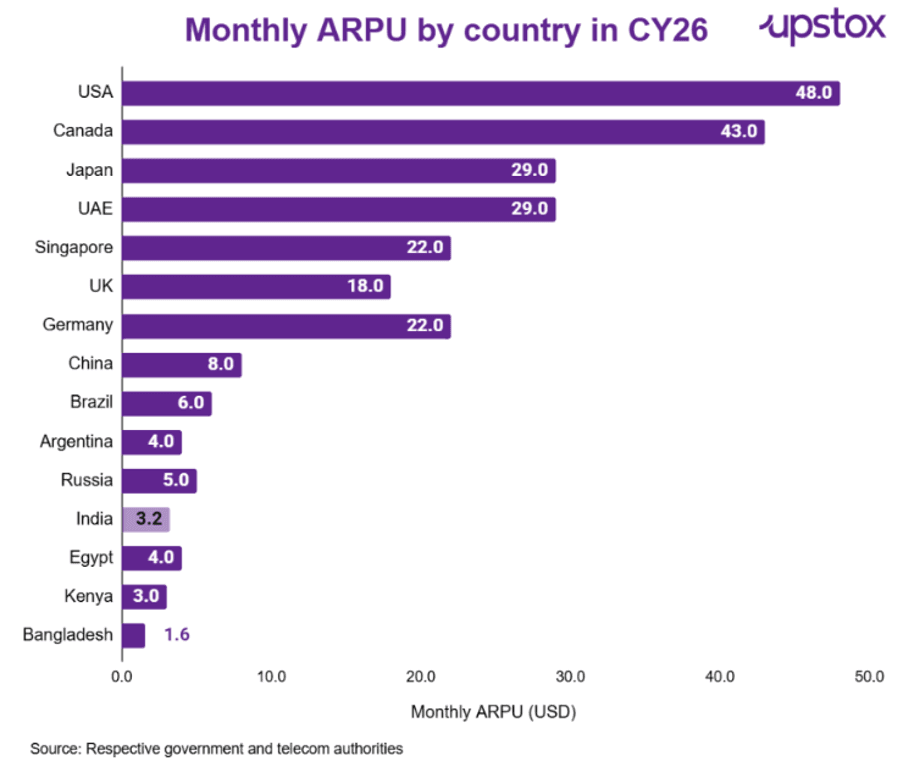
Even on a purchasing-power-parity basis, Indian telecom tariffs remain structurally underpriced. Entry-level plans are around 20% cheaper than in China despite offering superior data and voice benefits, while the pricing gap is even wider for higher-data smartphone plans.
Why India's telecom is in a sweet spot
The sector is seeing a rare combination: consolidated competition, rising ARPU, high data demand, and improving leverage. Most capital-intensive industries get one or two of these at a time. Telecom is getting all four together.
Structural data growth
India’s monthly data usage per user increased nearly 15x to 21GB between CY16 and CY24, driven by affordable data and wider adoption. The next phase will be led by higher video consumption, data-heavy applications and deeper digital adoption across sectors. This could push monthly usage beyond 75GB per subscriber over the next 5–10 years.
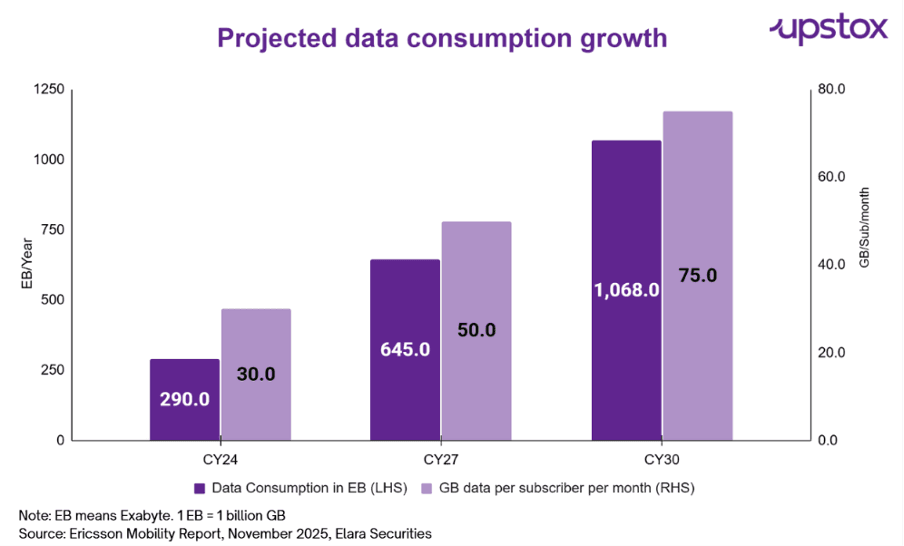
Video continues to dominate data traffic (~50–60%)
Video is driving data consumption in two ways. First, better devices and faster networks are pushing users toward higher resolutions—moving from 480p to 4K can consume nearly 8x more data. Second, the rapid growth of short-form video is increasing both viewing time and overall data usage.
AI is creating a new layer of data demand
On smartphones, AI features such as smart cameras, voice assistants, and personalised content are increasing user activity. For businesses, AI adoption across customer service, analytics, and automation is driving more data exchange between devices and the cloud.
Tier II, III and rural India offer strong growth potential
Smaller cities and rural markets are seeing faster smartphone adoption and better network coverage. Rural teledensity is still around 60%, compared with over 130% in urban India, leaving significant room for new users and higher data consumption. India is seeing rapid 5G adoption, led by network expansion, affordability, and the need for high-speed networks.
Largest digital distribution platforms
With 524 million users, Jio and Airtel with 373 million users offer unmatched digital reach in India. Enterprise partners can bundle their services with telecom plans to quickly access a large customer base. Partnerships with AI platforms such as Gemini and Perplexity show how telcos can help digital services scale and monetise faster.
Premiumisation can further improve ARPU
Beyond tariff hikes, telecom companies are increasing ARPU through better network quality, stronger indoor coverage and more reliable services. They are also moving users to higher-value plans with more data, premium content and bundled digital services. This shift from low-cost data to better customer experience allows telcos to charge more for differentiated connectivity.
Strengthened financial health
Last but not least, telecom players' financial health today is not bloated by the burden of debt or regulatory dues but strengthened from continuous deleveraging and consistent cash flow generation. Both Jio and Bharti Airtel have significantly reduced leverage. Jio’s net debt-to-EBITDA declined from 0.88x in FY24 to 0.36x in FY26, while Airtel’s fell from 2.19x to 1.36x.
| Reliance Jio | Reliance Jio | Reliance Jio | Bharti Airtel | Bharti Airtel | Bharti Airtel | |
|---|---|---|---|---|---|---|
| Particulars | FY24 | FY25 | FY26 | FY24 | FY25 | FY26 |
| Net leverage – net debt/EBITDA | 0.88x | 0.71x | 0.36x | 2.19x | 1.94x | 1.36x |
Source: Company reports
Lower debt, stronger cash flows and better profitability have improved balance-sheet strength, giving both companies greater flexibility to invest in networks, spectrum and new digital businesses.
Potential risks
Despite the improving outlook, India’s telecom sector remains exposed to several risks:
-
Delay in tariff hikes: ARPU growth depends heavily on periodic tariff increases. Aggressive competition or regulatory pressure could delay tariff revisions and weaken earnings growth.
-
High capital expenditure: Continuous investments in 5G networks, spectrum, fibre infrastructure and network upgrades could keep capital intensity elevated and limit free cash flow generation.
-
Regulatory and spectrum-related risks: Changes in spectrum pricing, licence fees, adjusted gross revenue obligations or other government policies could increase costs and affect balance sheets.
-
Competitive disruption: Renewed pricing aggression by an existing operator or the entry of a new player could reduce pricing discipline and pressure margins.
-
Slower monetisation of 5G: While 5G adoption is rising, operators may struggle to generate sufficient incremental revenue from consumers and enterprises to justify large network investments.
-
Subscriber saturation and dual-SIM reduction: With mobile penetration already high in urban markets, subscriber growth could slow. Industry-wide efforts to improve monetisation may also lead users to discontinue secondary SIM cards.
-
Execution risk in digital businesses: Telecom companies are expanding into cloud, content, fintech, enterprise solutions and AI partnerships. These businesses may require additional investments and may not generate expected returns.
-
Cybersecurity and service disruption: Rising dependence on telecom networks increases exposure to cyberattacks, data breaches and network outages, which could lead to financial, regulatory and reputational damage.
In summary
India’s telecom sector could be entering a structurally stronger phase. Industry consolidation has restored pricing discipline, while rising data consumption, tariff normalisation and premiumisation are supporting steady ARPU growth. At the same time, lower leverage and improving free cash flows are strengthening balance sheets and creating room for continued investment in 5G, networks and digital platforms.
With AI, video and deeper rural digitisation set to accelerate data demand, telecom is no longer just a connectivity business it is becoming critical infrastructure for India’s digital economy. The next phase of value creation will therefore be driven not merely by subscriber additions, but by better monetisation, stronger cash generation and disciplined capital allocation.
About The Author
Next Story

