
Upstox Originals
Reliance shares are down 26% this year. What could turn them around?

7 min read | Updated on October 19, 2026, 18:08 IST


SUMMARY
Reliance Industries, one of the heaviest stocks in India's benchmark indices, hit a 52-week low on 13 October. A slowdown in retail, delayed telecom tariff hikes and fuel-export uncertainty have weighed on it all year. The next two weeks bring Q2 results, Jio's listing and a possible tariff hike. Could any of these turn the stock around?
Stock list
In Q1FY27, Reliance's consolidated EBITDA rose 10.1% year-on-year to ₹54,067 crore. | Image: Shutterstock
Reliance Industries just delivered its best-ever quarterly EBITDA. Yet, its stock plunged to a 52-week low in October. If the business is growing, why are investors heading for the exit?
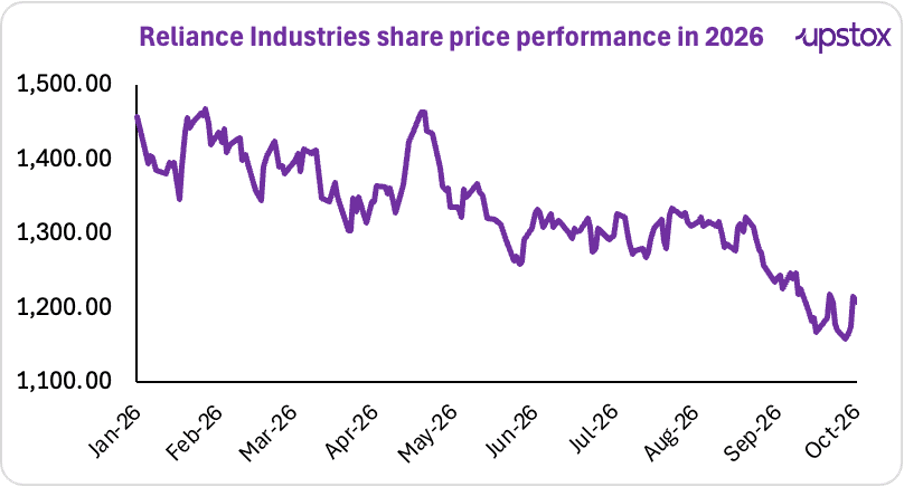
On 13 October, Reliance Industries (RIL) hit an intraday low of ₹1,152.20, down 28.5% from its 5 January high of ₹1,611.20. The stock bounced back 3.44% on 15 October to close at ₹1,215, before slipping to ₹1,208 on 16 October.
This is no ordinary stock. Reliance has one of the largest weightings in India's key stock indices, meaning its decline can weigh on index returns and millions of investors' portfolios. Nomura estimates that the stock has fallen 26% this year, compared with a 14% decline in the Nifty.
Source: Investing.com, as of Oct 16, 2026
Here's the odd part. The business itself has kept growing. In Q1FY27, Reliance's consolidated EBITDA rose 10.1% year-on-year to ₹54,067 crore, a record for any quarter. So, what went wrong with the stock? And with Q2 results, Jio Platforms' listing and a possible tariff hike all due in the coming weeks, what could turn it around?
What went wrong for Reliance shares this year?
We can trace some of the origins to January 2026.
On 6 January, Reliance fell 4.5%, its worst day since June 2024, Bloomberg reported. Analysts had warned of rising competition in retail, and investors were worried about possible US action over Reliance's purchases of Russian crude.
Retail results added to the concern. In the December 2025 quarter, Reliance Retail's revenue grew 8.1% year-on-year and its EBITDA only 2%, according to CNBC. Analysts pointed to aggressive expansion in quick commerce, continued weakness in fashion and lifestyle, and the impact of the new labour code, according to Outlook Business. Citi trimmed its earnings estimates for the group, citing the retail slowdown.
Then came a policy shock. On 26 March, amid the conflict in West Asia, the government imposed export duties on diesel and aviation fuel to keep more fuel at home. An official later said the duties would not apply to Reliance's SEZ refinery, but the episode reminded investors how exposed refining profits are to policy decisions.
Telecom didn't help either. Motilal Oswal attributes the muted performance of Reliance and Bharti Airtel this year mainly to delays in tariff hikes.
The slide kept going through the year. Reliance closed at ₹1,268.70 on 10 September. On 1 October, it closed at ₹1,174.60, below its previous 52-week low, and less than two weeks later it set the new low of ₹1,152.20.
Put together, investors were left with a business that was growing, but not in the parts they were paying the most for.
Which parts of the business are working, and which aren't?
| Segment | Q1FY27 EBITDA (₹ crore) | YoY change | What investors want to see |
|---|---|---|---|
| Jio Platforms | 20,865 | +15.1% | A tariff hike that does not cost subscribers |
| Oil-to-chemicals (O2C) | 17,010 | +17.2% | Fuel margins holding up beyond Q2 |
| Reliance Retail | 6,309 | −1.1% | Margins recovering from 7.9% |
| RIL consolidated | 54,067 | +10.1% | Growth that does not rely on one segment |
Source: Reliance Industries, Q1FY27 results press release, 17 July 2026
Two of the three engines are firing. Retail, the one investors value most, is not. That sets up the triggers to watch.
Trigger 1: Can Q2 results show a retail recovery?
Retail is the biggest single piece of Reliance's valuation. In Motilal Oswal's sum-of-the-parts valuation, which values each business separately and adds them up, Reliance Retail is worth ₹505 per RIL share, more than Jio's ₹413.
Right now, it is also the piece that is not growing profits. In Q1FY27, Retail's EBITDA fell 1.1% even as revenue grew 7.4% to ₹90,408 crore. Margins slipped by 80 basis points (0.8 percentage points) to 7.9% because of spending on digital commerce, including quick delivery. The physical business is still expanding: Reliance added 252 stores in the quarter, taking its network to 20,169.T
On the Q1 earnings call, management said it aims to double retail's operating EBITDA over three years. The Q2FY27 results, due later this month, will be the first test of that promise.
Trigger 2: Can oil-to-chemicals keep up its momentum?
O2C, which covers refining, petrochemicals and fuel retailing, posted its highest EBITDA in four years in Q1, helped by stronger margins on transport fuels.
The September quarter could be even better. Nuvama expects O2C EBITDA to rise 38% year-on-year to ₹20,700 crore, and consolidated EBITDA to grow 17%.
The catch is that refining margins move with global supply and demand, and, as March showed, with export policy. Investors tend to pay less for earnings that can reverse in a quarter.
Trigger 3: Will the tariff hike finally arrive?
Motilal Oswal has built in a 15% tariff hike in December 2026. Nomura also expects a hike in the October–December quarter.
It matters because Jio's earnings depend heavily on what each customer pays. Telecom subsidiary Reliance Jio Infocomm accounted for 93.89% of Jio Platforms' EBITDA in Q1FY27, according to Jio's red herring prospectus (RHP). And growth in average revenue per user (ARPU) has slowed. ARPU rose from ₹181.7 a month in the March 2024 quarter to ₹206.2 a year later, after the July 2024 hike. Since then, it has moved only to ₹215.6 in the June 2026 quarter.
With the network already built, a higher price per user lifts revenue without a matching rise in costs. But Nomura flags a catch. After the July 2024 hike, Jio lost 0.3% of its subscribers over the next three quarters, while Bharti Airtel added 2%.
Trigger 4: Will Jio's listing put a price on its biggest growth engine?
Jio Platforms' IPO opens on 21 October, and the shares are expected to list on 28 October. At the upper end of the ₹1,065–1,119 price band, the ₹30,213 crore issue values Jio at ₹10.3 lakh crore.
For Reliance, the listing does one useful thing: it replaces analyst estimates with a daily market price for its 64.48% stake. By Nomura's estimate, that stake is worth ₹481–506 per RIL share at the price band, or 41–43% of RIL's share price.
The pricing also leaves some room. At ₹1,119, Jio is valued at 33.3 times its FY26 earnings per share of ₹33.59, against 40.71 times for Bharti Airtel, according to the RHP. But a listing is not a payout. All the IPO money goes to Jio, mostly to repay debt, not to Reliance. Nomura's view is that the stock's fall has already more than priced in Jio's lower-than-expected valuation. Early trading may also be volatile: half the shares allotted to anchor investors can be sold 30 days after allotment, according to the RHP.
What could keep the stock down?
The holding-company discount, the cut investors take when a listed parent owns a listed subsidiary, may not shrink. Once Jio trades, investors who want telecom exposure can buy Jio directly, with less reason to own it through Reliance. Nomura, for one, prefers Bharti Airtel as its top telecom pick.
Reliance is also spending heavily. Capex was ₹38,682 crore in Q1FY27, and net debt rose 4.5% year-on-year to ₹1,22,914 crore.
And the factors that hurt this year haven't gone away. Retail competition remains intense, and fuel export rules can change at short notice.
So, what could possibly turn Reliance shares around?
The Q2FY27 results will show whether retail margins are recovering and O2C strength is holding up. Jio's listing on 28 October will show how the market values its telecom business. And a tariff hike, if it comes before year-end, will test whether Jio's customers stay. If retail starts growing profits alongside Jio and O2C, Reliance will have a reason to recover that does not depend on any single event.
About The Author
Next Story

