
Upstox Originals
India is cheaper. Why are foreign investors still selling?

7 min read | Updated on October 22, 2026, 11:55 IST


SUMMARY
Indian stocks have got cheaper. The Nifty 50 is about 15% off its January high and its trailing P/E has slipped below 20x. Yet foreign investors have sold nearly ₹2.85 lakh crore of Indian equities this year, and they are still selling. For a dollar investor, it turns out, cheaper is not the same as cheap. Here is why the selling hasn't stopped.

FPIs had sold a net ₹2.85 lakh crore of Indian equities between January and 7 October 2026/ | Image: Shutterostock
FIIs pulling money out of Indian markets is hardly breaking news anymore. We hear about it almost every other day. What is puzzling is why it hasn't stopped.
You see, while foreign investors have kept walking away, Indian stocks have quietly gone on sale. The Nifty 50 closed at 22,421 on 1 October, about 15% below its all-time high of 26,373 hit on 5 January, and its trailing P/E has slipped to between 18 - 19x.
That is the puzzle. The usual reason to sell, that India was too expensive, has weakened. Yet the selling continues. The answer, as the numbers below show, is that India has become cheaper in rupees and cheaper than its own past, but not cheaper in the ways that matter to someone investing dollars.
FPIs had sold a net ₹2.85 lakh crore of Indian equities between January and 7 October 2026, according to NSDL.
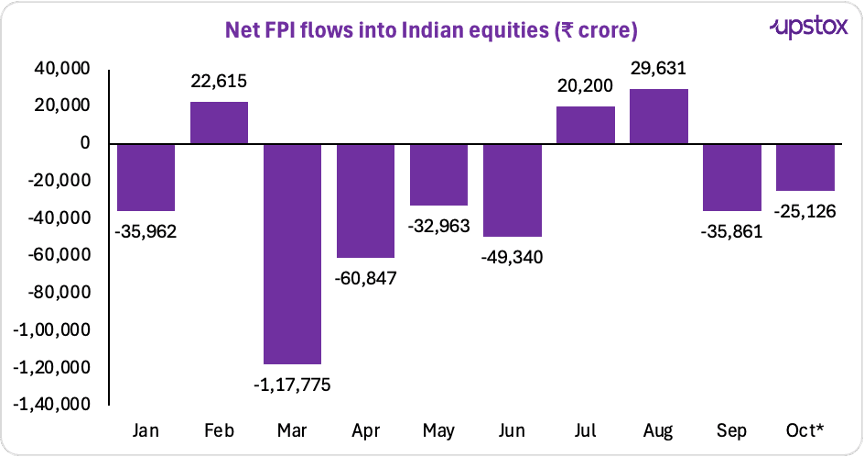
Source: NSDL, as of 7 Oct, 2026
The selling isn't a straight line, though. FPIs bought in February, July and August and sold in every other month, with March alone accounting for ₹1.18 lakh crore. Two months of buying have not become a trend: September and the first week of October were net-selling months again.
India's valuation premium is shrinking
Measured against its own history, India has clearly become cheaper. The official Nifty 50 factsheet showed a trailing P/E of 19.33x as of Oct 2026, a long way from the mid-20s multiples the index carried through much of its post-pandemic run.
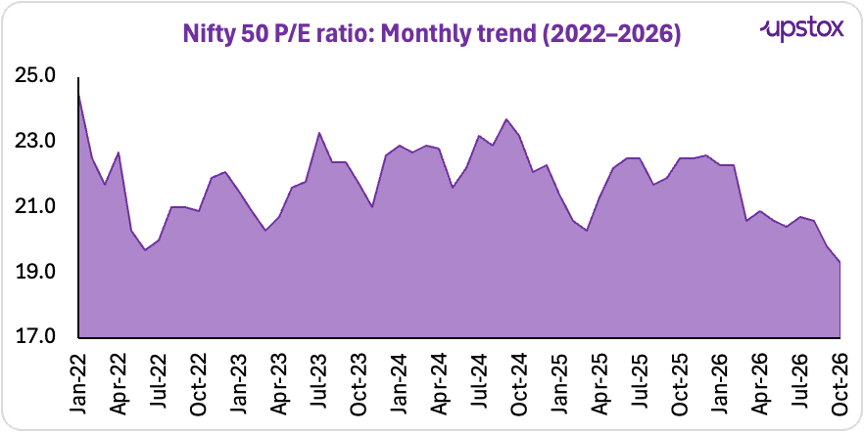
Source: NSE Indices, as of Oct, 2026
The fall has also been broad-based. With the index down roughly 15% from its January high, many large caps that were once "too expensive to touch" are now trading at discounts that domestic investors haven't seen in years.
Yet foreign investors continue to sell. What's keeping them away?
What happens to returns when the rupee keeps slipping?
For a domestic investor, a 10% gain in an Indian stock is a 10% gain. For a foreign investor, it isn't that simple. If the stock rises 10% in rupee terms but the rupee weakens 7.5% against the dollar, the dollar return shrinks to under 2%. A seemingly attractive equity return suddenly looks far less exciting.
The rupee hit an intraday low of ₹96.85 per dollar on 7 October and was down 7.5% in 2026. Currency isn't a side issue for FPIs; it is part of the return itself.
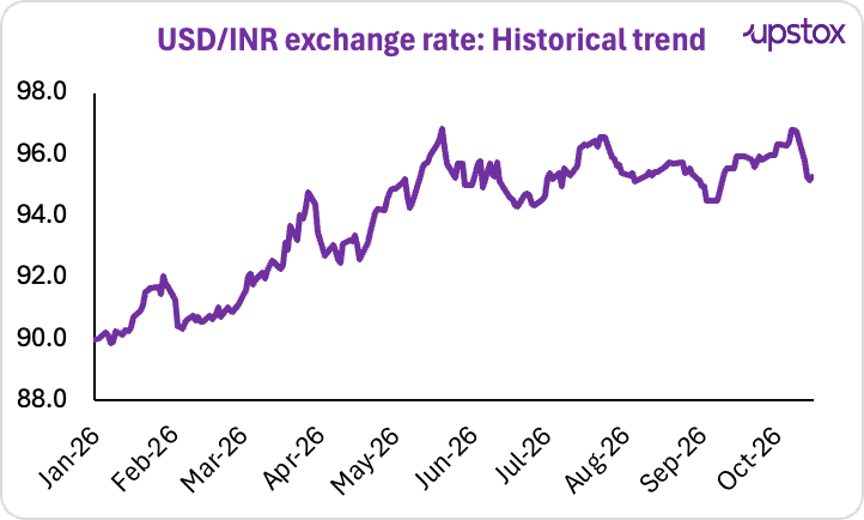
Source: investing.com, as of Oct 7, 26
A weak rupee also creates a feedback loop. Foreign selling pressures the currency; currency weakness makes foreign investors more cautious; that caution leads to more selling.
Can anyone see where earnings are heading?
A lower multiple only looks attractive if you trust the "E" in the P/E. Right now, that's the hard part. BofA Securities cut its FY27 Nifty earnings growth estimate to 8.5% in April, down from 11% in early March and 14% before the West Asia conflict, citing a squeeze on margins from expensive commodities and a hit to demand.
Others are far more upbeat, with Street consensus still pencilling in low-to-mid-teens growth for FY27. That gap is itself the problem. When forecasts for the same index range from single digits to the mid-teens, a P/E of 15 could be cheap or it could be fair, depending on whose numbers you believe. Add a weak monsoon and costlier oil, and foreign investors would rather wait for the Q2 FY27 results season to show its hand than buy on hope.
India is cheaper than its past, not cheaper than its peers
Global investors don't assess India in isolation. India is no longer priced like an unquestioned growth favourite, yet it is still dearer than several Asian and emerging-market options.
The gap looks even wider in the MSCI universe: at end-May 2026, MSCI India traded at roughly 20x forward earnings, against under 12x for China and Indonesia and under 10x for Brazil. India deserves some premium for growth quality and market depth. The question is whether that premium is adequately paid back in dollar returns.
| Market | One-year forward P/E (times) |
|---|---|
| Nifty 50 | 15.1 |
| Taiwan Taiex | 15.2 |
| S&P 500 | 16.8 |
| Nikkei | 20.3 |
| FTSE 100 | 11.7 |
| Hang Seng | 9.5 |
| Kospi | 4.7 |
Source: Livemint
Why take risk in India when US bonds pay over 5%?
India is also competing against a much juicier risk-free alternative. The US 10-year Treasury yield touched 5.36% earlier this month, its highest since 2002, and was still hovering around 5.2–5.3% in the second week of October. Brent crude, meanwhile, was above $102 a barrel.
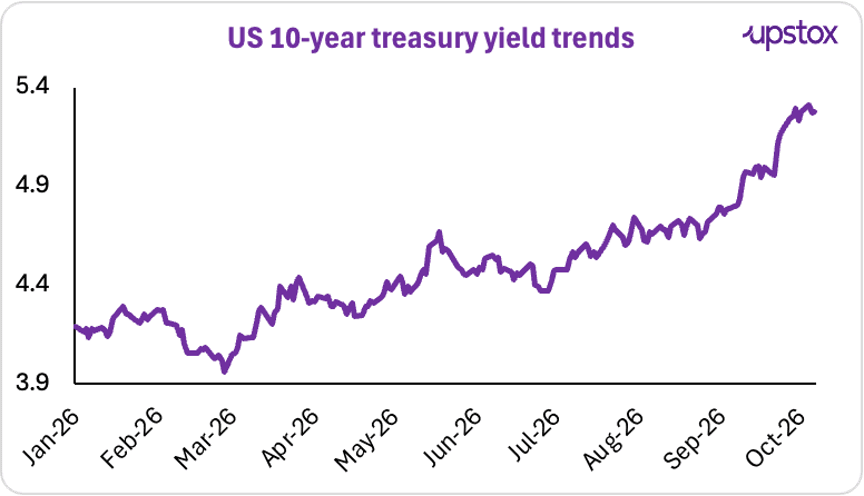
Source: Investing.com, as of Oct 7, 2026
Is India missing the market's hottest profit pool?
Global money has been chasing what's working. Taiwan and South Korea offer direct exposure to semiconductors, memory chips and the AI investment cycle. The US offers mega-cap tech companies with visible AI-led revenue and earnings momentum. India, by contrast, is mainly a play on domestic consumption, financial services, industrials, telecom and manufacturing.
Those are solid long-term themes. But they aren't the same as owning a company that sells the chips, servers or software powering the AI boom. That doesn't make India a weak market. It means India is selling steadier domestic growth, while much of the world is buying immediate AI-linked earnings acceleration. And a market gets re-rated when investors see a catalyst, not just a discount.
Has China become the cheaper growth story?
China is the other big magnet for emerging-market money, and Beijing has spent 2026 trying to give investors a reason to return. The government renewed RMB 1.3 trillion of ultra-long special treasury bonds, with RMB 250 billion set aside for consumer trade-in subsidies on cars, appliances and gadgets. It has also widened interest subsidies on consumer and service-business loans, raising the eligible loan cap for businesses ten-fold to RMB 10 million.
Combine that with valuations, and the pitch is simple. The Hang Seng trades at under 10 times forward earnings, against about 15 times for the Nifty. For a fund manager benchmarked to an emerging-market index, every dollar taken out of India and parked in cheaper Chinese stocks narrows the valuation risk in the portfolio.
The bear case on this trade deserves a mention, though. China's stimulus has repeatedly sparked rallies that faded, and the CSI 300 fell about 6% in September alone. Cheap can stay cheap. If the Chinese bounce stalls again, India's relative appeal improves without India doing anything at all.
So, why isn't cheaper enough?
Put these together and the pattern is clear. Foreign investors aren’t asking whether India is cheaper than it was. They are asking whether an Indian stock bought today will beat a US bond, in dollars, after the rupee has had its say. With a 21% drawdown in dollars, earnings forecasts that range from single digits to the mid-teens, cheaper options elsewhere and a shrinking weight in emerging-market benchmarks, the answer for many is not yet.
The RBI’s October move, a 25-basis-point repo rate rise to 5.50% and a shift to a “calibrated tightening” stance, acknowledges that the rupee, not the P/E, is the problem. It narrows the gap with US yields, but it also weighs on growth. FPIs were net sellers in September and again in October, so it hasn’t changed behaviour yet. Until the dollar maths works, a lower P/E on its own won’t stop the selling.
About The Author
Next Story

