
Upstox Originals
How India Inc. is preparing for the next phase of the AI race

9 min read | Updated on March 27, 2026, 17:10 IST


SUMMARY
From asset-light software to capital-heavy compute, India’s largest corporates are deploying billions to build data centres, energy backbones, and sovereign AI capacity—turning a structural data gap into a once-in-a-generation opportunity.
Stock list

Reliance with Jio has committed ₹10 lakh crore over the next 7 years to build an entire AI value chain
To say that the AI race is heating up would be an understatement. Global AI capex today is higher than the annual military spending of most countries.
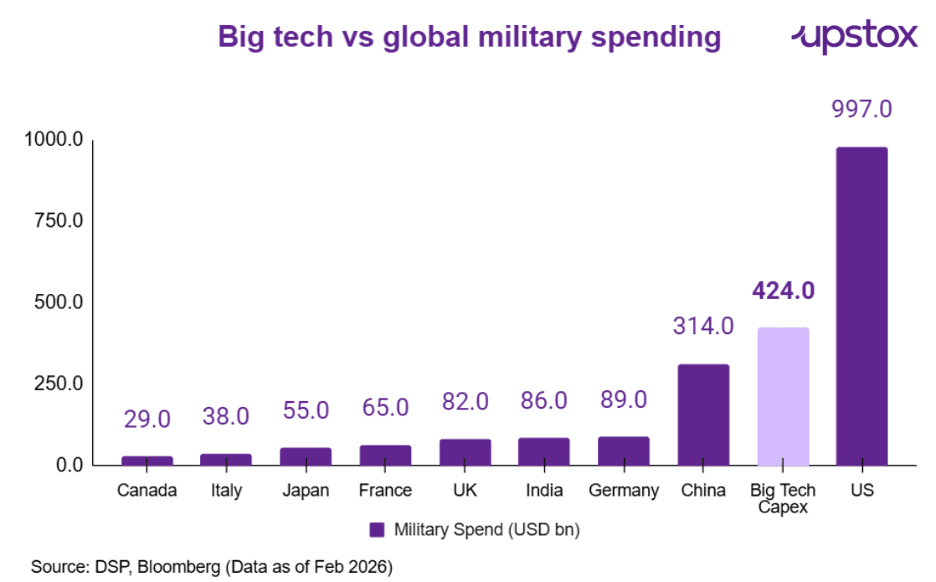
As a result, the playbook has shifted—from building software to owning the full stack: data, compute, energy, and distribution. In this article, we look at how India Inc.’s largest players are stepping in to build this infrastructure-led AI ecosystem.
| Company | What They Are Doing in AI | Investment Commitment |
|---|---|---|
| Reliance Industries | Building full-stack AI ecosystem (data centres, GPUs, telecom distribution, AI platforms, energy integration) | ₹10 lakh crore (~$110 billion) over 5–7 years |
| Adani Group | Creating renewable-powered hyperscale data centres + energy backbone; targeting sovereign AI infrastructure | $100 billion by 2035 |
| Infosys | Building AI-First Services to scale enterprise AI adoption | No fixed capex; targeting $300 billion enterprise AI opportunity by 2030 |
| Tata Consultancy Services | Developing AI data centres (HyperVault) + enterprise AI services | $7–8 billion planned for data centres |
| Larsen & Toubro | Investing in GPU cloud (E2E Networks) + building AI infra with NVIDIA; infra + compute hybrid model | ₹1,407 crore (~$170M) for ~21% stake in E2E |
Source: Exchange filings, Media Interviews, Company Press Release
Reliance & Reliance Jio - Full stack, infrastructure-led play
Reliance Industries is taking one of the most aggressive and vertically integrated bets by building sovereign AI infrastructure and ecosystem in India. The company, along with its telecom arm Jio, has committed ₹10 lakh crore (~$110 billion) over the next 7 years encompassing entire AI value chain:
| Segment | What Reliance is Building | Details / Scale |
|---|---|---|
| AI framework | AI data centers with gigawatt-scale power | Multi-GW capacity in Jamnagar and Andhra; ~120 MW rollout in the near future |
| Investment | Total AI Capex Commitment | ₹10 lakh crore (~$110 bn) over 7 years |
| Energy integration | Renewable + energy storage for AI | Powering AI infra through green energy ecosystem |
| Edge computing | Nationwide AI compute layer via Jio | Distributed computing integrated with telecom network |
| Consumer AI | AI embedded in devices | AI-enabled routers, set-top boxes, enterprise gateways |
| AI platforms | India-first AI ecosystem | AI services in local languages for mass adoption |
| Cost strategy | AI token cost reduction | Making AI computation affordable at scale |
| Partnerships | Global AI collaborations | Meta JV (~₹855 crore), Google partnerships for AI/cloud |
| Enterprise AI | AI across industries | Deployment across retail, energy, telecom, logistics |
Source: Media Articles, Company filings.
-
NVIDIA GPUs and compute backbone: Reliance is using NVIDIA GPUs to build an AI supercomputing infrastructure through Jio. This will help them train and test models on a large scale.
-
AI models and platforms (Meta and Google): Reliance may access global AI models and technology because it works with Google and Meta. This speeds up the process for both commercial and consumer use cases.
-
Distribution advantage (Jio): Jio has more than 450 million users and is the AI delivery engine, sending AI to mobile devices, PCs, and companies on a big scale and at a low cost.
-
Putting together energy and infrastructure: Reliance produces multi-GW AI data centers that address both computation and power needs by combining renewable energy.
Adani’s AI Strategy – Energy + Compute at Unprecedented Scale
Adani Group is making one of the largest global bets on AI infrastructure, positioning itself as the energy + data centre backbone of India’s AI ecosystem. The group has committed $100 billion (~₹8 lakh crore) by 2035 towards building renewable-powered, AI-ready data centres—one of the most significant energy-compute integration plays globally, with a broader ecosystem opportunity of ~$250 billion over the next decade.
Through AdaniConneX (its JV with EdgeConneX), the company is building a national hyperscale data centre platform, scaling capacity from ~2 GW to 5 GW+, designed specifically for AI workloads such as high-density compute and liquid cooling. This expansion is being anchored by strong global partnerships—most notably with Google (for a $15 billion AI data centre hub in Visakhapatnam), along with collaborations with Microsoft and Flipkart—allowing Adani to combine global demand with local execution.
What truly differentiates Adani is its integrated energy advantage. With control over renewable generation, transmission, and storage, the group is uniquely positioned to provide reliable, low-cost power for AI infrastructure.
In essence, Adani is not just building data centres—it is creating a sovereign AI infrastructure stack, spanning energy, compute, and core infrastructure, with the ambition of making India a self-reliant hub in the global AI ecosystem.
Gautam Adani wants to establish "technological sovereignty" by finding the right balance between energy and computing. The plan has:
-
Gigawatt-Scale Expansion: Increasing AdaniConnex's capacity from 2 GW to 5 GW.
-
Strategic Hubs: Working with Google to build a gigawatt-scale AI data center in Visakhapatnam and with Microsoft on projects in Hyderabad and Pune.
-
Energy Backbone: The 30 GW Khavda project from Adani Green Energy powers high-density AI clusters, making sure that computing is carbon-neutral.
-
Domestic Supply Chain: Investing together in making important parts like transformers and innovative power electronics to lower the risk of problems in the global supply chain.
| Segment | What Adani Is Doing | Scale |
|---|---|---|
| Capex commitment | AI + data centre investment | $100 billion by 2035 |
| Ecosystem impact | Total AI infra opportunity | $250 billion (incl. induced investment) |
| Data centre capacity | Current → Target | 2 GW → 5 GW+ |
| Key partnership | Google AI hub | $15 billion investment |
| Other partners | Microsoft, Flipkart | Multi-city AI infra expansion |
| Energy backbone | Renewable + storage + grid | Integrated AI power solution |
Source: Media Articles, Company filings.
Infosys - Betting on AI Service Opportunity
Infosys is putting itself in the middle of the adoption of AI in businesses (also termed AI First Services, which made up 5.5% of its Q3 revenue). As per Infosys, less than 1% of businesses have fully incorporated AI into their operations, which shows a huge gap in execution.
Infosys is working on AI-First Services to solve this problem. By 2030, the company hopes to have a $300 billion corporate AI market. The business is pushing beyond its usual IT services to become an "AI architect," helping big companies around the world use AI in a way that is secure, scalable, and profitable.
Infosys has identified six key pillars driving this opportunity:
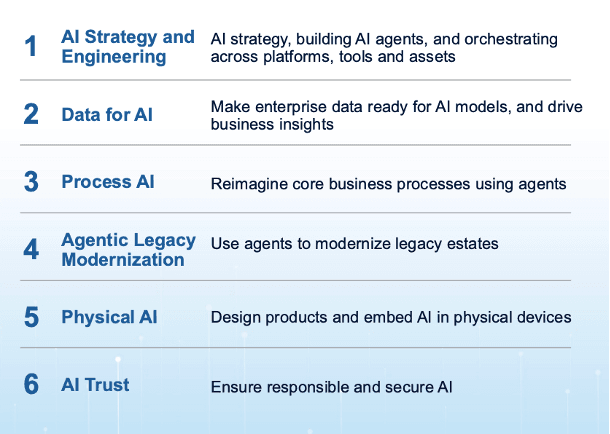
The Topaz Fabric platform is at the heart of this plan. It is meant to tackle the largest problem with AI adoption, which is moving from experimental projects to real business results. Topaz integrates older business systems with more modern AI models using more than 600 pre-built agents and domain-specific LLMs. This lets businesses automate, optimise, and make decisions at scale.
Infosys has officially signed a deal with Anthropic to offer Claude models, such as Claude Code, to its Topaz platform. This will help the company build its ecosystem. Infosys already uses AI to serve almost 90% of its top 200 clients, which shows that adoption is spreading beyond pilots to core operations.
Tata Consultancy Services - Building AI Data Centre
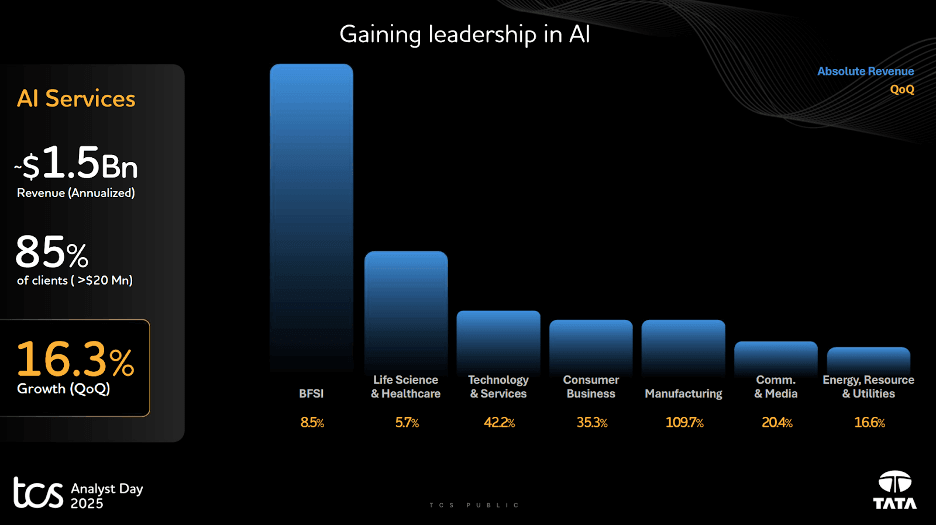
Riding the bandwagon, TCS also offers similar AI First Services and plans to become the "world's largest AI-led technology services company,” and this business is growing at a rate of 16.3% per quarter.
Source: Media Articles, Company filings.
TCS, unlike Infosys, is taking a significant step into AI infrastructure through its subsidiary HyperVault, aiming to build gigawatt-scale AI data centres in India. As part of its collaboration with OpenAI, TCS plans to develop facilities starting from 100 MW and scaling up to 1 GW, with an estimated investment of $7–8 billion.
Why is TCS entering a capital-heavy business? India’s current AI-ready data centre capacity stands at ~1.7 GW (2025), while demand is expected to reach 10–12 GW by 2030. By building 1 GW+ AI-ready capacity, TCS is positioning itself early to serve hyperscalers, enterprises, AI-native firms, and the public sector—all of whom require high-density, liquid-cooled, low-latency infrastructure to whom they can also crossell its enterprise AI solutions
L&T's AI Strategy: Putting Money into the Compute Layer, Not Just Building It
Larsen & Toubro is taking a different and strategic approach to AI. They see themselves as more than just an infrastructure builder; they also see themselves as a player in the core compute and cloud layer of the AI ecosystem.
Larsen & Toubro is taking a differentiated approach to AI by moving beyond pure infrastructure execution into the compute and cloud layer of the ecosystem. Its ₹1,407 crore investment for ~21% stake in E2E Networks marks a strategic entry into India’s GPU cloud and sovereign AI compute space, enabling capabilities across model training and inference.
This is further strengthened by its partnership with NVIDIA to build AI-ready infrastructure and gigawatt-scale AI factories, integrating compute, storage, and networking.
Together, this creates a hybrid model—E2E provides the AI platform and GPU cloud, while L&T brings data centre execution, engineering, and enterprise access—effectively offering an end-to-end AI infrastructure stack. At the same time, L&T is embedding AI within its own core business through AI-ready data centres, power infrastructure, smart networks, and industrial automation, improving efficiency across projects and operations.
Last thoughts
As per PwC Al has the potential to contribute between $550 billion and $600 billion to the five sectors - energy, education, agriculture, healthcare and manufacturing by 2035, India just needs to build the infrastructure and develop the capabilities to exploit this opportunity. In light of this, these companies are not merely following a trend; they are establishing the foundation of a global AI superpower.
About The Author
Next Story

