
Upstox Originals
From targets to execution: Inside India’s next industrial push

13 min read | Updated on October 28, 2026, 16:16 IST

SUMMARY
India's new industries have moved from targets to factories and paying customers, but India still wins mostly at the final assembly step, while most of the value sits in the parts. Let's look at what companies in six key industries are actually building, signing and shipping.
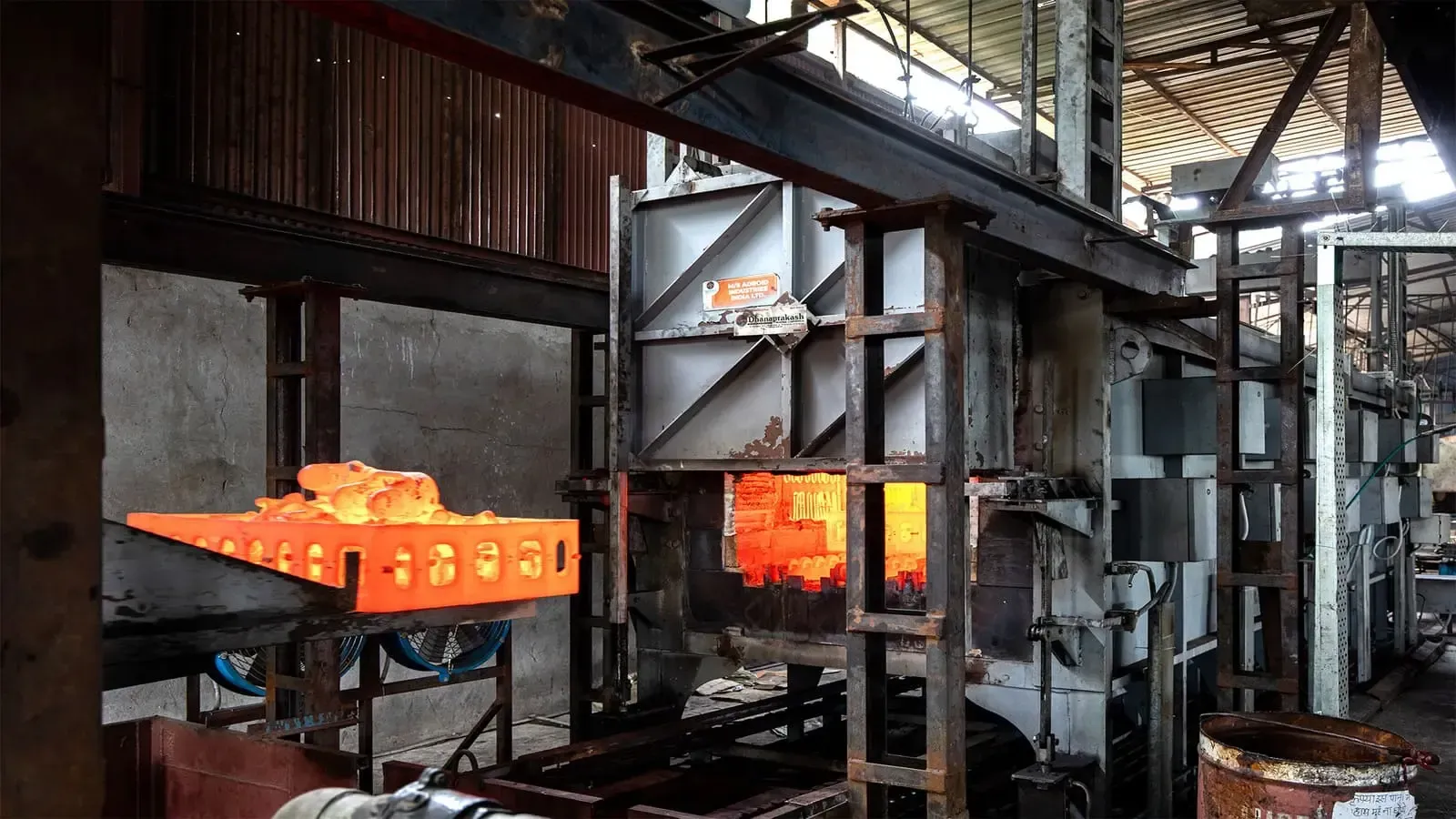
India has about 156 GW of solar module capacity, second only to China. | Image: Shutterstock
For years, stories about Indian manufacturing were built on targets: a $40–45 billion space economy, gigawatts of data centres, near-total solar self-reliance. Targets tell you what policymakers hope for. Orders, approvals and working plants tell you what is happening.
This article looks at six industries: electronics, solar, aerospace, semiconductors, space and data centres. In each, we track company-level moves (approvals, agreements, orders, capacity additions and new products) and how far each has got. A signed agreement is not a factory, and a new factory is not yet output. The companies named in this article are indicative examples of each trend, not an exhaustive list.
| Industry | Biggest move in the recent past | How far it has got |
|---|---|---|
| Electronics | 38 of 106 approved component plants already producing | Operating, scaling up |
| Solar | Premier Energies' 7 GW cell plant commissioned; Waaree and ReNew building wafer plants | Cells operating, wafers under construction |
| Aerospace | Airbus–Tata helicopter assembly line opened; Aequs wins Safran contracts | Operating, with long-term contracts |
| Semiconductors | Micron shipping India-packaged memory to Dell and HP | Packaging operating; no chip fab yet |
| Space | Skyroot reaches orbit, then wins two US launch bookings | First commercial orders |
| Data centres | Google's ~$10bn, 1 GW Vizag campus breaks ground | Customers committed; capacity being built |
Source: PIB, Media Articles, Company Data
The pattern: The buyer comes first
The industries that moved fastest are the ones where a large global buyer arrived before the local ecosystem did. Apple and Samsung brought orders, engineers and quality standards to electronics; suppliers grew around them. India now makes more than a quarter of the world's iPhones. In aerospace, Boeing buys more than $1.4 billion a year from over 375 Indian suppliers, and Airbus's Indian sourcing has tripled from $500 million in 2019 to more than $1.5 billion.
The real story of 2026 is that the newer industries are now finding their own anchor buyers: Dell and HP for India-packaged memory, Renesas for chip assembly, Reflect Orbital for Indian rockets, and Meta, Google and CoreWeave for data centres.
The second pattern is a warning. India is strongest at the last step of each chain: assembling phones, making solar modules, machining aircraft parts. The high-value inputs (chips, displays, solar wafers, engines) are still mostly imported. That is why the most important moves below are companies stepping one level up the chain.
Electronics: From assembling phones to making the parts inside them
India produced electronics worth about ₹12.1 lakh crore in FY26, and electronics exports have grown roughly five-fold in five years. But in a typical India-made phone, less than 15% of the value is added locally, and an estimated 85–90% of circuit boards are imported.
That is now changing. Under the Electronics Component Manufacturing Scheme, 106 projects worth ₹69,548 crore had been approved by August 2026, across 30 product categories in 15 states. 38 of those plants are already producing, and another 16 are close.
Here is what that looks like company by company. Each of these moves targets a part India imports today, such as displays, batteries, camera modules, phone casings or servers:
| Company | Move | Status |
|---|---|---|
| Samsung, Tata Electronics, Foxconn | Projects for phone enclosures, camera sub-assemblies and other parts cleared in a single $4.6bn round | Approved Jan 2026 |
| Dixon + HKC | 74:26 joint venture to make LCD display modules, a part India largely imports | Approved Mar 2026 |
| ATL India (TDK) | Lithium-ion cell plant in Haryana, about ₹2,900 crore | Under construction |
| Kaynes Technology | Edge-AI camera modules for commercial vehicles, including driver-fatigue monitoring | Launched |
| Jabil + Adani Enterprises | Proposed 50:50 JV to make AI and data-centre hardware in India | Non-binding, Oct 2026 |
Source: MeitY, Media Articles
The direction is clear: from finished phones to displays, batteries, camera modules and now servers. The test is whether these suppliers win repeat customers and stay competitive as incentives step down.
Key risks: Many projects depend on incentives and may struggle once support tapers. Machinery and know-how still come largely from China and East Asia, and some deals, like Jabil–Adani, are not yet binding.
Solar: Moving back from panels into cells and wafers
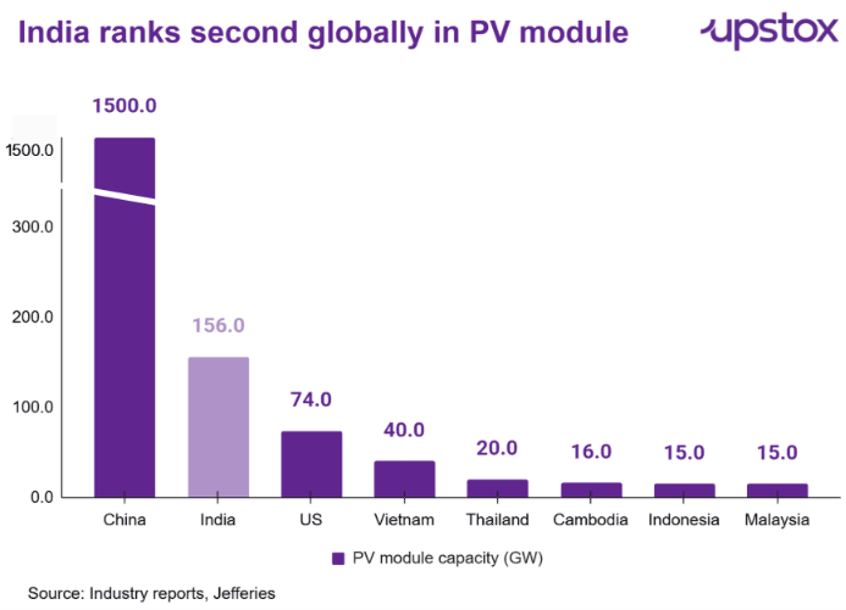
India has about 156 GW of solar module capacity, second only to China. But a panel is only the last step. Modules are made from cells, cells from wafers, wafers from ingots, and ingots from polysilicon. India's capacity shrinks sharply at each step back: 35 GW of cells, and almost no wafers or polysilicon.
The biggest money is now going into exactly those gaps:
| Company | Move | Type | Status |
|---|---|---|---|
| Premier Energies | 7 GW TOPCon cell plant in Andhra Pradesh, taking total cell capacity to 10.6 GW | Capacity expansion | Commissioned Sept 2026 |
| Premier Energies | ₹3,011 crore of cell and module orders (1,846 MW) for delivery over FY27–FY28 | Order | Secured Q1 FY27 |
| Waaree Energies | 10 GW ingot and wafer plant in Nagpur, about ₹6,200 crore; India's largest | Capacity expansion | Construction began Mar 2026 |
| ReNew | 6 GW ingot and wafer plant in Andhra Pradesh, about ₹3,990 crore | Capacity expansion | Commercial operation targeted Jan 2028 |
| Vikram Solar | First TOPCon module from new Tamil Nadu plant; plans 12 GW of wafers by FY29–FY30 | New capacity | Production began Jul 2026 |
Source: Company Data, Media Articles
Industry-wide, cell capacity is expected to reach about 130 GW by end-2027, and around 60 GW of ingot and wafer capacity is due in 2028. That is when local sourcing rules extend to wafers too.
The risk is economics, not ambition. Module margins have fallen to single digits, and integrated ingot-to-cell capacity costs about $140 million per GW. If everyone builds at once, the problem shifts from too little capacity to too much. Polysilicon remains the missing link.
Key risks: Margins are already in single digits, and a rush of new plants could create overcapacity. Exports face trade barriers, and polysilicon is still almost entirely imported.
Aerospace: from parts supplier to assembler
India's aircraft and parts exports grew from $1.4 billion in FY20 to $7 billion in FY25. What has changed in the past year is the kind of work arriving: not just machined parts, but final assembly and engine maintenance.

Four moves from the past year show this shift, from assembling whole helicopters to servicing jet engines and winning long-term contracts for flight-critical parts:
| Company | Move | Type | Status |
|---|---|---|---|
| Tata Advanced Systems + Airbus | India's first private-sector helicopter final assembly line (H125), in Karnataka; first delivery due early 2027 | New capacity | Opened Feb 2026 |
| Safran | LEAP engine maintenance centre in Hyderabad, about €200 million, targeting 300 engine visits a year | New capacity | Opened Nov 2025, ramping up |
| Aequs + Safran | Long-term contracts for superalloy engine parts and landing-gear assemblies for the Airbus A320, A330, A350 and Boeing 787 | Long-term order | Signed Oct 2026 |
| Airbus | 5,000-seat engineering and technology centre in Bengaluru | Capacity expansion | Opened Mar 2026 |
Source: Company Data
The Aequs deal is the one to note. It extends the company's work to six Safran units and into flight-critical parts, among the hardest components to qualify. Approvals in aerospace take years, but once won they tend to last for decades. Engines and critical systems remain the hardest parts to localise.
Key risks: Orders depend on how many planes Airbus and Boeing actually build, and their output has slipped in recent years. Certification is slow, and engines and specialised alloys are still imported.
Semiconductors: packaging is real, chip-making is not yet
A year ago, not a single commercial chip plant was running in India. Today, memory chips finished in Gujarat are going into Dell and HP laptops. But there is a catch. Making a chip has two big stages. First, the chip is printed on a silicon wafer in a fab. Then it is cut, packaged and tested. India has started doing the second stage. The wafers still come from abroad.
Here are India's main chip projects, from plants already shipping to customers to the first fab still being built:
| Company | Move | Type | Status |
|---|---|---|---|
| Micron, Sanand | Memory assembly and test plant, about $2.75bn total investment | Order / shipments | Operating since Feb 2026; shipping to Dell and HP |
| Kaynes Semicon, Sanand | Power modules for Alpha & Omega Semiconductor; second unit being qualified for Fujitsu and Infineon | Order | Opened Mar 2026 |
| CG Semi + Renesas, Sanand | Assembly and testing of automotive-grade chips, about ₹7,600 crore; Renesas a partner and buyer | Agreement | Operating; second phase due by end-2026 |
| Tata Electronics, Assam | Packaging plant, about ₹27,000 crore, planned for 48 million chips a day | Capacity expansion | Under construction |
| Tata Electronics + PSMC, Dholera | India's first commercial chip fab, 50,000 wafers a month | Capacity expansion | Under construction |
| HCL + Foxconn, Jewar | Display-driver chip plant, 20,000 wafers a month | Approval | Planned for 2028 |
Source: Company Data, Media Articles
Packaging is a real foothold. It builds skills, suppliers and customer relationships, and gives a future fab local buyers to sell to. But it captures only a small part of a chip's value. The milestone that will show whether India can make chips, not just finish them, is the first commercial wafer out of Dholera.
Key risks: Chip plants are costly and rely heavily on subsidies. Packaging margins are thin and exposed to global chip cycles, and the Dholera fab depends on a foreign technology partner.
Space: first commercial orders, not yet a business
For decades, Indian space meant ISRO. Private companies were only allowed in from 2020. Six years later, a Hyderabad startup has put satellites in orbit on its own rocket, and an American company has booked two more launches on it. Here are the moves that took Indian private space from test launches to its first commercial orders:
| Company | Move | Type | Status |
|---|---|---|---|
| Skyroot Aerospace | Vikram-I put two satellites in orbit, India's first private orbital launch | Milestone | Achieved 18 Jul 2026 |
| Skyroot + Reflect Orbital | US company books two dedicated Vikram launches | Order | Signed Oct 2026 |
| Pixxel-led consortium (with Dhruva Space, SatSure, PierSight) | Build and run India's national Earth-observation constellation: 12 satellites over five years, ₹1,200 crore private commitment | Agreement | Signed with IN-SPACe, Jan 2026 |
Source: ISRO, PIB
These numbers need to be kept in proportion. India's space economy was about $8.4 billion in 2023, but most of that is ISRO and satellite services like DTH and telecom. The 400+ private startups have raised only about $0.6 billion in total. The government's $40–45 billion target for 2030 implies a five-fold jump in seven years, so it is best read as an ambition, not a forecast.
The real test is repeatability: rockets that fly regularly, and revenue that comes from customers rather than funding rounds.
Key risks: With only a handful of launches so far, one failure can set the sector back. Most startups still depend on funding rather than revenue, and global launch prices are falling.
Data centres: the customers are lined up; power is the bottleneck
Data centres are not a new story in India. Leased capacity has grown from 404 MW in 2019 to an estimated 2,076 MW in 2026. It is expected to reach 9,576 MW by 2031.

In just the past year, the world's biggest tech companies have committed billions of dollars to Indian data centres. Some are building their own campuses; others have signed up to lease capacity built by Indian groups:
| Company | Move | Type | Status |
|---|---|---|---|
| 1 GW AI data-centre campus in Visakhapatnam, nearly $10 billion | Capacity expansion | Construction began Apr 2026 | |
| Amazon Web Services | Additional $13 billion for Mumbai and Hyderabad, 2026–2030 | Investment commitment | Announced Jun 2026 |
| Reliance + Meta | 168 MW AI data centre in Jamnagar, built by Reliance and leased by Meta | Agreement | Signed Jun 2026 |
| AdaniConneX + CoreWeave | 240 MW AI deployment at Taloja, Navi Mumbai; first phase mid-2028 | Agreement | Announced Oct 2026 |
| Microsoft | Hyderabad cloud region, with HDFC Bank and Bajaj Finserv as early customers | New capacity | Opened Aug 2026 |
Source: Company Data, Media Articles
Unlike chips or space, this industry's problem is not finding customers. It is delivering power, cooling, land and fibre fast enough. Announced megawatts become industrial growth only when they are built, powered and filled.
Key risks: Power, water and land approvals can delay projects for years. If AI demand grows slower than expected, some announced capacity could sit underused. The bigger story: one industry is creating demand for the next
Space, semiconductors, data centres, electronics, solar and aerospace may look like separate industries, but they are built on similar foundations: skilled engineers, precision manufacturing, reliable power, digital infrastructure and capital
The most interesting signals are the links between these six industries:
- Chips → electronics: Micron's India-packaged memory is going into laptops assembled in India for Dell and HP.
- Data centres → electronics: Adani's proposed hardware JV with Jabil sits alongside its 240 MW CoreWeave deal. AI investment could create demand for India-made servers, not just buildings.
- Data centres → solar: AI campuses need large amounts of clean power. Meta's Jamnagar deal includes renewable energy, and Adani plans to power its data centres from its own green-energy business.
- Aerospace → precision manufacturing: Contracts like Aequs’s pull Indian forging, machining and coating firms into global supply chains.
Strength in one industry creates customers and suppliers for another. But the chain is only as strong as its weakest imported link.
What to watch
- Utilisation: whether new plants like Premier's cell lines and Micron's packaging lines run near full capacity
- Value addition: whether the local share of a phone's value rises above 15%
- The first wafer: when Waaree's and ReNew's solar wafer plants and Tata's Dholera chip fab start production
- Repeat launches: how often Skyroot flies, and for how many paying customers
- Built vs announced: how many announced data-centre megawatts are actually commissioned
India is no longer just announcing ambitions in these industries. Companies are signing customers, opening plants and entering parts of the chain that were previously imported. Whether India becomes an industrial powerhouse will depend on how quickly it takes the next step up that chain.
About The Author
Next Story

