
Upstox Originals
China's solar milestone holds a critical lesson for India

6 min read | Updated on September 23, 2026, 14:30 IST


SUMMARY
China has just done something that very few expected. Its solar panels now outnumber its coal plants. India is close to overtaking China and could generate more solar power than China by 2036. But here's the real question: does having more solar capacity than coal actually mean the coal era is over? Capacity vs generation: which is the real scoreboard? Let's find out.
One gigawatt of coal provides electricity 4x longer than 1 gigawatt of solar installations. | Image: Shutterstock
Recently, China announced that, at full capacity, their solar installations can provide more electricity than coal power plants for the first time. According to China’s National Energy Administration and released on September 1, solar modules produced 1,286 GW of electricity, overtaking coal by a narrow margin of 1,285 GW. The gap is razor-thin as solar edged ahead of coal by less than 0.1% of total installed capacity.
It seems like the long-awaited triumph of renewable energy, but, despite the impressive numbers, coal power plants still provide almost half (49.7%) of China’s electricity for the first half of 2026. Solar modules, with almost the same installed capacity, provided only 13%.
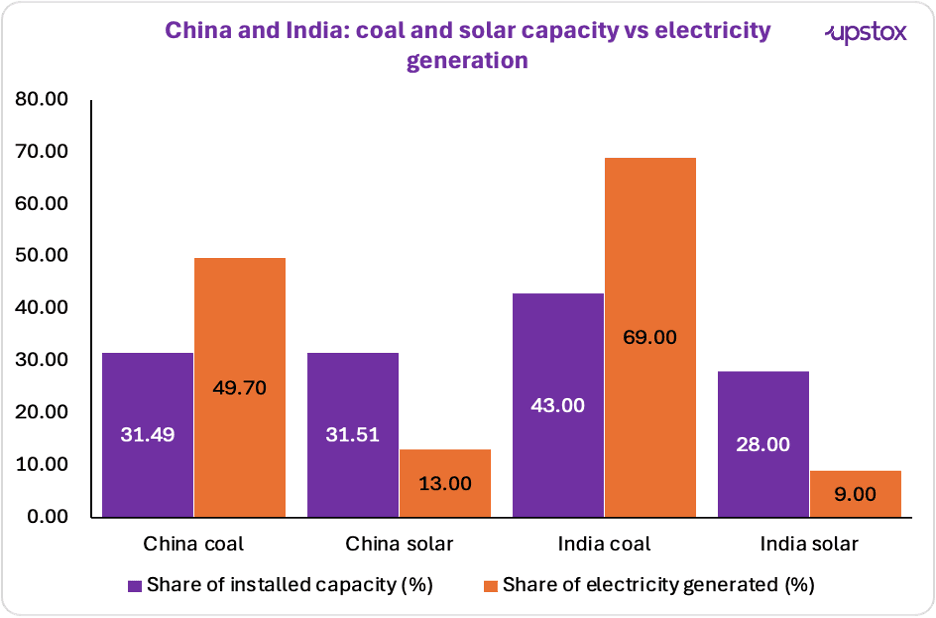
Source: NEA, CEC (China); CEA (India, FY26 provisional)
The reason is simple and is related to the number of hours. One gigawatt of coal provides electricity 4x longer than 1 gigawatt of solar installations.
The same paradox occurs in India. Coal still makes up roughly 40% of India’s installed capacity against about 29% for solar as per Ministry of New and Renewable Energy (MNRE) and Central Electricity Authority (CEA) data. However, if we look at the electricity generated, coal accounts for 70% as against 9% contributed by solar. The lesson doesn't change. Capacity is what gets installed. Generation is what's actually there when the sun goes down, and that's the number which really counts.
How do India and China compare?
India is heading in a similar direction. The country added roughly 45 GW of new solar capacity in the last financial year, compared with a much smaller addition of coal capacity. This means India is currently adding solar several times faster than coal, according to data from the MNRE. If that pace continues, a similar capacity crossover for India isn't far-fetched in the next few years.
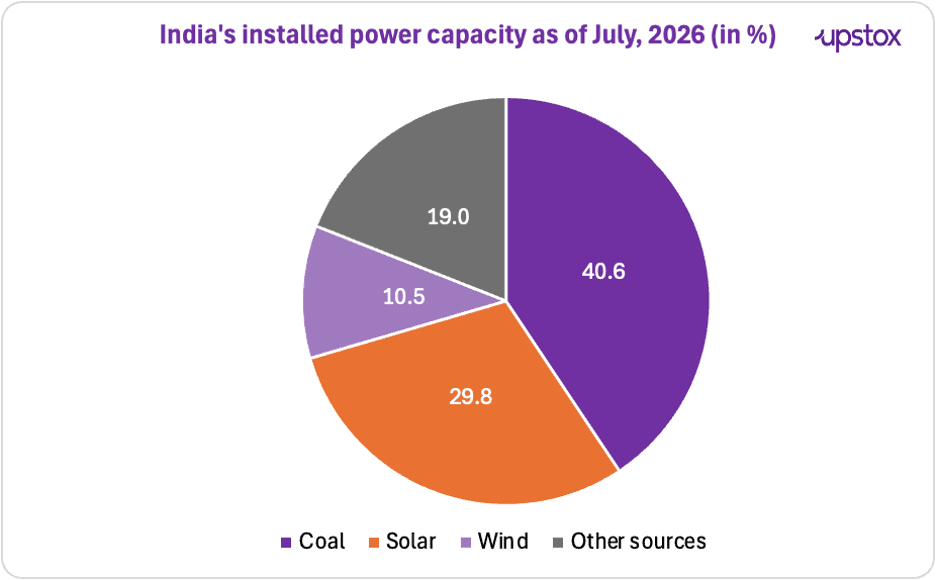
Source: CEA, MNRE
However, here's where the India story gets interesting, and it's not that much to do with who has more panels, but more to do with where those panels are.
While in China, nearly half of the solar capacity is installed on the roofs of residential, commercial and industrial buildings, where the electricity is actually used, according to the National Energy Administration (NEA). Meanwhile in India, according to the MNRE, just 1 in 6 of solar megawatts are on rooftops, with the rest sited in large solar farms in the deserts of Rajasthan and Gujarat, far from the loads in the cities and towns. They have rooftops. We have deserts. And every distance the power must travel, it loses some on the way.
Can India overtake coal by 2036?
In installed capacity alone, yes, we might beat China and maybe sooner than 2036 and by a wider margin. By 2035-36, the government's own long-term roadmap, the CEA’s National Generation Adequacy Plan, published in March 2026 projects solar at 45% of India's total installed capacity, with coal down to 28%.
But in electricity actually generated, the same plan says no. It projects coal still supplying just over half of India's power in 2035-36, versus roughly a quarter from solar. That's exactly why capacity is the wrong number to celebrate. Coal's share does shrink, from about 64% today to a little over half, but it doesn't lose the top spot. Coal capacity itself is even planned to grow, from 224 GW today to 315 GW by 2036, per the CEA.
| CEA projection, 2035-36 | Capacity | Share | Generation | Share |
|---|---|---|---|---|
| Solar | 509 GW | 45% | 984 BU | 27% |
| Coal | 315 GW | 28% | 1,819 BU | 51% |
| Wind | 155 GW | 14% | 320 BU | 9% |
| Large hydro | 77 GW | 7% | 256 BU | 7% |
| Nuclear | 22 GW | 2% | 147 BU | 4% |
| Cumulative Storage (BESS + pumped hydro) | 174 GW / 888 GWh |
Source: CEA
This gap between "capacity" and "generation" can be closed mainly by one thing: batteries. According to Mercom India Research, India has built roughly 9.3 GWh of battery storage till 2026. The CEA's own numbers suggest a genuinely coal-light grid by 2036, with a projected 888 GWh of cumulative storage capacity, nearly a hundred times where India stands today. Until that gap closes, coal's night shift looks safe, whatever happens to the panel count during the day.
What can India learn from China?
A few things follow from this.
Rooftop solar needs to catch up.
The government's PM Surya Ghar scheme aims to put solar panels on one crore (10 million) homes. As of the most recent count, only about 1 in 4 of that target has been achieved, according to MNRE, which means there is a long runway to close, and it would make a big difference in India's solar mix, drawing closer to China's rooftop-heavy model.
Storage matters as much as panels.
As per Carbon Brief’s analysis, China wastes over a quarter of its potential wind and solar power because the grid can't absorb it. India's battery storage capacity is growing quickly on a small base, but it is a fraction of what is expected to be needed to transfer meaningful daytime solar power to the evening when demand peaks, according to CEA planning estimates. Panels without the ability to store or move that power don't completely solve the coal problem. They just shift it to a different bottleneck.
The grid, not the panel count, is the real test.
According to CEA data, India's non-fossil power sources (solar, wind, hydro and nuclear combined) already make up just over half of the country's total installed capacity. Coal, meanwhile, still accounts for roughly 4 in 10 units of installed capacity. On paper, that means India is close to a crossover moment to China's. But as China shows, having the capacity is one milestone, and reliably delivering that power to homes after sunset is another, which ultimately determines how much coal India can retire.
The takeaway
China's milestone is a genuine landmark. India is on a similar path, just a few years behind. The shape of our solar growth matters as much as its speed. Closing the structural gaps through schemes like PM Surya Ghar, stronger local grids, and serious investment in storage may end up mattering more for Indian households than the headline capacity number ever will.
On current trends, India's installed solar capacity could realistically overtake coal within this decade, well ahead of what seemed possible even five years ago. But as China's experience shows, that crossover is a milestone worth watching, not a finish line. The panels are the easy part. Getting that power to your switchboard reliably, every evening, is where both countries still have real work to do.
About The Author
Next Story

