
Upstox Originals
India’s capex pipeline grew 39% to ₹99.7 lakh crore. So who is really investing?

7 min read | Updated on November 19, 2026, 16:31 IST

SUMMARY
India’s private sector capex pipeline grew 39% YoY to ₹99.7 lakh crore in September 2026. Is a massive surge in capex by businesses finally underway? A closer look at the numbers shows that the jump came largely from two sectors and one state. ITES, which today mostly means data centres, and conventional power accounted for 87% of the increase, and Maharashtra alone accounted for about half.
India’s private sector capex pipeline grew 39% YoY to ₹99.7 lakh crore in September 2026. | Image: Shutterstock
A cricket fan will tell you that a huge total does not necessarily mean every batsman scored heavily. Picture Team India putting up 350 in a one-day match. Spectators cheer enthusiastically. The headlines write themselves. Then you open the scorecard: two batsmen made over 300 of those runs, and the rest of the team managed about 45 between them.
It is still an impressive total. But would you call it a team effort?
India’s private capex pipeline has just played that kind of innings. In September 2026, it stood at ₹99.7 lakh crore, up 39% YoY. That is roughly ₹28 lakh crore added in just one year. In the eight years to March 2022, the pipeline added only ₹7 lakh crore. So, is every company really investing, or just a few big ones? Let’s take a look.
What exactly is ₹99.7 lakh crore?
It is the total cost of all private projects that companies have announced but not yet finished. Think of it as India Inc.’s building plan. It shows the full cost of these projects, not what has been spent so far. Big projects spend their money over several years, not all at once. Some numbers below are our own calculations from rounded figures.
Who added the most?
| Sector | Added in the year (₹ lakh crore) | Share of the increase |
|---|---|---|
| Information Technology Enabled Services (ITES) | 16.8 | 60% |
| Conventional power | 7.6 | 27% |
| Others | 3.6 | 13% |
| Total | 28.0 | 100% |
Source: Union Bank of India (CMIE CapEx data); shares calculated from the report’s figures
Just two sectors made up 87% of the growth. And ITES is the big surprise. It has just 160 of the pipeline’s 5,311 projects, and its project count rose by only 52 during the year. Yet the value of ITES projects jumped more than eightfold, from ₹2.2 lakh crore to ₹18.9 lakh crore. An average ITES project now costs ₹11,827 crore. The average for all projects? Just ₹1,878 crore.
When did ITES projects become this big?
When you hear ITES, you probably think of call centres and back offices. Not this time. Of the ₹14.98 lakh crore of new ITES projects announced between April 1 and August 5, 2026, nearly 99% was for data centres and artificial intelligence. And just 13 companies were behind them.
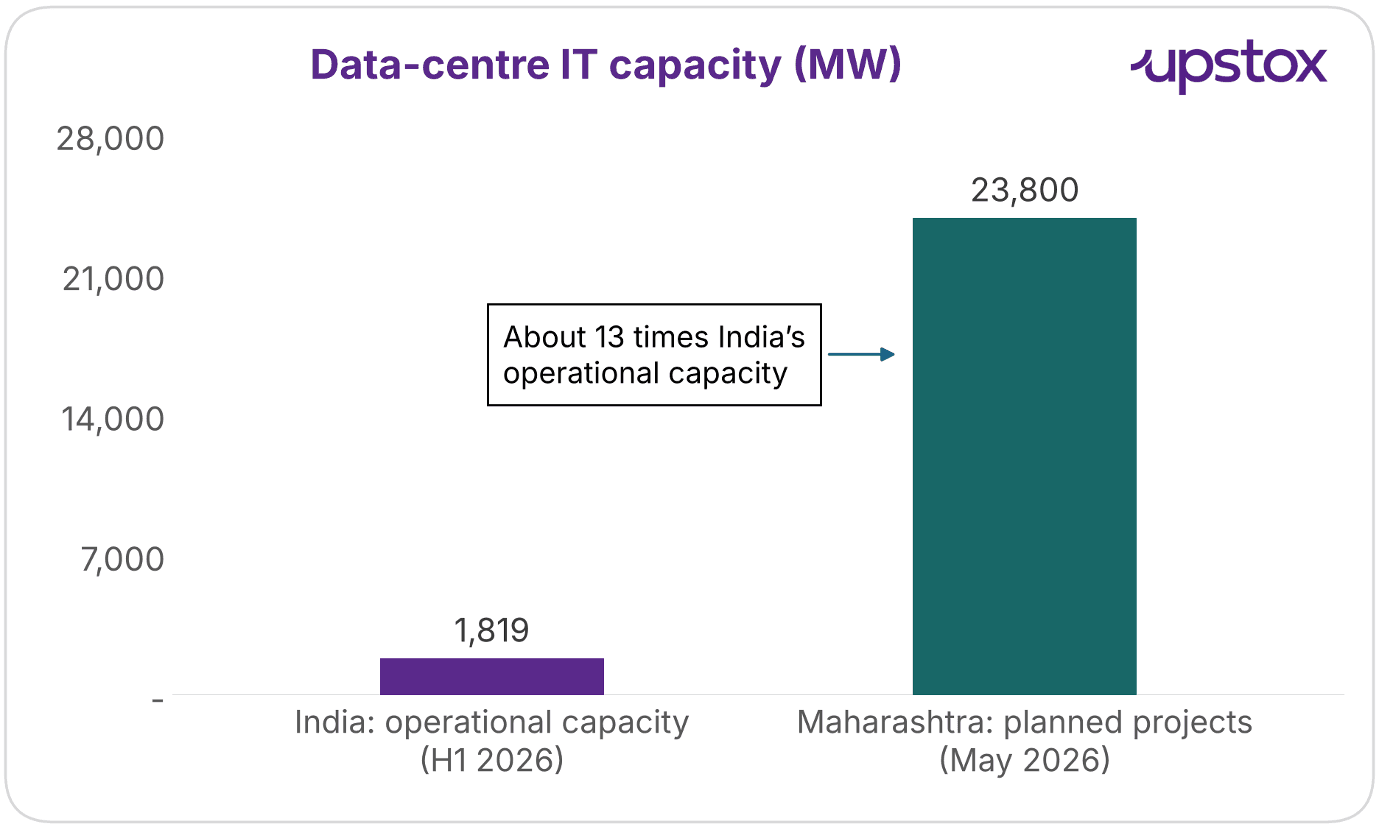
Look at Maharashtra. In May 2026, the state listed 44 mega data-centre projects worth ₹16.69 lakh crore, with nearly 23,800 MW of IT capacity. And that is just one state. All of India had only 1,819 MW of data-centre capacity actually running in the first half of 2026.
Source: Maharashtra Industries Department and MIDC (via IANS), May 2026; Savills India, H1 2026
So how many of these will actually get built, and when? That is the real question.
Power takes an interesting turn
Conventional power usually means coal. Not this time either. In the same period, ₹6.5 lakh crore of the ₹6.86 lakh crore of new conventional power projects was for nuclear power, from just four companies.
On May 19, 2026, Maharashtra signed nuclear power MoUs worth ₹6.5 lakh crore with NTPC, Adani Power, Reliance Industries and Lalitpur Power Generation Company, for 25,400 MW of capacity. That is almost the ₹7 lakh crore the whole private pipeline added in the eight years to March 2022, signed in just one day.
But does an MoU mean a plant is coming up? Not yet. An MoU only shows intent. The state has asked the companies to start surveying sites, and a nuclear plant usually takes several years to build. Also, these announcement numbers cover a different period and include government companies, so they show the direction, not an exact split of the ₹28 lakh crore.
What happened to everyone else?
Take out ITES and conventional power, and the rest of the pipeline grew only about 6% YoY, to around ₹64.9 lakh crore. Manufacturing, the biggest segment at ₹41.3 lakh crore, grew just 5% YoY.
Think about the companies that make the soap you use, the fridge in your kitchen or the car you drive. Between April 1 and August 5, 2026, consumer goods companies, including automakers, announced less than ₹2,000 crore of new investment. ITES announced ₹14.98 lakh crore in the same period. In simple words, the money has not yet reached the companies that make everyday products.
One state, half the story
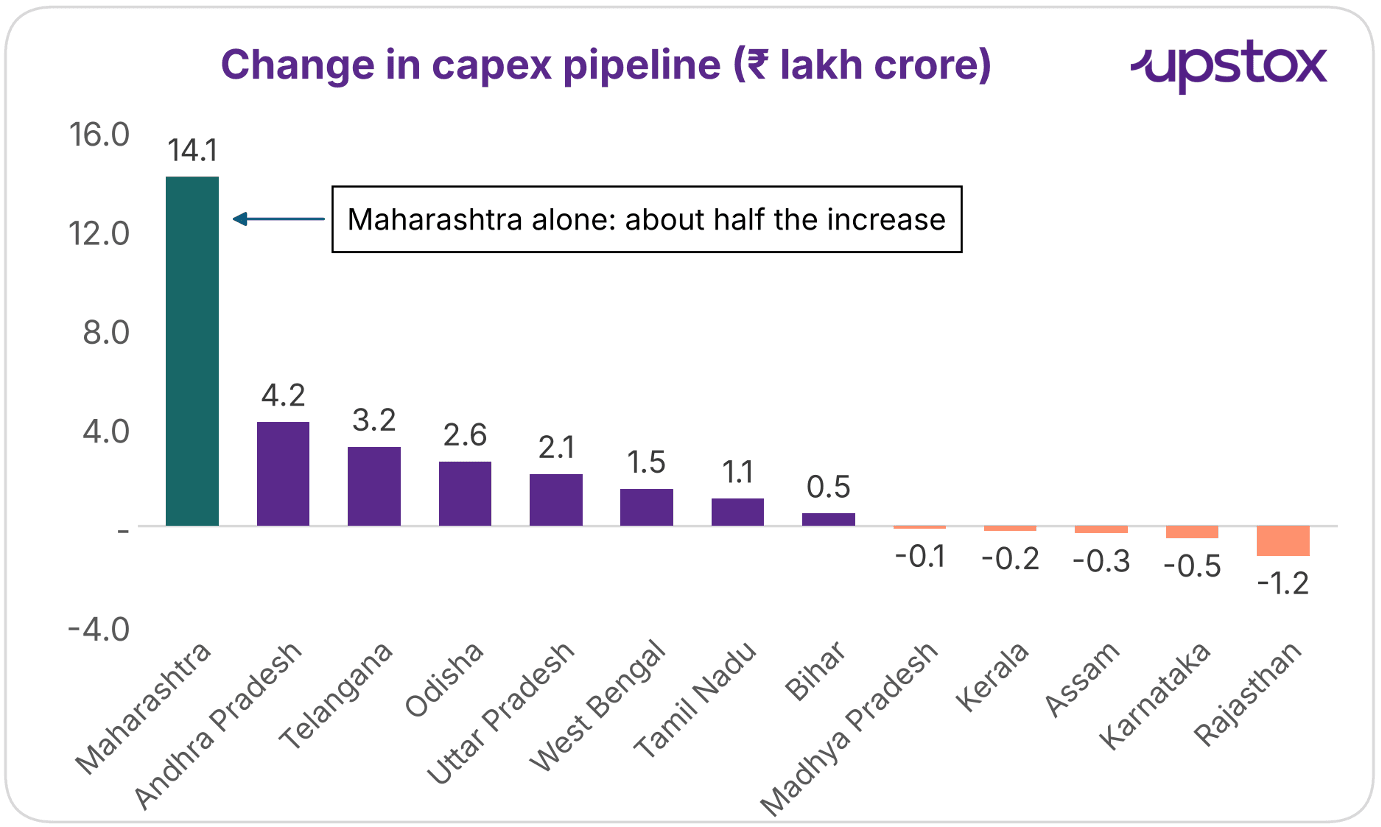
Maharashtra alone added ₹14.1 lakh crore to the pipeline during the year, about half of the national increase. Its pipeline value nearly doubled, up 97% YoY, but the number of projects stayed the same. The projects simply got much bigger. The state’s share of India’s private pipeline has risen from 9% in 2014 to 29% now.
Add Andhra Pradesh, Telangana, Odisha and Uttar Pradesh, and these five states made up ₹26.2 lakh crore, or 94% of the increase. The rest of India together added less than ₹2 lakh crore. Some states actually went backwards: Rajasthan’s pipeline shrank by ₹1.2 lakh crore and Karnataka’s by ₹0.5 lakh crore.
Source: Union Bank of India (CMIE CapEx data); change between Sep-25 and Sep-26
Is any of this actually getting built?
Yes, some of it. Between January and June 2026, India added 258 MW of data-centre IT capacity, 59% more than a year earlier. Maharashtra says 28 of its data-centre projects, worth ₹7.77 lakh crore, are under construction.
Bank money is moving too, even if it makes fewer headlines. Banks and financial institutions approved loans for 1,032 private projects worth ₹4.4 lakh crore in FY26, up from 907 projects worth ₹3.7 lakh crore in FY25. These projects have their funding fully tied up, and the money will be spent over several years.
Smaller pockets are growing too. Andhra Pradesh, Odisha, Telangana, Uttar Pradesh and Tamil Nadu saw both more projects and higher values. Across India, the number of hotel and restaurant projects rose by 102, and health service projects by 44. One problem stands out, though. Private companies plan to spend ₹32.0 lakh crore on making power, but only ₹0.17 lakh crore on the lines that carry it. Much of India’s power grid is built by government-owned companies. Still, more power plants will need more power lines.
In summary
Now back to that one-day match. Even if a few batsmen did most of the scoring, a total is a total. Data centres and power plants will need a lot of steel, cement, cables and transformers along the way. The ₹99.7 lakh crore pipeline is real, and a part of it is already under construction.
However, the numbers don’t lie. Two sectors made up 87% of the growth, five states made up 94%, and manufacturing grew just 5%. So, will the rest of the team join in? Four things will tell us: whether manufacturing picks up, how many data-centre and nuclear MoUs turn into real construction, whether more states start adding projects, and whether power lines keep up with power plants. For now, the big hitters have done most of the scoring. The rest of the team is still padding up.
About The Author
Next Story

