
Personal Finance News
Senior citizen faced tax penalty for ₹2.2 crore 'unexplained investment' after her son made her joint owner in his ₹1.1 crore flat. How she got relief

5 min read | Updated on October 08, 2026, 14:39 IST


SUMMARY
This ITAT ruling is relevant for senior citizens, to parents named as co-owners in a child's home loan, and to anyone assessed without receiving the notices.

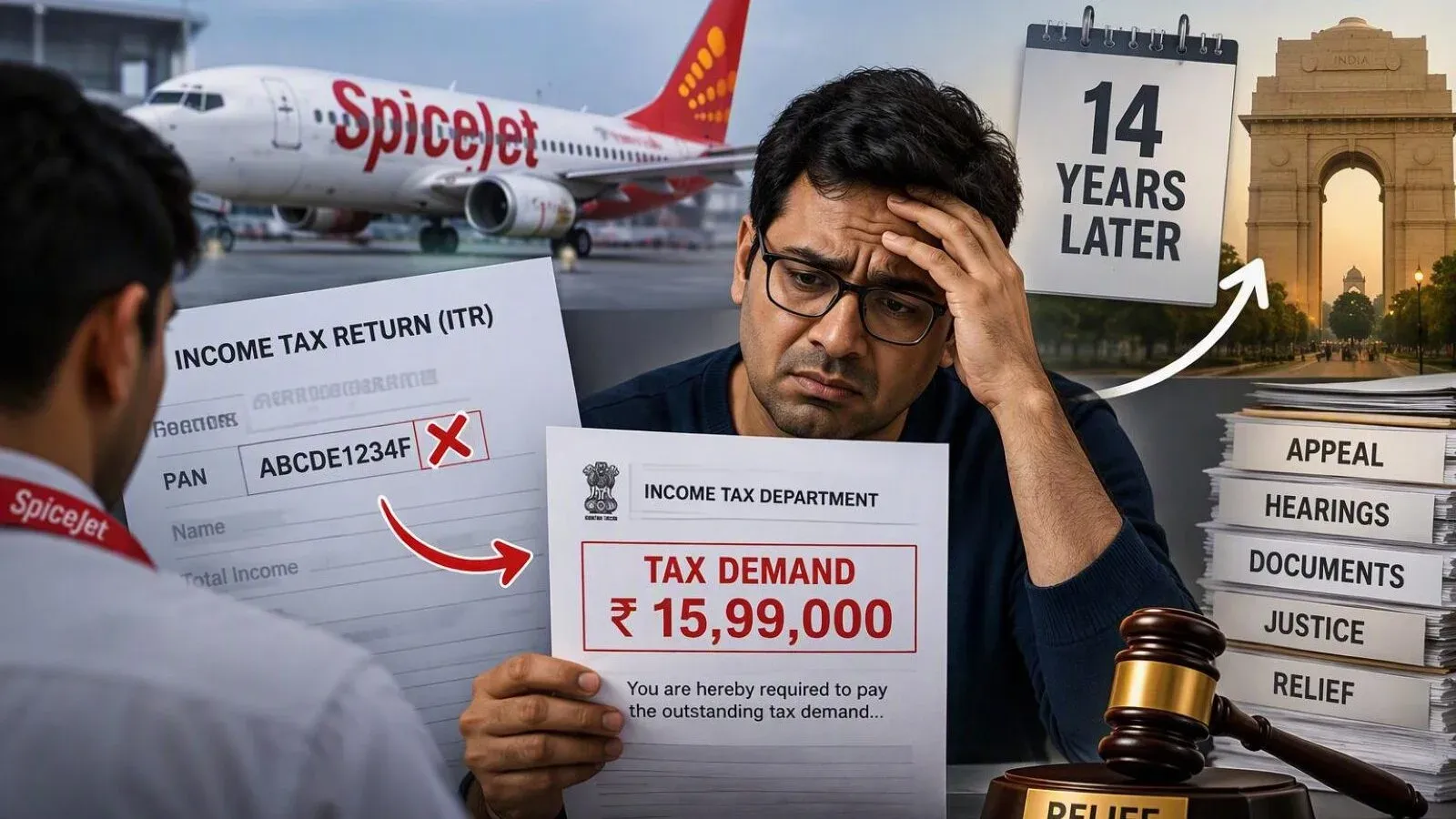
For families, there is a practical lesson from this case. | Representational image/AI generated
A senior citizen woman with no taxable income of her own was named a joint holder when her son bought a flat in Navi Mumbai on a housing loan. The routine arrangement, however, turned into a tax problem when the tax department read the same flat as two separate investments and attributed an unexplained investment of ₹2.20 crore to her. She had no chance to explain at the time, because the notices never reached her.
Case history
Jaishri Pande, the senior citizen, had not filed a return for the year. Yet, iInformation flagged under the Risk Management System of the tax department threw up two entries for the purchase of immovable property, one for ₹1,10,00,000 dated September 18, 2015 and another for an identical amount dated November 5, 2015. Treating these as two distinct purchases, the tax officer reopened the case, issued a notice under section 148 on March 16, 2023 and followed it up with notices under section 142(1) in late 2023, before a final show cause notice on January 24, 2024.
As there was no response from Pande, the assessment was completed ex parte on February 29, 2024, treating the aggregate ₹2,20,00,000 as unexplained investment. The tax officer also fixed total penalties of approx. ₹66.2 lakh.
Pande challenged the assessment as well as the three penalty orders before the CIT(A). But all the appeals were filed belatedly. CIT(A) refused to condone the delay without touching the merits of the case.
Before the tribunal, her counsel explained the reason for the delay in appeals: She was not living at the address on her PAN records, but at a flat in CBD Belapur, Navi Mumbai. Therefore, the postal notices never reached her. She was not on the e-filing portal until September 25, 2025 and learned of the demands only on February 4, 2026, after which she moved promptly.
The tribunal accepted this, noting that the assessment order itself recorded no compliance and service by affixture, and that nothing showed she personally received the notices.
"The assessee is a senior citizen who had no independent source of taxable income and had not been regularly filing returns of income," the ITAT observed, adding that her conduct showed no conscious inaction and she stood to gain nothing from the delay.
The ITAT also said that limitation rule cannot defeat a genuine case: "The expression 'sufficient cause' cannot be construed in a manner which converts a rule of limitation into an instrument for foreclosing adjudication despite the existence of a bona fide and reasonable explanation."
Relying on the Supreme Court in Collector, Land Acquisition v. Mst. Katiji and in N. Balakrishnan v. M. Krishnamurthy, where the length of delay is not decisive but the bona fides of the explanation are, the bench condoned the delay and admitted the appeals on merits.
What the ITAT found
The tribunal found that the registered Agreement for Sale dated September 18, 2015 and the Deed of Assignment dated November 5, 2015 were not two purchases. The Deed of Assignment expressly recorded that it was executed in furtherance of the Agreement for Sale, which was already registered with the Sub-Registrar, Thane-6. Both documents concerned the same flat in CBD Belapur. Further, the receipt acknowledged a single sale consideration of ₹1,10,00,000 from the assignees, Manu Pande and Jaishri Pande, with no reference to a second property or a second payment.
The ITAT said that the two entries represented "two connected instruments or stages of one and the same property transaction" and the "addition of ₹2,20,00,000 consequently proceeds from a manifest duplication of the same transaction merely because the Agreement for Sale and the consequential Deed of Assignment were registered or reported on different dates."
Moreover, a certified ICICI Bank statement identified her son, Manu Pande, as principal borrower and the assessee as co-applicant. It recorded a housing loan of ₹1,09,71,988 sanctioned on September 29, 2015 and disbursed in two tranches.
The tribunal held that "the mere appearance of the assessee's name as a joint holder in a registered instrument cannot, without examination of the payment trail, justify attribution of the entire investment to her."
Key lessons from the case
The ruling is relevant for senior citizens, to parents named as co-owners in a child's home loan, and to anyone assessed without receiving the notices.
For families, there is a practical lesson from this case. When a parent is named a joint holder or co-applicant in a child's home loan, one should keep the loan sanction, disbursement and payment records. These documents help separate a co-owner from an unexplained investor.
And for senior citizens living away from the address on their PAN, it is advisable to update the e-filing portal and PAN details to avoid a situation like Pande, where the notices that never arrived almost cost her ₹2.20 crore.
Related News

About The Author
Next Story

