
Personal Finance News
He moved ₹11.34 crore through his bank accounts for a living, but the taxman treated ₹8.34 crore as unexplained income. ITAT disagreed

4 min read | Updated on October 07, 2026, 18:33 IST


SUMMARY
There is an important takeaways from the case for agents who routinely deal with customers' cash: They should keep the agency agreements, commission records and inter-account reconciliations ready.
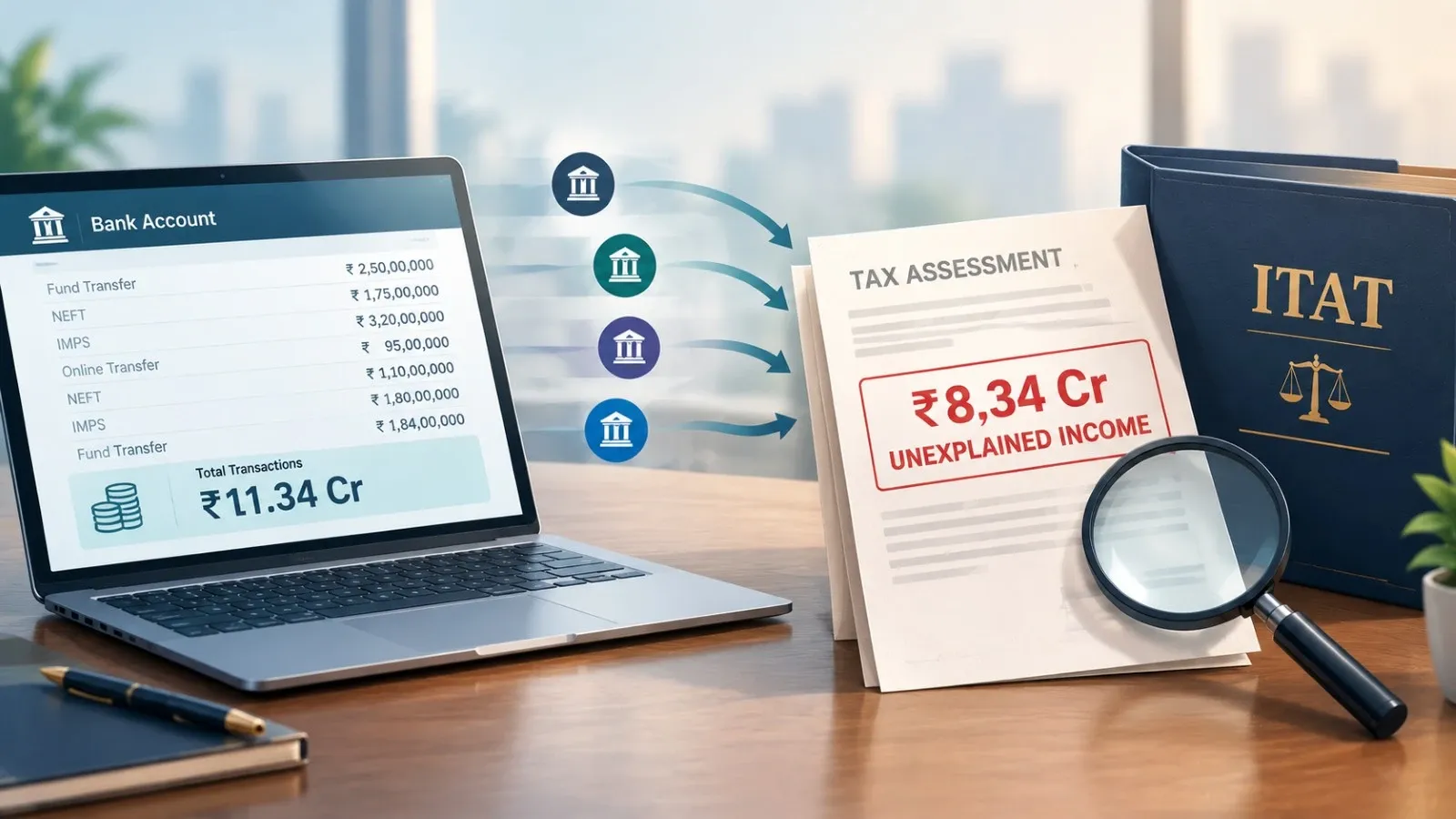
There is an important takeaways from the case for agents who routinely deal with customers' cash. | Representational image
This article explains the case history in brief as per the ITAT order and a key takeaway.
Case history
As per the order dated September 22, 2026, Thane-based Varma had filed his return for AY 2020-21 declaring a total income of ₹6,60,250. However, his assessment was reopened under section 147.
During reassessment, the officer examined his bank accounts and found cash deposits of ₹1,05,65,300 in the Axis Bank account, ₹1,49,86,267 in the IDFC Bank account and ₹4,45,76,400 in the Corporation Bank account. The officer also noticed cash withdrawals of ₹1,48,13,900 from the Yes Bank account. The aggregate credits across the accounts were ₹11,34,28,125.
Varma explained that he was a Business Correspondent Agent for several entities. The accounts were operational accounts used in the ordinary course of that business to receive cash from customers and transfer it to his principals. He also produced agreements and certificates covering his agency arrangements with Vodafone M-Pesa Ltd, IDFC First Bank Ltd and others. Further, Varma said the receipts were not his income but customers' funds in transit on which he earned commission.
However, the assessing officer took the commission Varma had earned from Vodafone M-Pesa Ltd of ₹1,50,306, applied a rate of 0.5% to it, and calculated the corresponding transaction value at ₹3,00,61,200. Subtracting that from the aggregate credits of ₹11,34,28,125, he treated the balance of ₹8,33,66,925 as unexplained money under section 69A read with section 115BBE. The officer also added this amount to Varma's income.
However, the assessing officer didn't take some other transactions into account. Varma had also earned commission of ₹3,65,317 from IDFC First Bank Ltd and ₹6,84,990 from Nearby Technologies Pvt. Ltd, plus smaller amounts from Hermes I Tickets Pvt. Ltd, FINO Payments Bank Ltd, Nearby Insurance Broking Services Pvt. Ltd and Ramdev Co-op Credit Society Ltd, aggregating ₹2,16,222, all reflected in his Form 26AS and disclosed in his return.
Before the CIT(A), Verma showed that after excluding transfers between his own bank accounts, the actual credits were ₹8,88,80,859, and pointed out that the officer had ignored the cash withdrawals altogether in arriving at the unexplained figure.
The CIT(A) found the explanation plausible, noting that the business inherently involved frequent deposits and withdrawals of customer funds. The "mere existence of large bank credits could not, by itself, lead to the conclusion that the amounts represented unexplained income," it said. Inter-bank transfers between Varma's own accounts did not constitute income.
"The assessment order thus proceeds by considering only one segment of the assessee's agency business while disregarding the other principals whose commission income was admittedly reflected in Form 26AS," the tribunal said.
It relied on the coordinate bench's decisions in Varma's own case for assessment years 2017-18 and 2018-19, and observed that "the principle of consistency assumes particular significance where the nature of the business and the basis on which the impugned bank transactions arise remain substantially the same"
The Revenue's second complaint, that the CIT(A) had accepted explanations and documents at the appellate stage without a remand report, also failed. Once "the very basis adopted by the Assessing Officer for making the addition is found to be unsustainable," the bench said. It added that "there is no justification for restoring the matter merely for the purpose of undertaking the same exercise afresh".
There is an important takeaways from the case for agents who routinely deal with customers' cash: They should keep the agency agreements, commission records and inter-account reconciliations ready, because a single reverse calculation from one principal can produce an alarming addition.
Related News
About The Author
Next Story

