Market News
Undervalued or excess cash? The real reason behind buybacks at Bajaj Auto, Wipro & Zydus Life

7 min read | Updated on May 30, 2026, 02:55 IST


SUMMARY
Multiple companies have rolled out a share buyback offer for investors in Q4, as experts now shed light on why these firms are looking at a repurchase deal amid an overall weak stock market.

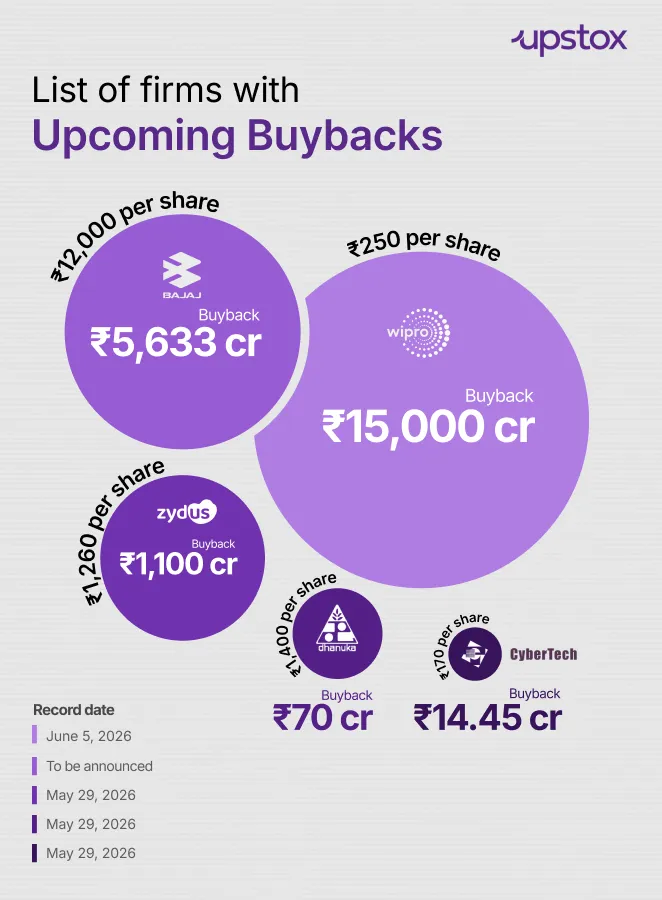
Wipro, Zydus Lifesciences, and Bajaj Auto are amongst 5 companies which have upcoming buybacks in store for shareholders. | Image: Shutterstock.
Companies with adequate holdings of free cash reserves are shifting their attention back to share buybacks, where firms repurchase a portion of their outstanding stock from shareholders, usually at a premium price.
Experts attributed the recent buyback moves of the companies to the taxation changes, which have been implemented under the new Finance Act 2026, as firms that were hoarding cash now found an opportunity to reward shareholders via the repurchase route.
Why are companies looking at buybacks now?
Independent capital markets analyst Ambareesh Baliga said that, at the current market scenario, the companies are looking at buybacks at a lower share price rather than carrying out the corporate action at a higher level.
So far in 2026, the benchmark stock market index, NIFTY50, has fallen 8.56% on the backdrop of the supply chain disruption and West Asia crisis.
“Since most of the stocks have fallen, those companies which were sitting on cash and had no better use for it are doing a buyback now, rather than doing a repurchase at higher levels,” said Baliga.
The buyback move signals that the company repurchasing its shares is expected to be a better opportunity than investing in any other business ventures using the cash in hand.
“The companies are looking forward to better ROI, in this case from buybacks rather than from some other investment options, like capex or takeover, among other things,” said the analyst.
The buyback option also allows shareholders in the current market to get out at a premium price while the company repurchases its shares from the open market via the tender offer.
Is buyback a good method to reward shareholders?
Mumbai-based independent stock market analyst, Ajay Bodke, explained how the companies, earlier, used to prefer buybacks as the route for rewarding shareholders, essentially due to the tax efficiency perspective.
In 2019, the government norms were revised to tax the companies instead of the shareholders, shifting the tax liability to one side. Over the years, the government has updated its norms several times, with the latest one being in April 2026, marking the buyback profits under capital gains.
Company promoters prefer buybacks to increase their stake in the company, unless they also decide to take part, in which case, both outstanding shares and promoter holdings get reduced.
“Companies do buybacks because it's a signalling mechanism to the investor fraternity as a whole that the management or the promoters or the board is giving a signal that it believes that the underlying business is fundamentally not fairly priced or it is undervalued,” said the analyst.
Experts said that when the companies look at a buyback, they usually hold free cash flow in hand while having completed their outlined capital expenditures (capex) for a particular period, with no opportunities for growth at the right price.
“So if the management believes that the market is not ascribing the intrinsic value or the fair value to the business, and if they believe that the market is undervaluing the business, then the signal is sent through buybacks,” said Bodke.
Buybacks usually indicate that the company’s management is backing the idea that the shares of the company are undervalued and that there is more growth potential ahead, adding to the reasoning behind their investments.
Have the tax rules changed for buybacks?
Under the Finance Act 2026, effective from April 1, 2026, the share buyback tax liability has undergone a major shift, as now the income from buyback will not be considered as a dividend income.
Earlier, investors had to pay tax on the entire amount received without the deduction of the original purchase cost of the shares. Now, after the revisions, the share buybacks are taxed as capital gains income, similar to other share sale transactions.
Upcoming buyback details
The buyback represents 9.81% and 7.55% of the total paid-up equity capital and free reserves of the firm, according to the financial statements on March 31, 2026.
As part of the share repurchase agreement, the company will buy back 8,50,000 full paid-up equity shares with a face value of ₹10 apiece from the shareholders as on the record date on a proportionate basis through the tender offer.
As of the stock market close on May 27, the buyback is at a 12% premium from the current market price of ₹151.22 per share, with a record date of Friday, May 29.
The company’s share repurchase deal will comprise the firm buying back 5,00,000 shares of the company as on the record date of the corporate action for the tender offer. The promoter and promoter group of the company will also participate in the buyback offer.
As of Wednesday’s closing session, the buyback offer price is at a 18% premium. Shares of the company closed 0.48% higher at ₹1,180.30, ahead of the record date on Friday, May 29.
Although the buyback per share price has been increased, the offer total remains the same as the company will repurchase 87,30,158 shares, compared to its earlier 95,65,217 shares announcement.
NSE data showed that the buyback proposal is at a 16% premium on top of Wednesday’s closing price, one day ahead of the record date on Friday, May 29.
Wipro plans to buy back 60,00,00,000 shares with a face value of ₹2 apiece at the offer price, as of the eligibility based on the pre-determined record date of Friday, June 5, 2026.
At Wednesday’s closing level, Wipro’s buyback offer price marks a 24% premium over the closing price of the shares at ₹201.58 per share.
With the repurchase deal, the company aims to buy back 46,94,000 equity shares from the shareholders, which represents almost 1.68% of the total paid-up share capital of the firm.
Based on Wednesday’s closing price of ₹10,808.50 apiece, the buyback offer marks a 11% premium on top of the current market price.
Stocks that have announced buybacks will be in focus of the stock market investors ahead of the company-determined record date, as people looking to qualify for the corporate action need to be invested in the company’s stock one day ahead of the record date.
Related News
About The Author
Next Story