
Personal Finance News
Senior Citizens' tax planning guide for AY 2026-27: Which regime offers greater savings?

4 min read | Updated on June 08, 2026, 07:24 IST


SUMMARY
Old vs new tax regime for senior citizens in AY 2026-27: Compare tax slabs, Section 87A rebate, 80TTB, 80D deductions and pension taxation to choose the better option.

Apart from the exemption limit, taxpayers should also consider the deductions and rebates available under each regime before making a choice.
Senior citizens can choose between the old and new tax regimes while filing their income tax return (ITR) for AY 2026-27. The right choice depends on factors such as pension income, interest income, and the amount of deductions available.
Basic exemption limit: Old vs new tax regime
| Particulars | Old Tax Regime (Senior Citizen 60–79 yrs) | Old Tax Regime (Super Senior 80+ yrs) | New Tax Regime |
|---|---|---|---|
| Basic Exemption Limit | ₹3,00,000 | ₹5,00,000 | ₹4,00,000 |
| Standard Deduction (Salary/Pension) | ₹50,000 | ₹50,000 | ₹75,000 |
| Section 80C Deduction (PPF, EPF, ELSS, LIC, etc.) | Up to ₹1,50,000 | Up to ₹1,50,000 | Not Available |
| Additional NPS Deduction u/s 80CCD(1B) | Up to ₹50,000 | Up to ₹50,000 | Not Available |
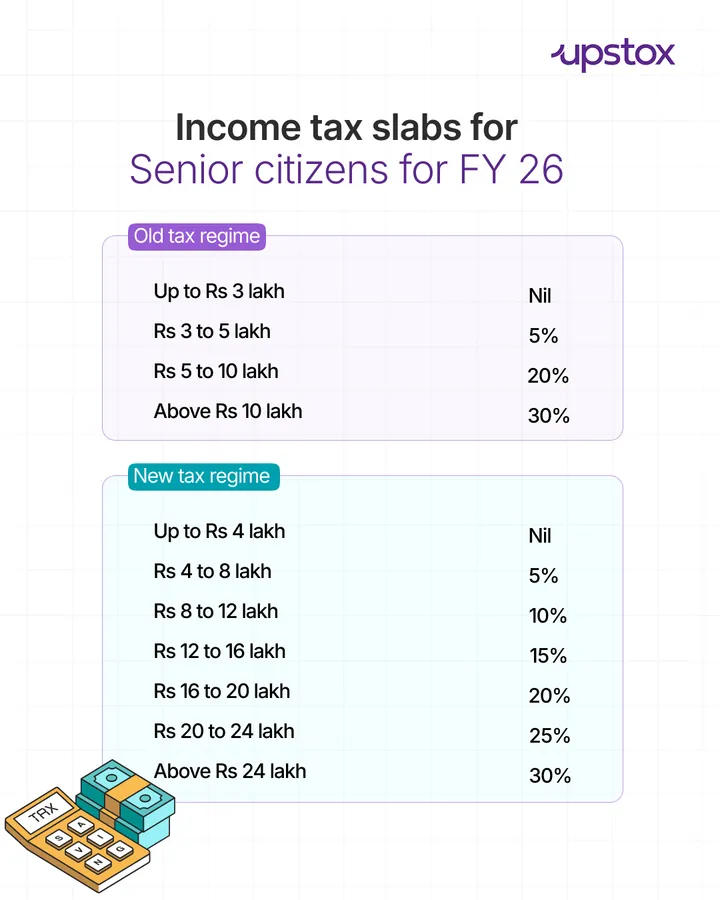
Under the new tax regime, the basic exemption limit is ₹4 lakh, meaning income up to this level is not subject to tax under the applicable tax slabs. However, resident individuals can also avail of the rebate under Section 87A, which reduces the tax liability to zero where the taxable income does not exceed ₹12 lakh, effectively making income up to ₹12 lakh tax-free, subject to applicable conditions and excluding income taxed at special rates.
Apart from the exemption limit, taxpayers should also consider the deductions and rebates available under each regime before making a choice.
How is pension income taxed?
Pension received from a former employer is generally taxed under the head “Income from Salary” under both the old and new tax regimes.
When the new tax regime may be better
The new regime is generally beneficial for senior citizens who do not claim many deductions and prefer a simpler tax structure.
"Key advantages include lower tax rates across income slabs and a simplified tax filing process," said Soni.
-
Have limited tax-saving investments
-
Do not claim major deductions
-
Prefer a simpler tax structure
-
Benefit from lower slab rates
When the old tax regime may be better
The old regime can be more beneficial for senior citizens who actively claim deductions and exemptions, such as:
-
Section 80C deduction for eligible investments
-
Section 80D deduction for health insurance premiums
-
Section 80TTB deduction of up to ₹50,000 on interest income from deposits
-
Section 80DDB deduction for specified medical treatment expenses
Other eligible exemptions and deductions
"For retirees who earn substantial interest income from fixed deposits or incur significant medical and insurance expenses, these deductions can substantially reduce taxable income and may result in lower tax liability than the new regime," said Soni.
Which tax regime should senior citizens choose?
For most senior citizens with limited deductions, the new tax regime is likely to be more tax-efficient due to lower tax rates and simplified compliance.
"However, senior citizens who regularly claim deductions under Sections 80C, 80D, 80TTB or 80DDB should compare their tax liability under both regimes before filing their return. In many such cases, the old tax regime may still provide greater overall tax savings despite higher tax rates," explained Soni.
The final choice depends on an individual's income profile, pension income, interest earnings, medical expenses and eligibility for deductions.
Related News

About The Author
Next Story

