
Personal Finance News
He retired from Bank of Baroda before leave encashment up to ₹25 lakh became tax-free. Yet ITAT allowed him the full exemption; here's why

4 min read | Updated on November 22, 2026, 20:44 IST

SUMMARY
The ITAT ruling is relevant to every employee retiring from a bank, a public sector undertaking or a private company who finds the leave encashment exemption restricted to ₹3 lakh.
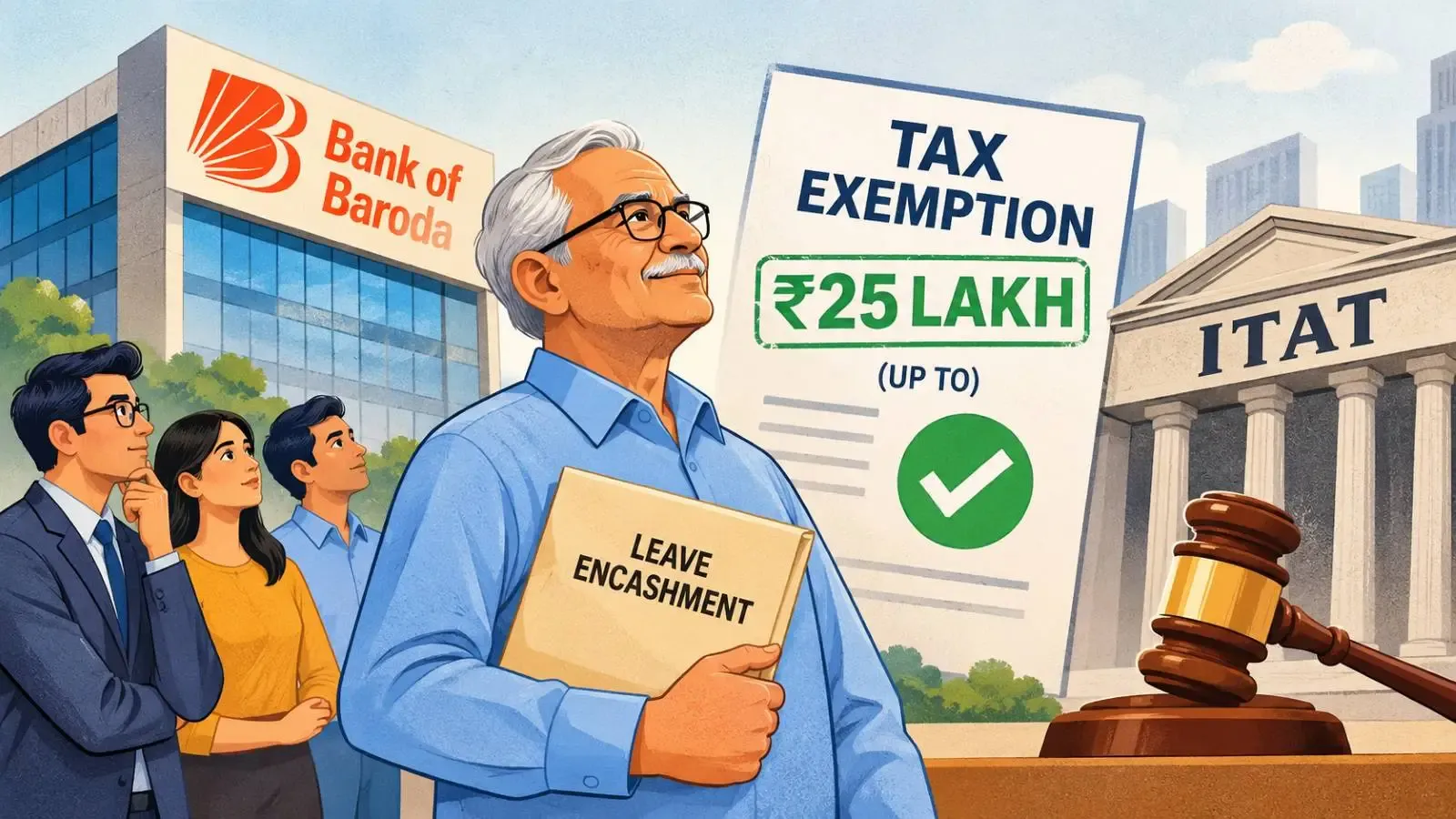
The ITAT ruling is relevant to every employee cut on leave encashment exemption. | Representational image/Shutterstock
Mahesh Chand Methi of Kota, Rajasthan retired from the Bank of Baroda around two years before the government made leave encashment up to ₹25 lakh exempted under section 10(10AA) of the Income-tax Act, 1961.
He had received ₹9,54,104 as leave encashment on retirement in FY 2019-20. Methi claimed the entire sum as exempt in his income tax return for AY 2020-21, but the Income Tax Department allowed only ₹3,00,000 as exempt, adding the balance to his total income.
This article explains the case history and takeaways for readers, as per the tribunal's order dated November 2, 2026.
Case history
Methi declared a total income of ₹11,11,220 in his ITR. He claimed the entire leave encashment of ₹9,54,104 as exempt. The Department, however, restricted the exemption to ₹3,00,000, while adding ₹6,54,104 to his taxable income.
Methi appealed against the Department's decision before the Addl. CIT(A), which held that the exemption limit then relied upon was ₹3,00,000 and upheld the adjustment done by the Department.
"Section 10(10AA)(i) of the Act provides for exemption in respect of leave encashment received by employees of the Central or State Government, whereas section 10(10AA)(ii) governs such receipts in the case of other employees, subject to the monetary limit notified by the Central Government. Since the limit prescribed by the notification then relied upon was Rs.3,00,000/-, the Ld. Addl. CIT(A) upheld the adjustment made by the CPC and dismissed the assessee’s appeal," CIT(A) said.
What the tribunal said
By the time the matter reached the tribunal, there was a delay of 442 days, explained in a notarised affidavit dated February 26, 2026. Methi said he was not aware of the technical confusion and had filed the appeal on proper legal advice.
The tribunal accepted his explanation, relying on the Supreme Court's decision in M/s Concord of India Insurance Co. Ltd. v. Smt. Nirmala Devi, which held that "a legal advice tendered by a professional and the litigant acting upon it one way or the other could be a sufficient cause to seek condonation of delay."
The key issue before ITAT was whether the enhanced exemption limit of ₹25,00,000 prescribed by CBDT Notification No. 31/2023 dated May 24, 2023 applied to leave encashment received on retirement in the year relevant to assessment year 2020-21.
The bench noted that coordinate benches have considered the identical issue and allowed the benefit of the enhanced limit even for leave encashment received in earlier years. The tribunal relied particularly on Renu Moongia v. ITO, decided in ITA No. 1196/JPR/2025, which had itself followed Ram Charan Gupta v. ITO, Govind Chhatwani v. CIT(A) and Vijay Kumar Jain v. ITO. The reasoning in that line of cases is that a CBDT circular, though it cannot override the statute, can relax its rigours where the relaxation benefits the assessee, and the notification raising the limit from ₹3 lakh to ₹25 lakh is exactly such a relaxation.
The tribunal recorded that his leave encashment of ₹9,54,104 was below the enhanced limit of ₹25,00,000, and that the Revenue had not brought to its notice any decision reversing the coordinate view.
"Respectfully following the decisions cited above, we hold that the assessee is entitled to exemption in respect of the entire amount of ₹9,54,104/- received as leave encashment, subject to the provisions of section 10(10AA) of the Act," it held.
The takeaway
The ITAT ruling is relevant to every employee retiring from a bank, a public sector undertaking or a private company who finds the leave encashment exemption restricted to ₹3 lakh by taxmen . Methi's case adds to a number of decisions in which the tribunal has held that the revised ceiling can apply even to retirements in earlier years.
Related News
About The Author
Next Story

