
Personal Finance News
He sold a property and never filed an ITR. Seven years later, the taxman levied a ₹90 lakh penalty, but ITAT gave him another chance

3 min read | Updated on October 11, 2026, 19:22 IST


SUMMARY
For anyone selling property, the case provides some important takeaways: TDS by the buyer puts the transaction on the taxman's radar. But silence on your part by not filing the return will now make an assessment go away.
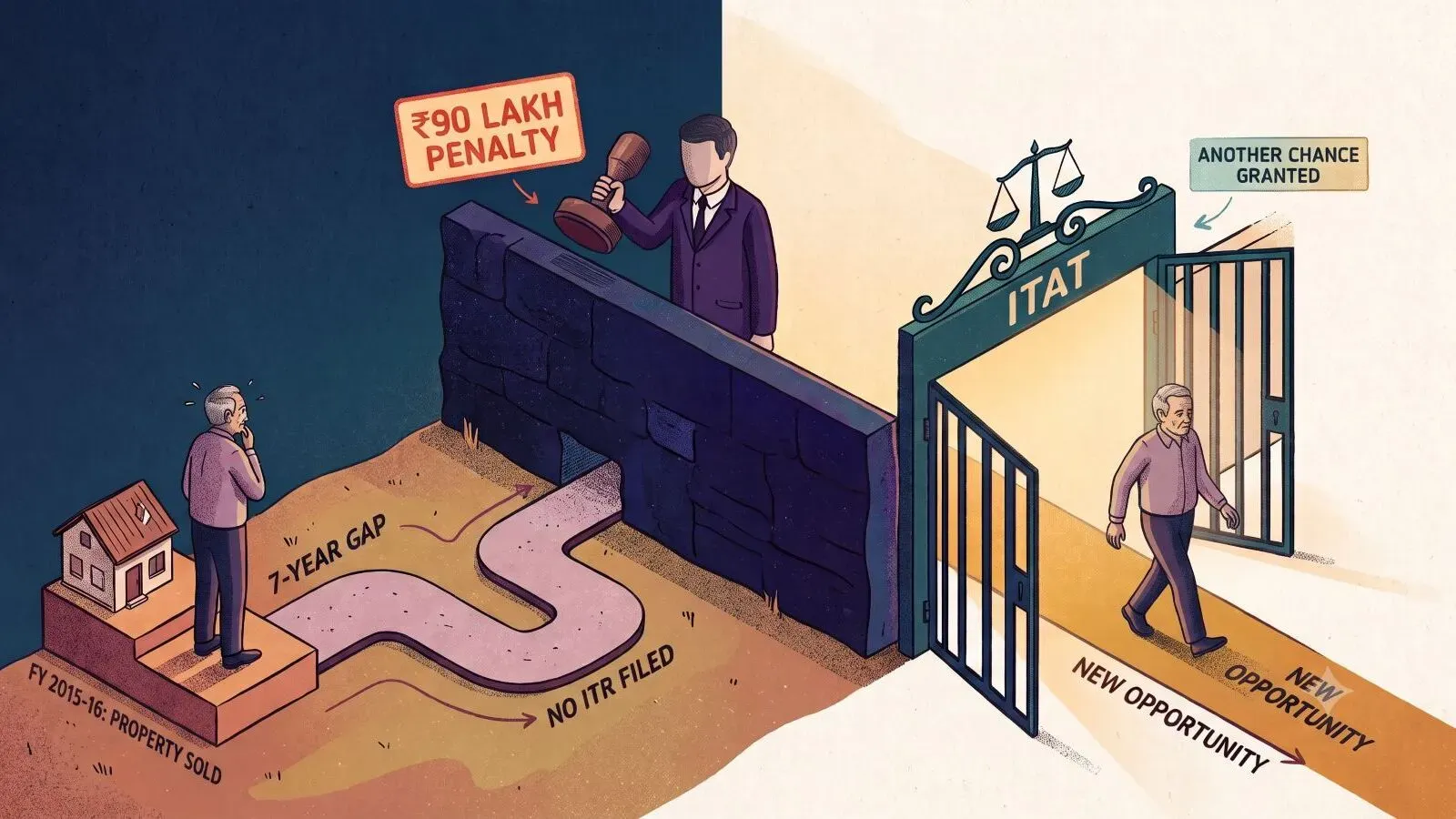
The image is a pictorial representation of the case. | AI generated
This article explains key details of the case from the ITAT order dated September 9, 2027 and takeaways for taxpayers
How the tax dispute started
The department received information that Masurkar had received sale consideration on the sale of immovable property, that TDS under section 194-IA had been deducted in FY 2015-16 by the buyer, and that no return had been filed for AY 2016-17.
The assessing officer issued a reopening notice under section 148 on February 17, 2023, seven years after the transaction, and followed it up with notices under section 142(1) with questionnaires and a show cause notice but there was no compliance by the assessee.
The officer went to the builder under section 133(6), obtained information, but the assessee didn't make any submissions on the disputed issue despite adequate opportunities. The tax officer finally invoked section 144, adding short-term capital gains of ₹2,65,00,000, interest income of ₹1,14,925, to Masurkar's income. He assessed Masurkar's total income as ₹2,66,14,925 by order dated March 19, 2024 and later announced a penalty of whopping ₹90,09,013 September 1, 2024.
CIT(A) rejected Masurkar's appeals against the tax department due to unexplained delay.
At the ITAT, his counsel said the delay "was not a wanton act nor deliberate but the circumstances beyond the control of the assessee".
The tribunal noted that the CIT(A) had passed his orders on the premise of non-compliance, but "there could be various reasons for no proper compliance" and the assessee had filed the condonation request in Form 35 explaining sufficient cause
The ITAT then laid out the law, quoting the Supreme Court's thirteen principles in B. Madhuri Goud v. B. Damodar Reddy (2012) 12 SCC 693, which call for "a liberal, pragmatic, justice oriented, non-pedantic approach" to condonation, and Collector, Land Acquisition v. Mst. Katiji (167 ITR 471), where "sufficient cause" was read as "adequately elastic" to serve the ends of justice rather than scuttle decisions on merits
Applying them, the tribunal found there was a reasonable cause in filing of the appeals with delay and there was no benefit derived in causing delay.
However, Masurkar has not won the tax case yet. The ITAT has just remitted the disputed issues for fresh adjudication, with an adequate opportunity of hearing for the assessee.
For anyone selling property, the case provides some important takeaways:
TDS by the buyer puts the transaction on the taxman's radar. But silence on your part by not filing the return will now make an assessment go away. The taxman can build the assessment even without you.
For those who slept through their appeal deadlines, delay with sufficient cause can still be forgiven, but only the hearing may be restored, not the outcome.
Related News
About The Author
Next Story

