
Personal Finance News
He retired from State Bank of India and claimed his full leave encashment, but the taxman allowed only ₹3 lakh exemption. What ITAT held
4 min read | Updated on October 12, 2026, 21:06 IST


SUMMARY
The practical takeaway from this case is that the old ₹3 lakh ceiling for leave encashment exemption is no longer the wall it once was for non-government retirees.
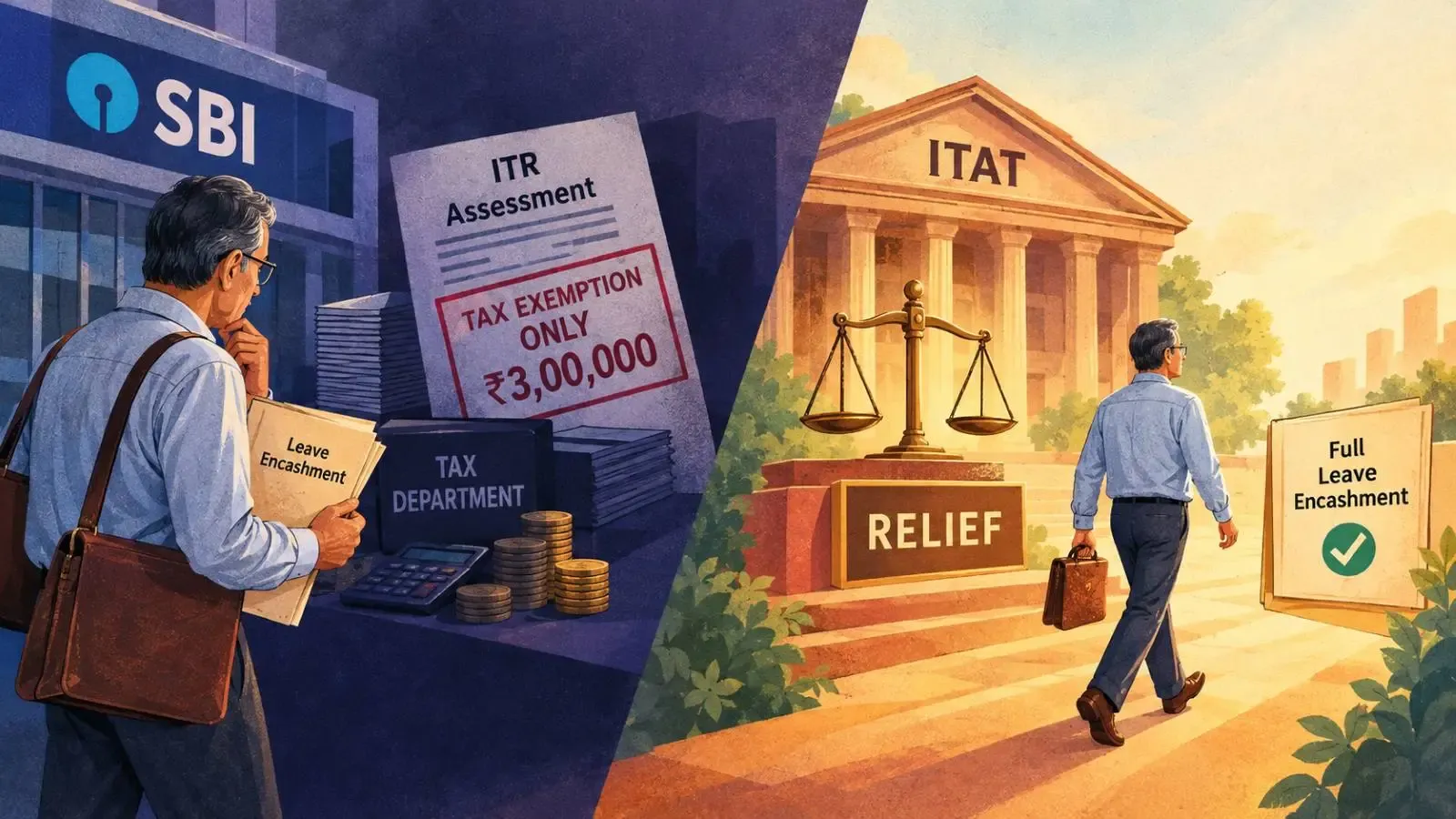
The key issue before the tribunal issue was whether a bank employee is entitled to the higher exemption. | Representational image/AI generated
A retiree from the State Bank of India (SBI) claimed exemption for his leave encashment under section 10(10AA) of the Income-tax Act, as any government employee would. The tax department allowed only ₹3 lakh and taxed the rest, on the ground that a bank employee is not a government employee.
Based on the ITAT order dated August 4, 2026, this article explains details of the case along with takeaways for government, especially public sector bank, employees.
The case began with the processing of the return under section 143(1). The assessing officer restricted the section 10(10AA) leave encashment exemption to ₹3,00,000, on the view that the assessee was employed with the State Bank of India, not a central or state government department.
The CIT(A) confirmed that action on September 20, 2023, making the assessee to appeal before the tribunal. However, his appeal was late by 894 days, but the tribunal condoned the delay, following the Supreme Court's ruling in Collector, Land Acquisition v. Mst. Katiji & Others.
The key issue before the tribunal issue was whether a bank employee is entitled to the higher exemption, or is confined to the ₹3 lakh limit that then applied to those who are not government employees.
The precedent the tribunal followed
The ITAT relied on its own recent decision in Ram Charan Gupta, Jaipur v. ITO, Ward 4(2), Jaipur, in ITA No. 408/JPR/2022 dated June 27, 2023, which had rejected the Revenue's identical stand . That case concerned a retired bank employee who had claimed ₹6,97,100 as leave encashment exempt under section 10(10AA), only for the CPC to allow ₹3,00,000 and tax the balance of ₹3,97,100 There, the CIT(A) had leaned on the Delhi High Court's decision in Kamal Kumar Kalia v. Union of India, which held that employees of public sector undertakings and nationalised banks, though treated as "State" under Article 12 for constitutional remedies, do not thereby become central or state government employees. The first appellate authority had also cited the Bangalore tribunal's ruling in KPTCL Davangere v. ITO. But the tribunal in Ram Charan Gupta pointed to what the Delhi High Court had said next.
In Kamal Kumar Kalia, the court had issued notice to the Union of India, observing: "We are however of the, prima facie, view that the grievances of the petitioner with regard to exemption limit under Clause (ii) of Section 10 (10AA) not being raised since 1998, appears to be justified." The court noted that "the last drawn salaries have increased manifold since time and notification issued under Clause (ii) of Section 10(10AA) was lastly issued... on 31.05.2002"
In the prevision case, the decisive development, the bench noted, was that the CBDT had since revised the limit of its own accord. "Recently the Central Board of Direct Taxes Suo-motu revised the limit for deduction u/s 10(10AA) of the Act and the revised limit now stood at ₹25,00,000," the tribunal recorded.
Since the leave encashment claimed in Ram Charan Gupta, ₹6,97,100, was below the revised limit, the assessee was eligible, and the assessing officer was directed to allow the claim within the revised limit.
In the present case, the tribunal adopted that reasoning "mutatis mutandis" to accept the SBI employee's sole ground, and allowed his appeal.
What it means for retirees
The practical takeaway from this case is that the old ₹3 lakh ceiling is no longer the wall it once was for non-government retirees. Where the leave encashment received is within the revised ₹25 lakh limit notified by the CBDT, the exemption can be claimed even by a bank employee whose employer is not a government department.
For retirees, who may be facing a similar case before the tribunal or any other forum, another takeaway is to check the figure allowed against the revised limit rather than accept an intimation that caps it at ₹3 lakh. And for those whose claims were trimmed in earlier years, this recent decision of the tribunal offers a template for challenging it.
Related News
About The Author
Next Story

