
Personal Finance News
Govt employee paid ₹2.5 lakh in cash for a plot. The builder returned it and took a cheque, but taxman still added it to his income. What ITAT held
5 min read | Updated on November 19, 2026, 21:12 IST

SUMMARY
For a property buyer, a cash payment that is later reversed and replaced by a cheque is not the end of the story if a receipt survives at the seller's office. However, buyers should keep all transactions documented to avoid trouble.
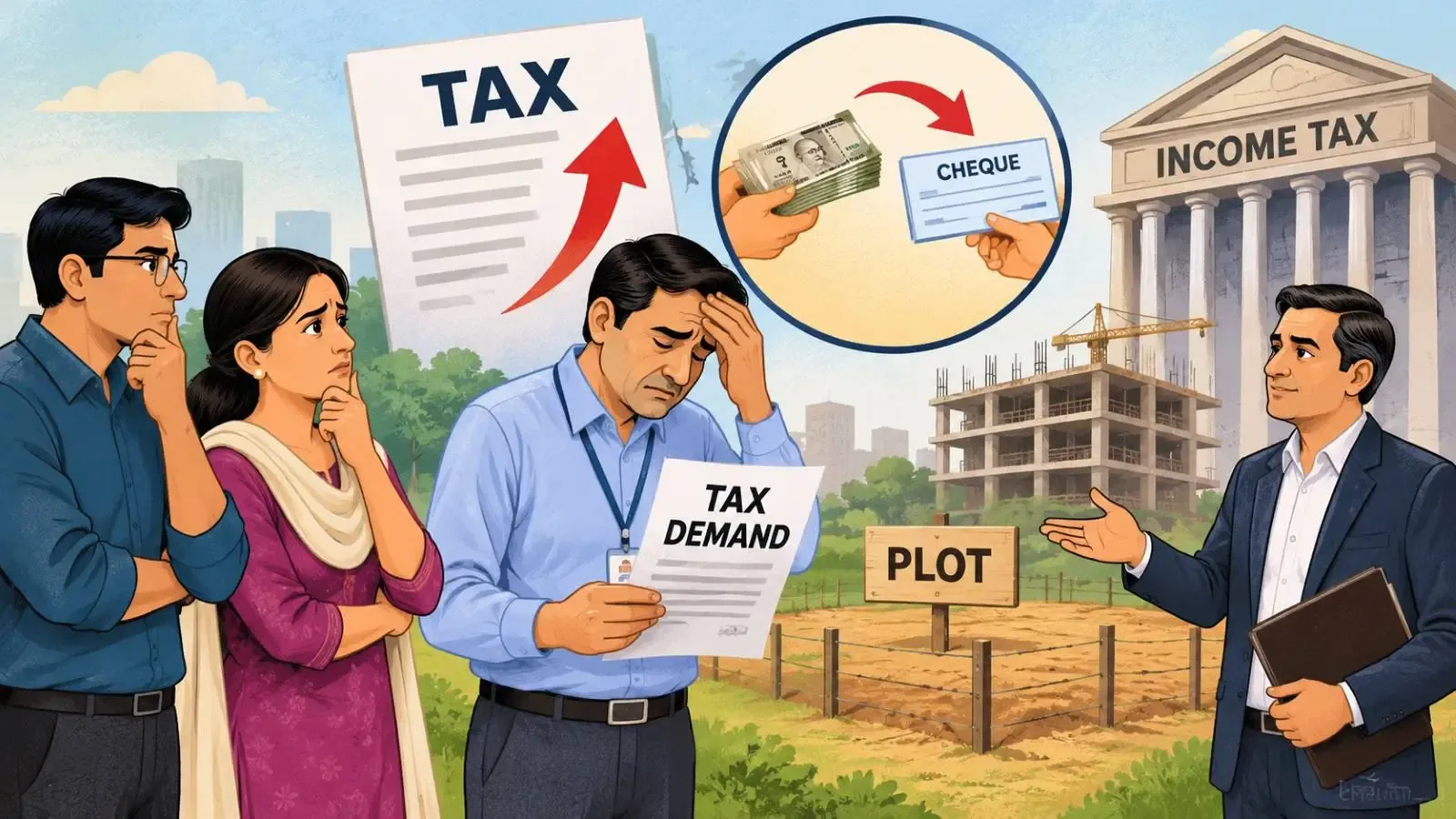
The receipt was not recovered from him. It was found as a loose paper during the search at the Gadiya Group's premises. | Representational image/AI generated
Vijay Rambhau Pandav, a salaried employee of the Government of Maharashtra, bought a plot in Aurangabad for ₹15,62,000. On the morning of January 3, 2020, he handed ₹2,50,000 in cash to a staff member of the builder, Gadiya Group, and took a receipt. Later that afternoon, the group's director called him, returned the cash, and asked for 20% of the consideration (₹3,12,000) as the booking amount, instead. Pandav took the money back and paid ₹3,00,000 by cheque the same day.
Based on the ITAT order dated October 10, 2026, this article explains the case history and key takeaways from it for land buyers.
How the tax dispute started
Pandav filed his return on September 1, 2020, declaring income of ₹7,84,920. The department then received information from the DDTI (Investigation), Aurangabad, about a search under section 132 in the case of Manji Pride Group, Gadia Group and their associated entities. Incriminating material concerning the assessee was said to have been found, suggesting that he had paid ₹2,50,000 in cash as on-money to the Gadiya Group for the purchase of a plot.
The case was reopened under section 147 and a notice under section 148 was issued, followed by notices under section 142(1) and a show cause notice. But the assessee did not comply with any of them as he was, as the tribunal later recorded, a state government employee deputed on "special secret duty which involves frequent movement throughout the State of Maharashtra"
The assessing officer completed the assessment under section 147 read with section 144 on March 19, 2025, determining his income at ₹10,34,920, including the ₹2,50,000 addition.
When Pandav appealed against the addition, the CIT(A)/NFAC dismissed it as belated by 12 days, without condoning the delay or going into the merits of the case.
Before the tribunal, Pandav did not deny that he had paid ₹2,50,000 in cash to the builder. He also agreed to buy the plot for a total consideration of ₹15,62,000. However, he submitted that on January 3, 2020 he visited the group's office in the morning with ₹2,50,000 in cash and paid it to a staff member, who issued him a receipt. That afternoon, he received a call from a director of the group, who returned the cash and asked him to pay 20% of the total consideration, that is ₹3,12,000, as the booking amount. The group's official took an acknowledgment on the same receipt recording the return of the ₹2,50,000, and the assessee signed it as "Received". He then paid ₹3,00,000 by cheque on January 3, 2020 and ₹12,000 by NEFT on January 21, 2020.
As for the cash, he showed ₹40,000 withdrawn on January 1, 2020 and ₹1,70,000 withdrawn on January 3, 2020 from his joint Axis Bank account with his father, plus ₹40,000 already in hand,
He also pointed out that, as a state government employee, he had informed his department of the purchase and the manner of payment when posted at Sironcha in Gadchiroli district.
And, crucially, the receipt was not recovered from him. It was found as a loose paper during the search at the Gadiya Group's premises.
What the ITAT held
The tribunal went through the sequence of events and found it consistent.
"Initially the assessee paid an amount of ₹2,50,000/- to the employee of the Gadiya Group who was not aware with any of the procedure," it observed, "however, when the Director of the group returned the above amount and suggested to make payment through check to secure the booking of the plot the assessee on the same day made payment through check"
"We further find that the assessee has explained the sources of ₹2,50,000/- cash," the bench recorded, noting the two withdrawals and the ₹40,000 already available with him, adding up to the amount paid.
"Considering the totality of the facts of the case and in view of submission/explanation furnished by the assessee, we are of the considered opinion that no on-money was paid by the assessee and the amount of ₹2,50,000/- which was paid initially by the assessee was from the explained sources of income," it held while setting aside the CIT(A)'s order. The tribunal also directed the assessing officer to delete the addition of ₹2,50,000.
Takeaways
The ruling matters to government employees and to any property buyer whose transaction is reconstructed from papers seized at a builder's office.
It shows that a receipt found at the seller's end proves only that cash changed hands, not that it stayed with the seller. A buyer who can trace the money and its reversal can defeat an on-money allegation
To conclude, for a property buyer, a cash payment that is later reversed and replaced by a cheque is not the end of the story if a receipt survives at the seller's office. However, buyers should keep the acknowledgment of return, the bank entries for the withdrawal, and the cheque or NEFT record that followed.
Related News
About The Author
Next Story

