
Personal Finance News
She bought a new home after selling her old flat, yet taxman denied Section 54 relief for not filing ITR; but ITAT said ITR filing isn't a condition for the exemption

6 min read | Updated on November 16, 2026, 16:27 IST

SUMMARY
The ITAT ruling is relevant for taxpayers, including non-resident individuals, who sell or buy property, and whose exemption claim under Section 54 is rejected for a procedural lapse rather than on the merits.
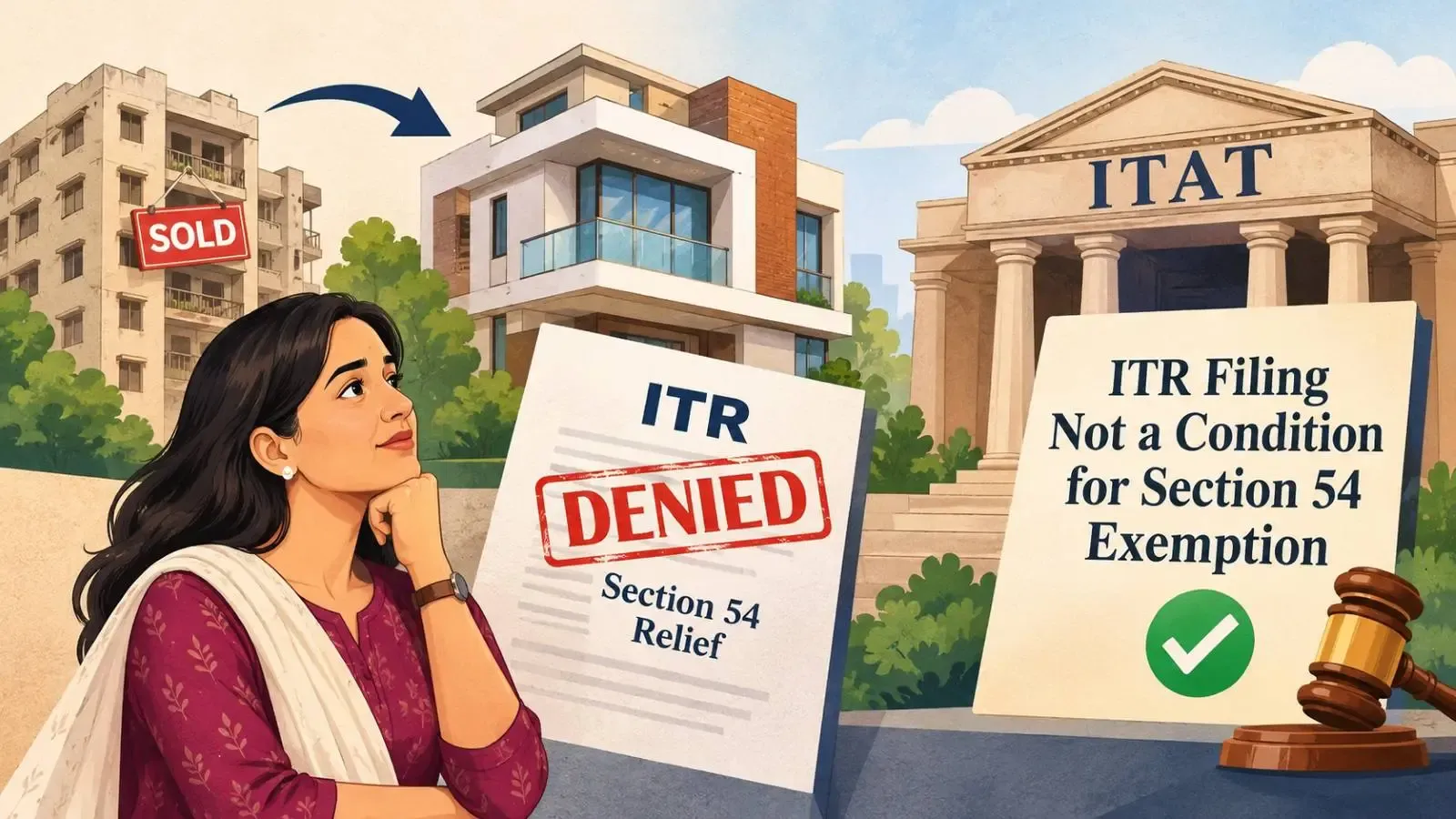
Section 54(1) grants the deduction where the gain arises from a residential house held as a long-term capital asset. | Representational image/AI generated
Margaret Smith, a non-resident individual in Jodhpur, did not file a return for assessment year 2016-17. The tax department learnt of a property purchased by her and issued a notice under section 148 in April 2023. She responded with a return declaring total income of just ₹3,240.
The reassessment that followed proposed two additions to her total income: ₹34,89,500 as unexplained investment in a flat bought for ₹62,27,500, and ₹16,50,000 as a short-term capital gain from the sale of an old residential flat at Jodhpur.
The unexplained-investment addition was later deleted by the Dispute Resolution Panel (DRP), and the gain was eventually computed at ₹10,53,992. But the panel refused to provide her Section 54 exemption on that gain solely because she had not filed an original return.
Based on the ITAT order pronounced on November 3, 2026, this article explains the case history and takeaways for taxpayers .
How the dispute started
As per the order, she bought the new flat by a registered deed dated December 3, 2015, and sold the old one on April 17, 2015. The tax officer took the entire consideration as gain as its purchase deed was not produced.
Before the DRP, she filed an additional evidence on which a remand report was called for. The panel found the source of the investment in the new flat explained and directed the deletion of addition under section 69.
On the old flat, she produced a deed dated November 2, 1996 , and the officer worked out the gain at ₹10,53,992, which she accepted. She also claimed that the gain was exempt under section 54 of the Act, as the entire sale proceeds were invested in the new flat, but it was denied.
The DRP accepted the computation but rejected the exemption, saying, " However, to claim deduction under Section 54 of the Income Tax Act, which provides exemption from long-term capital gains tax on sale of a residential property if the capital gains are reinvested in purchasing or constructing another residential house property, filing of the Income Tax Return (ITR) is compulsory. The taxpayer must declare the capital gains and the exemption claim in their ITR."
"However, in the case of the assessee no ITR was filed as has been accepted by assessee himself. In view of the above, the claim of assessee for granting of exemption u/s 54 cannot be given," it added.
In conformity with the panel, the assessing officer added ₹10,53,992 as long-term capital gain without the deduction.
What the ITAT held
The tribunal noted that the computation of the gain was not in dispute. The only question was whether the deduction could be denied solely because no return was filed and the claim was made in the return filed under section 148.
The ITAT observed that Section 54(1) grants the deduction where the gain arises from a residential house held as a long-term capital asset and the assessee purchases another residential house within one year before or two years after the transfer, or constructs one within three years.
"None of these conditions is linked to the filing of a return," the bench held, saying, "The only reference to section 139 is in section 54(2), which requires any part of the gain not utilised before the date of furnishing the return to be deposited in the Capital Gains Account Scheme. Where the entire gain has already been utilised in purchasing the new house, section 54(2) of the Act has no application."
It further noted that the assesseee had sold the old old flat on April 17, 2015 and bought the new one on December 3, 2015, well before the due date for the return, so nothing remained to be deposited.
The ITAT also noted that even where section 54(2) applies, the Rajasthan High Court in PCIT v. Shankar Lal Saini has held that the reference to section 139 in sections 54, 54B and 54F is not confined to 139(1).
The DRP's premise that no return was filed was, in any case, "contrary to the record." She had filed her return on May 18, 2023 in response to the notice, and section 148(1) provides that the Act's provisions apply to such a return as if it were a return required to be furnished under section 139.
On identical facts, the Mumbai Bench in Sanjay Gopaldas Bajaj v. ITO held that an assessee "is entitled, in law, to claim deduction under section 54 of the Act in the return of income filed in response to notice under section 148, provided the substantive conditions prescribed under the said section are duly satisfied."
The tribunal then made the point at the heart of the case: having treated the ₹62,27,500 investment as the assessee's own for the section 69 addition, the Revenue could not disregard the same investment for section 54.
Every fact needed for the deduction had already been examined and accepted by the officer and the DRP, which itself recorded that she "had purchased a new property within the time available for an amount exceeding capital gains amount".
"Section 54 of the Act is a beneficial provision and the Assessee did exactly what it intends," the bench held.
"To deny her the deduction for want of a return which the Act does not make a condition of the deduction would be to let the shadow of procedure obscure the substance of the law," the ITAT added.
The tribunal directed the assessing officer to allow the deduction and delete the addition.
Takeaways
The ITAT ruling is relevant for taxpayers, including non-resident individuals, who sell or buy property, and whose exemption claim under Section 54 is rejected for a procedural lapse rather than on the merits.
The case shows that a taxpayer who has missed the original return deadline but faces reassessment over a property transaction can still claim section 54 in the section 148 return, provided the substantive conditions are met and documented.
Related News


About The Author
Next Story

